Larkin’s Attitude to Death in His Monologues
March 15, 2023
Philip Larkin (1922–1985) is one of the most distinguished and influential poets of post-war England, celebrated for his realistic vision, conversational style, and profound exploration of the ordinary experiences of human life. Among the recurring themes in his poetry, death occupies a central and inescapable position.
Read morePoem Church Going A Satire on Christianity
March 15, 2023
Philip Larkin's Church Going is one of the most celebrated poems in modern English literature, offering a profound and thought-provoking exploration of religion, faith, and the changing role of the Christian Church in the modern world.
Read moreSignificance of the Title of the Play Waiting for Godot
March 14, 2023
The title Waiting for Godot is one of the most significant, symbolic, and thought-provoking titles in modern English drama. Samuel Beckett deliberately chose a title that immediately emphasizes the central action of the play—waiting.
Read moreWaiting for Godot As An Absurdist Play
March 14, 2023
Waiting for Godot by Samuel Beckett is one of the greatest masterpieces of modern drama and the finest example of the Theatre of the Absurd.
Read moreReligious Significance of the Play Waiting for Godot
March 14, 2023
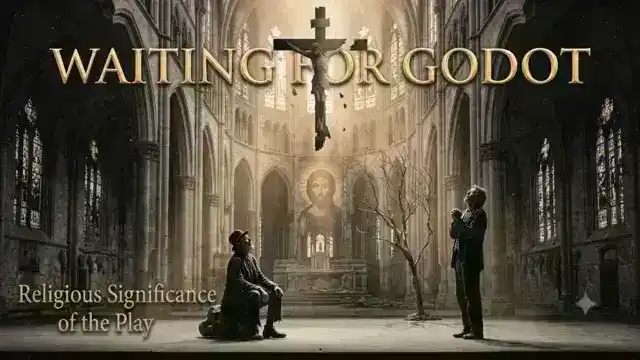
Waiting for Godot is one of the most influential plays of the twentieth century and a landmark of the Theatre of the Absurd. There is religious significance of the Play Waiting for Godot.
Read moreMusee Des Beaux Arts, Summary and Critical Analysis
March 13, 2023
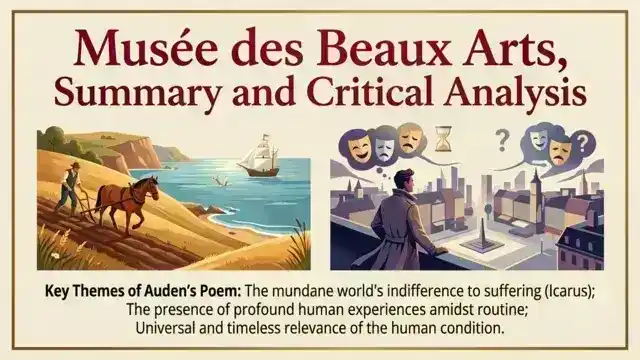
Musée des Beaux Arts is one of the finest and most celebrated poems by the renowned Anglo-American poet W. H. Auden.
Read morePoem Sailing to Byzantium, Summary and Critical Appreciation
March 10, 2023
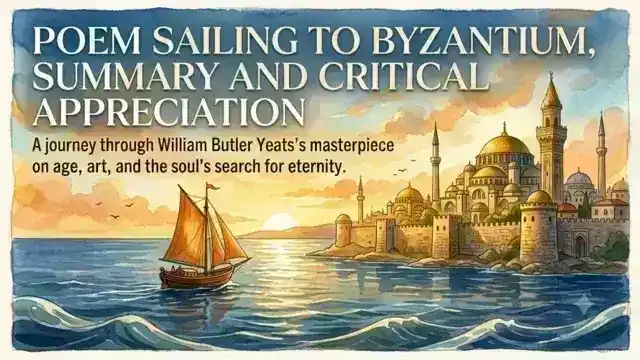
The poem ‘Sailing to Byzantium’ was published in ‘The Tower’ in 1928. This poem belongs to the third period of his poetic life when he was concerned to explore and express the intricacies of a private mythology.
Read moreYeats’ Poem Among School Children, Summary and Critical Appreciation
March 10, 2023
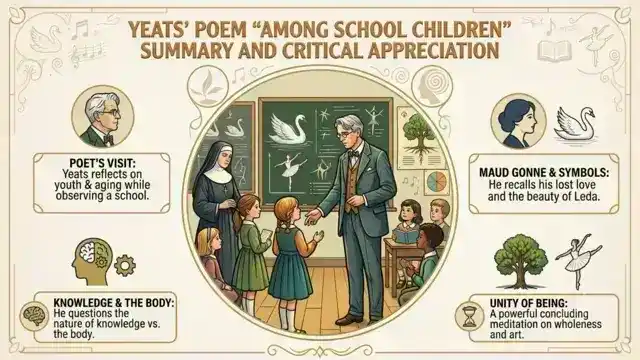
This poem ‘Among School Children’ is the result of W. B. Yeats’ experience as an Irish Senator visiting St. Otteran's School, a Church school in 1926, where teachers were nuns.
Read morePoem No Second Troy by W.B. Yeats, Summary and Critical Appreciation
March 9, 2023
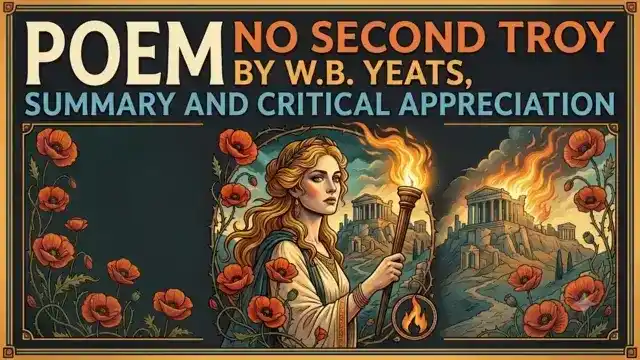
The poem ‘No Second Troy’ is one of the famous lyrics of W. B. Yeats. It is supposed to have been written between 1906 and 1907.
Read moreYeats’ Poem The Lake Isle of Innisfree, Summary and Critical Appreciation
March 9, 2023
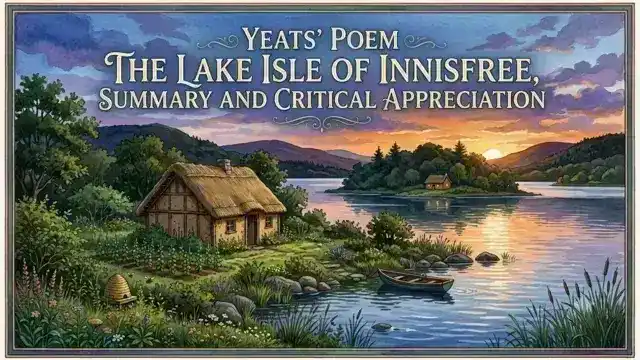
‘The Lake Isle of Innisfree’ by Yeats was written in 1890 and first published in The National Observer’. Innisfree is an island in Lough Gill, Country Sligo, where W. B. Yeats dreamed of living simple and peaceful life in the lap of Nature.
Read more