Introduction:
Philip Larkin’s Church Going is one of the most celebrated poems in modern English literature, offering a profound and thought-provoking exploration of religion, faith, and the changing role of the Christian Church in the modern world. First published in The Less Deceived (1955), the poem reflects the growing decline of religious belief in post-war England and questions the relevance of churches in an increasingly secular society. Written in a conversational yet deeply philosophical tone, Church Going combines irony, skepticism, and meditation to examine humanity’s enduring spiritual needs despite the weakening influence of organized Christianity.
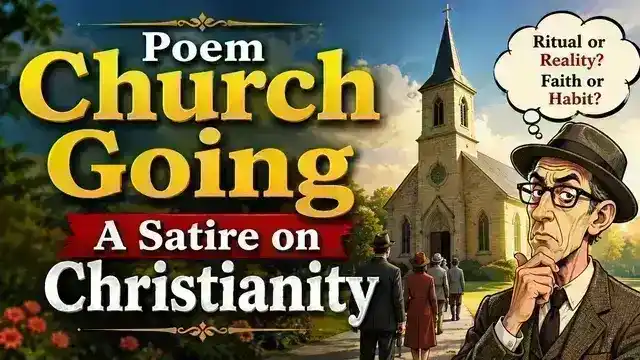
The poem presents the experience of a casual visitor who enters an apparently empty church without any strong religious conviction. Initially, the speaker treats the church with mild amusement and irony, viewing it as an outdated institution whose rituals have lost their significance. His detached attitude and humorous observations expose the decline of Christian faith and serve as a subtle satire on the formal practices and institutions of Christianity. However, as the poem progresses, his perspective gradually changes from casual curiosity to serious contemplation. He begins to realize that churches possess a timeless human significance that extends beyond religious doctrines and ceremonial worship.
As a satire on Christianity, Church Going does not attack the moral teachings of Christ or spiritual values themselves. Instead, Larkin questions the institutional authority of the Church and highlights the growing gap between religious traditions and modern life. Through gentle irony rather than harsh criticism, he exposes the mechanical observance of rituals, the diminishing number of believers, and the uncertainty surrounding the future of churches. Yet the poem ultimately suggests that, even in an age of doubt and disbelief, human beings will continue to seek places that inspire reflection, peace, and a sense of life’s deeper meaning.
Larkin masterfully blends realism with philosophical inquiry, making Church Going much more than a criticism of Christianity. It becomes a universal meditation on faith, mortality, tradition, and the enduring human search for purpose. The church symbolizes not merely a Christian place of worship but a sacred space where people confront life’s greatest mysteries—birth, death, love, suffering, and eternity. Thus, while the poem satirizes the decline of organized Christianity, it also affirms the lasting importance of spiritual contemplation in human existence.
Therefore, Church Going stands as a remarkable modern poem that skillfully combines satire, irony, symbolism, and philosophical reflection. It captures the conflict between religious skepticism and spiritual longing, revealing that although traditional Christianity may lose its influence, humanity’s need for meaning, reverence, and transcendence remains eternal. This balance of criticism and respect makes Church Going one of Philip Larkin’s finest achievements and one of the most insightful poetic commentaries on religion in the twentieth century.
Church Going as a Satire on Christianity:
Church Going is a satire on Christianity the way Larkin describes his visit to a church is all mockery. In this poem, he shows his sceptical attitude to Christianity then his attitude of scepticism becomes emphatic when he says that, at the end of every visit to a church, he has felt much at a loss and always wondered what to look for them.
“Yet stop I did: in fact – I often do,
And always end much at a loss like this,
Wondering what to look for.”
Larkin’s Scepticism about the Future of Churches:
This scepticism continues with his saying that he now wonders what would happen to the church buildings when people stop going to them to offer prayers. Evidently he believes that the time is coming when people would lose their religious faith and would therefore stop going to churches. In a half mocking tone he says that some of the churches would be used as museums with all the paraphernalia of a church on display, while the remaining churches would be “let to rain and sheep.”
“When churches fall completely out of use
What we shall turn them into, if we shall keep
A few cathedrals chronically on show,
Their parchment, plate and pyx in locked cases,
And let the rest rent – free to rain and sheep.”
Amusing Speculation About the Last Church Visitor:
Also amusing are the lines in which the speaker speculates as to the identity of the last, the very last, person who might visit church in the beli that he is visiting house of God for his spiritual edification.
” … I wonder who
will be the last, the very last, to seek
This place for what it was. “
The Church as a Place of Wisdom and Reflection on Death:
The last stanza seems to express the poet’s view that a few of the forsaken deserted, and ruined churches would continue to be visited by some people, if for no other reason, then only to draw some wisdom from the sight of the numerous graves in the churchyards . After all, the thought of death, to some extent, does make us wiser.
“A hunger in himself to be more serious,
And gravitating with it to this ground,
Which he once heard, was proper to grow wise in,
If only that so many dead lie round.”