Introduction:
Philip Larkin (1922–1985) is one of the most distinguished and influential poets of post-war England, celebrated for his realistic vision, conversational style, and profound exploration of the ordinary experiences of human life. Among the recurring themes in his poetry, death occupies a central and inescapable position. Unlike many poets who regard death as a gateway to spiritual fulfillment, immortality, or religious salvation, Larkin presents it as the ultimate reality of human existence—inescapable, final, and devoid of comforting illusions. His poetic monologues reveal an intensely personal yet universally relevant meditation on mortality, exposing the fear, uncertainty, loneliness, and existential anxiety that accompany the awareness of death. Through these dramatic and reflective voices, Larkin transforms individual experience into a profound commentary on the human condition.
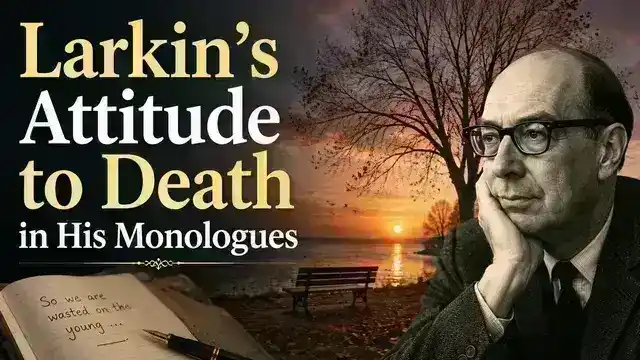
Larkin’s attitude to death is deeply shaped by his skepticism toward religion and his rejection of traditional beliefs in an afterlife. He does not offer metaphysical consolation or sentimental hope; instead, he confronts death with uncompromising honesty and intellectual clarity. His monologues frequently portray speakers who struggle to reconcile themselves with the certainty of extinction, revealing the psychological conflict between the instinct to live and the unavoidable knowledge of mortality. For Larkin, death is not merely the end of physical life but the annihilation of consciousness, memory, identity, and all human aspirations. This stark recognition gives his poetry a distinctive tone of melancholy, irony, and philosophical depth.
Several of Larkin’s finest poems, including Aubade, Church Going, Ambulances, The Old Fools, and Dockery and Son, exemplify his meditative approach to death. These poems often take the form of reflective monologues in which the speaker examines mortality through personal introspection, everyday observations, and ordinary situations. Larkin’s remarkable ability to combine simple language with profound philosophical insight enables him to present death not as an abstract concept but as a constant presence embedded within daily life. His speakers neither escape nor romanticize death; instead, they confront it with painful honesty, exposing the vulnerability and helplessness that define human existence.
At the same time, Larkin’s treatment of death is not entirely pessimistic. Although his poetry rejects false consolation, it encourages readers to acknowledge mortality with courage and realism. His monologues suggest that the awareness of death intensifies the value of life, making ordinary experiences, human relationships, and fleeting moments more precious precisely because they are temporary. By portraying death as the ultimate equalizer that spares no one regardless of status or achievement, Larkin underscores the shared destiny of humanity and the need to find meaning within the limits of earthly existence.
Thus, Larkin’s attitude to death in his monologues is characterized by realism, skepticism, existential anxiety, and philosophical reflection. His speakers confront mortality without religious illusion or emotional exaggeration, presenting death as an unavoidable fact that shapes every aspect of human life. Through his lucid, introspective, and emotionally restrained monologues, Larkin offers one of the most compelling modern explorations of mortality, making death not merely a poetic subject but the defining reality against which life itself acquires significance.
Meaning and Nature of the Dramatic Monologue:
A dramatic monologue is a lyrical or narrative poem in w single character speaks throughout the composition. The speaker comments upon a dramatic moment in his life, and during his relation of it, he reveals his own characteristics and those of the other persons involved. During his relation the reader also learns much of the locale and of the person or persons being addressed.
The First Characteristic of a Dramatic Monologue:
The first characteristic of a dramatic monologue is that there is one speaker in the poem who speaks throughout the monologue and according to Browning technique there is a second person also present in the monologue who does not speak at all but is only a listener.
Realistic and Psychological Features of the Dramatic Monologue:
The second characteristic is that there is realistic and psychological presentation of the basic theme in the monologue. Then thirdly the dramatic monologue is a series of remarks usually confessional addressed either orally or in an epistolary form to a group of listeners. Larkin’s monologue are more psychological than Shakespeare’s soliloquies. They are simpler and conversational or colloquial. Larkin has followed the example of Browning in most of his monologues.
Larkin’s Dramatic Monologues and Personal Convictions:
As one of the critics says, Larkin’s poems often take the form of dramatic monologues which seem intended to reveal Larkin’s own thoughts and feelings because he is speaking out of his own strong conviction. In these monologues the speaker is Larkin himself. Although emphasis on his own feelings and thoughts is rather egoistical but he himself has observed that it reflects the example of his literary master Thomas Hardy. In these monologues Larkin gives his own view on his favourite theme, his belief or attitude to religion and prevalent social customs and fashions. The basic theme of these monologues is death. Therefore a discussion on his approach to death is most important.
Larkin’s Obsession with Death in Church Going:
Every critic has noted Larkin’s obsession with death. According to Janice Rossen Larkin believes in the omnipresence of death. In many of his poems death is constantly described as the last destination of human life. For example in the monologue Church Going he perceives that churches will soon be fallen into ruins which is clear from the following lines:
“A shapeless recognisable each week,
A purpose more obscure, I wonder who
Will be the last, the very last, to seek
This place for what it was; one of the crew
That tap and jot and know what rood – lofts were?
Some ruin – bibber, randy for antique,
Or Christmas – addict, counting on a whiff
Of gown – and – bands and organ – pipes and myrrh?
Or will he be my representative.”
The Future of Churches Beyond Religious Belief:
Thus not only of man but of also institutions Larkin sees the deathly end of them. Thus, while Larkin dismisses the concept of a Church being a house of God, he yet believes that churches would continue to serve some emotional or spiritual purpose even after people’s rejection of the current religious beliefs.
Irony and Humour in Church Going:
Church Going is really an interesting and even entertaining poem. A vein of irony runs through the poem , and particularly amusing are the following lines:
“The echoes snigger briefly, Back at the door
I sign the book, donate an Irish six – pence,
Reflect the place was not worth stopping for,
Yet stop I did: in fact I often do.”