Introduction:
Waiting for Godot is one of the most influential plays of the twentieth century and a landmark of the Theatre of the Absurd. There is religious significance of the Play Waiting for Godot. Although the play appears to present a world devoid of certainty, purpose, and traditional values, it is deeply permeated by religious imagery, biblical allusions, and spiritual questions. Rather than offering a straightforward religious message, Samuel Beckett employs religious symbols to explore humanity’s search for meaning, hope, redemption, and salvation in an apparently indifferent universe. The play portrays two tramps, Vladimir and Estragon, who endlessly wait for the mysterious Godot, a figure whose identity is never revealed. This endless waiting has often been interpreted as a symbolic representation of humanity’s expectation of divine intervention, the coming of God, or the hope of spiritual fulfillment.
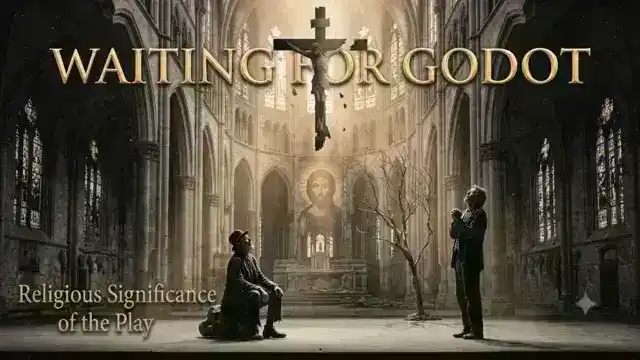
The religious significance of Waiting for Godot lies not in its affirmation of faith but in its profound examination of doubt, uncertainty, and the human condition. Throughout the play, Beckett incorporates numerous biblical references, including the story of the two thieves crucified alongside Christ, the recurring image of the barren tree, and discussions about repentance, forgiveness, and salvation. These elements evoke Christian theology while simultaneously questioning the reliability of religious certainty. The characters’ inability to understand or remember biblical events reflects the modern individual’s spiritual confusion and loss of faith in an age marked by existential anxiety.
Godot himself remains one of literature’s greatest mysteries. Many critics have interpreted him as a symbolic representation of God because of the similarity between the names “God” and “Godot,” although Beckett consistently refused to confirm this interpretation. Whether Godot represents God, salvation, hope, destiny, death, or an unattainable ideal, his perpetual absence symbolizes humanity’s endless expectation for meaning and deliverance that never fully arrives. This ambiguity allows the play to transcend any single religious doctrine and become a universal reflection on the human longing for transcendence.
The play also presents the paradox of hope and despair. Despite repeated disappointments, Vladimir and Estragon continue waiting because they believe that Godot’s arrival will transform their lives. Their unwavering expectation resembles religious faith, while Godot’s continual postponement reflects the uncertainty that often accompanies spiritual belief. Beckett neither rejects nor endorses religion; instead, he presents faith as a complex psychological necessity that enables human beings to endure suffering and uncertainty.
Moreover, the setting itself possesses symbolic religious significance. The lonely road and the barren tree create a desolate spiritual landscape reminiscent of humanity’s fallen condition. Yet the appearance of a few leaves on the tree in the second act subtly suggests the possibility of renewal, resurrection, and hope, echoing biblical themes of life emerging from apparent barrenness. The repeated cycle of waiting further reinforces the idea that human existence is characterized by continual expectation, endurance, and the search for ultimate truth.
Thus, the religious significance of Waiting for Godot extends beyond conventional theology. Beckett transforms familiar Christian symbols into philosophical and existential metaphors, inviting audiences to reflect on faith, doubt, salvation, mortality, and the meaning of existence. The play does not provide definitive religious answers; rather, it challenges readers and viewers to confront the mysteries of human life and the enduring desire to believe in a higher purpose despite the silence of the universe. Consequently, Waiting for Godot remains a timeless exploration of religion as both a source of hope and a subject of profound existential inquiry.
Waiting for Godot, Having Religious Element:
Waiting for Godot, an absurd drama as it is, has an unmistakably religious element. When Beckett was once asked to comment on the play Waiting for Godot, he quoted from St. Augustine: “Do not despair: one of the thieves was saved. Do not presume: one of the thieves was damned”. This is a significant statement and may be regarded as a clue to the play. For Beckett God has not failed. There is religious symbolism throughout.
The Reference to Salvation:
In Waiting for Godot, the first clearly explicit reference to salvation is found in Vladimir’s mention of the two thieves crucified on either side of Christ, one of whom was saved and the other damned. When asked by Estragon what the thief was saved from. Vladimir replied that the man was saved from hell. Vladimir wonders that of the four Evangelists , St. Matthew , St. Mark , St. Luke and St. John , only one speaks of a thief being saved. The four of them were there, and yet one speaks of the salvation of the thief. Two of the Evangelists do not mention any thieves at all, while the third says that both of them abused Christ.
The Chance Remarks made by Two Thieves:
Ever since the dawn of history there have been millions of persons who had to be damned for their misdeeds. Only two thieves got the splendid opportunity of being saved. They were by the side of Christ on Mount Calvary awaiting execution. One abused Christ, and was damned, and the other recorded his protect and the gateway to life eternal was thrown open to him. The damned thief missed a chance forever. While Pozzo tells Vladimir about Lucky: “Remark that I might easily have been in his shoes and he in mine. If chance had not willed it otherwise”, he might be thinking of the thieves. To each one his due.”
Grace of God:
Man cannot be sure of the Grace of God, which is awarded fortuitously. God willed otherwise, and, therefore, Pozzo, so long better placed, had to become blind, at the mercy of others. If Godot is God, he does not bestow favours in a strictly logical manner. For the ways of God are mysterious and inexorable. Take the case of Cain and Abel, who were siblings and brought up in the same environments. Abel was saved and Cain damned. In Act II, Pozzo and Lucky return. As Estragon cries out ‘Abel! Abel!’,Pozzo responds. But as he calls out ‘Cain! Cain!’ Pozzo responds for the second time. In either case Pozzo seeks help. Estragon concludes that Pozzo is ‘all humanity’.
Another Reference of the Two Boys:
There are several other references to the fortuitous bestowal of divine grace. Two boys serve as the messengers of Godot— one tends the goats and the other sheep. They are brothers Cain and Abel. But unpredictably Godot is kind to one who tends the goats, and beats the other who tends the sheep. When Estragon thinks that Godot is coming, he cries out in fear: ‘I’m accursed!’ Estragon feels, he is in hell. Vladimir, on the other hand, rejoices at what he imagines to be the arrival of Godot.
Salvation as Divine Grace, a Matter of Chance:
When asked to think, Lucky gives a demonstration of his thinking and mentions several words, namely, ‘apathia’, ‘athambia’, and ‘aphasia’. This is not mere rigmarole, and has a philosophical significance, for apathia means divine apathy; athambia means terror of God, and aphasia means the speechlessness of God. That is to say, God may be apathetic, God may be speechless; God has the capacity for terror. God will love and save only a select few.
To Wait for Godot is to Wait for Divine Grace and Salvation:
Vladimir and Estragon are waiting for divine grace. Their waiting for Godot means to wait for divine grace and salvation. Vladimir has consistently practised Christian tolerance and charity and has not left his friend even amidst trying circumstances. Beckett has taken infinite pains to distinguish the two tramps from Pozzo and Lucky. While the tramps have something to wait for, something to look forward to, Pozzo and Lucky are cast adrift with no objective in view.
A Religious or Christian Play:
Waiting for Godot then seems to be concerned with the hope of salvation through the workings of grace. And this view supports the belief that it is a Christian or a religious play. Vladimir’s and Estragon’s ‘waiting’ might be explained as signifying their steadfast faith and hope , while Vladimir’s kindness to his friend, and the two tramps’ mutual interdependence might be seen as symbols of Christian charity.
Waiting for Godot, Full of References to Christianity:
There are direct allusions to crucifixion and to Jesus Christ. Those who are learned in the Bible should spot references like the one to the place of crucifixion (the skull) in Lucky’s speech. However, Vladimir refers directly to Christianity in his allusion to the thieves who were crucified along with Jesus. The two tramps also talk about Christ and crucifixion towards the end of Act I, when they talk of Estragon comparing himself to Christ. The tree pose that they strike in Act II (68) is also one of crucifixion.
Conclusion:
The hope of salvation may be merely an evasion of the suffering and anguish that spring from facing the reality of the human condition. But this does not invalidate the religious implications of the play. It is possible, however, to believe either that the play visualizes the possibility of salvation or that it negates such a possibility.