Introduction of the Poem:
“The Visitor” is one of Nissim Ezekiel’s finest reflective poems, exploring the contrast between human expectations and the ordinary realities of life. Drawing upon the traditional Indian belief that the cawing of a crow foretells the arrival of a guest, the poet builds an atmosphere of suspense and anticipation. The speaker imagines that the expected visitor may bring profound change, spiritual revelation, or a test of character. However, the visitor turns out to be an ordinary acquaintance with no extraordinary purpose, exposing the gap between imagination and reality.
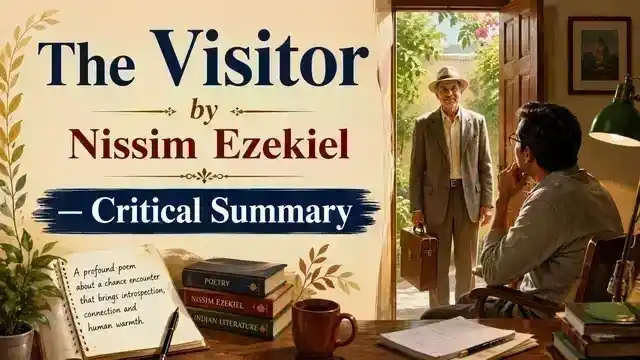
Through irony, symbolism, and subtle humour, Ezekiel suggests that people often burden ordinary events with exaggerated meanings, only to discover that life is largely shaped by commonplace experiences rather than miracles. The poem beautifully reflects the poet’s characteristic blend of psychological insight, philosophical reflection, and realistic observation, making it a thoughtful meditation on human expectations, perception, and the significance of everyday life.
The Visitor appears in The Exact Name (1965). The poem is based on a common Indian superstition that, if we hear a crow cawing on the roof or a wall in our house in the morning, it is a sign that a visitor would arrive during the day and that we should be ready to receive him. The poet’s own experience of this superstition turns out to be true. However, the poet is disappointed when the visitor arrives because he has nothing worthwhile to say to him and their conversation is trivial and insubstantial.
Critical Summary:
The crow has cawed three times at the window of the poet’s room. It has been gazing ominously at his eyes. Its wings are somewhat uplifted in a spiteful posture as if holding out the threat of a visitor. It looks tense with its neck stretched out like the neck of a woman scolding her husband. It is not all relaxed and the room is filled with its cawing sound.
The poet has received the crow’s message thrice as he sits lost in his thoughts; he has been thinking of the well – being of everything and everyone in the world. He is now worried how he will receive and deal with the visitor whose thoughts and opinions might not be in consonance with his own.
The poet waits all day for the arrival of the visitor because of its being associated with the cawing of a crow. The visitor might be an angel in the garb of a human being or an evil in an unfamiliar shape, trying to test the poet’s integrity. If an evil being, the visitor would ruin the poet’s sleep at night by holding out some temptation and eventually leading him astray.
But what happened was not what the poet had expected. The visitor came empty – handed; he had come only to while away his time. No doubt, he had good intentions. But he had nothing important to say; all his talk was trivial and inconsequential. In fact, there was more substance in the smoke that their cigarettes emitted than there was in their conversation.
The poet realized how mistaken he was in his assumptions about the visitor. His arrival was as trivial and routine as everyday occurrences in our lives. He had failed to foresee that miracles take place only inside the human mind and that, outside the mind; one sees only such ordinary things as the figure woven into a carpet by the carpet – maker and looking conspicuous. Or, one sees only the changes which take place in the man – woman sexual relations, or the change of seasons.
Critical Analysis of the Poem:
Introduction:
The Visitor is one of Nissim Ezekiel’s finest reflective poems, illustrating his characteristic blend of irony, realism, psychological insight, and philosophical depth. The poem explores the contrast between human expectations and the ordinary realities of life. Beginning with a traditional Indian superstition that the cawing of a crow foretells the arrival of a visitor, the poet gradually dismantles the romantic and mystical expectations attached to this belief. Instead of presenting an extraordinary encounter, Ezekiel depicts a mundane visit that ultimately reveals profound truths about human existence. Through simple language, vivid imagery, and subtle irony, the poem emphasizes that life’s real significance lies not in miracles or dramatic events but in everyday experiences.
Theme of Superstition and Expectation:
The poem begins with the repeated cawing of a crow, a familiar symbol in Indian folklore. According to popular belief, the cawing of a crow announces the arrival of a guest. The speaker immediately accepts this belief and anxiously prepares himself for the expected visitor.
The repetition of the phrase “Three times” highlights both the persistence of the crow’s call and the speaker’s growing anticipation. The crow’s “baleful eyes,” “sinister poise,” and “body tense” create an atmosphere of mystery and suspense. The poet uses these details to demonstrate how easily the human mind transforms an ordinary incident into something filled with supernatural significance.
Thus, the poem examines humanity’s tendency to seek hidden meanings behind ordinary occurrences.
Conflict Between Imagination and Reality:
One of the poem’s central concerns is the contrast between imagination and reality. The speaker allows his imagination to wander freely after hearing the crow’s call. He dreams that the visitor may be “an angel in disguise” or even a mysterious force sent to test his moral strength.
These expectations reveal the human desire for extraordinary experiences that give meaning to life. However, reality completely overturns these fantasies. The visitor turns out to be an ordinary acquaintance who merely wishes “to kill a little time.”
This sudden shift from expectation to reality forms the poem’s central irony. Ezekiel suggests that people often burden ordinary events with unrealistic hopes, only to discover that reality is much simpler than imagination.
Irony and Anti-Climax:
Irony is one of the poem’s strongest artistic features. The first three stanzas carefully build suspense. The reader expects some mysterious revelation or dramatic encounter.
Instead, the visitor arrives empty-handed and with no significant purpose. His conversation is shallow, and even the cigarette smoke becomes “more substantial than our talk.” This striking image humorously emphasizes the emptiness of their interaction.
The poem deliberately ends in an anti-climax. Rather than presenting disappointment as tragic, Ezekiel uses gentle irony to expose the gap between romantic expectations and the commonplace realities of everyday life.
Psychological Insight:
The poem reveals the workings of the human mind with remarkable subtlety. The speaker’s thoughts move rapidly from superstition to fantasy and finally to self-awareness. His expectations are not created by the visitor but by his own imagination.At the end of the poem, the speaker realizes his mistake:
“I see how wrong I was / Not to foresee precisely this.”
This realization demonstrates psychological maturity. Instead of blaming the visitor, the speaker recognizes that his disappointment resulted from his own exaggerated expectations.
Thus, the poem becomes a study of human psychology, showing how people often create emotional experiences through their own thoughts rather than through actual events.
Philosophy of Ordinary Life:
The final stanza presents the philosophical core of the poem. The speaker acknowledges that beyond the extraordinary visions of the mind lie “the ordinaries of most events.”
The expressions “Outside the miracles of mind,” “ebb-flow of sex and the seasons,” and “the ordinaries of most events” suggest that life naturally follows ordinary patterns rather than miraculous ones.
Ezekiel argues that genuine wisdom lies in accepting the commonplace realities of life instead of constantly searching for mystery, miracles, or supernatural meanings.
Symbolism:
The poem employs several meaningful symbols that enrich its interpretation.
1. The Crow: Symbolizes traditional superstition, expectation, and the tendency to interpret ordinary events as signs of something extraordinary.
2. The Visitor: Represents ordinary human reality that often fails to match our idealized expectations.
3. The Cigarette Smoke: Symbolizes the emptiness and transience of superficial human conversation.
4. Angel in Disguise: Represents humanity’s longing for spiritual revelation or meaningful transformation.
5. Figure in the Carpet: Symbolizes the hidden patterns or meanings people constantly seek in life.
These symbols give the poem multiple layers of meaning while maintaining its simplicity.
Imagery:
Ezekiel’s imagery is vivid yet controlled. The description of the crow creates visual tension: “baleful eyes”, “wings slightly raised”, “body tense”, “neck craned”. These images make the crow appear almost human and emotionally expressive.
Later, the image of “cigarette smoke” becoming more substantial than conversation effectively conveys emotional emptiness. The final natural imagery of “sex and the seasons” broadens the poem’s vision from an individual incident to the universal rhythms of life.
Language and Style:
The language of the poem is simple, conversational, and highly expressive. Ezekiel avoids decorative language while achieving great depth through ordinary words.
His style is marked by: simplicity and clarity, conversational tone, subtle irony, psychological realism, philosophical reflection, symbolic richness, understated humour, controlled emotional expression.
The gradual movement from suspense to realism reflects Ezekiel’s mastery of poetic structure.
Tone and Mood:
The tone changes throughout the poem. Initially, it is mysterious and suspenseful. It then becomes reflective and imaginative. During the visitor’s arrival, it turns quietly ironic. Finally, it becomes philosophical and accepting. The mood evolves from anticipation to disappointment and ultimately to thoughtful self-realization.
Poetic Devices:
Ezekiel effectively employs several literary devices:
1.Repetition: “Three times” emphasizes insistence and expectation.
2. Simile: “Neck craned like a nagging woman’s” vividly characterizes the crow.
3. Metaphor: “Miracles of mind” suggests the imagination’s power to transform reality.
4. Symbolism: The crow, visitor, cigarette smoke, and carpet carry deeper meanings.
5. Irony: High expectations end in an ordinary, insignificant meeting.
6. Imagery: Visual and sensory descriptions strengthen the poem’s atmosphere.
7. Contrast: Imagination is sharply contrasted with reality.
8. Enjambment: The flowing lines mirror the continuous movement of thought.
Message of the Poem:
The poem teaches that disappointment often arises not because reality fails us but because our expectations are unrealistic. Human beings naturally search for mystery, miracles, and hidden meanings, yet life is largely composed of ordinary experiences. True wisdom lies in accepting these ordinary moments with understanding rather than constantly expecting extraordinary events. Ezekiel reminds readers that everyday life possesses its own quiet significance and deserves appreciation.
Conclusion:
The Visitor is a brilliant example of Nissim Ezekiel’s mature poetic vision. Combining irony, symbolism, psychological realism, and philosophical reflection, the poem transforms an ordinary social visit into a profound meditation on human expectations and reality. The contrast between superstition and truth, imagination and experience, and mystery and ordinariness reveals Ezekiel’s remarkable ability to discover universal meanings in everyday life. The poem ultimately affirms that life’s deepest truths are found not in miracles or dramatic encounters but in the quiet acceptance of ordinary human existence.