Introduction of the Poem:
In The Old Playhouse, taken from The Old Playhouse and Other Poems (1973), Kamala Das recounts the unsatisfactory and disappointing conjugal life with her husband, and expresses her resolve to free herself from the prison of her husband’s house.
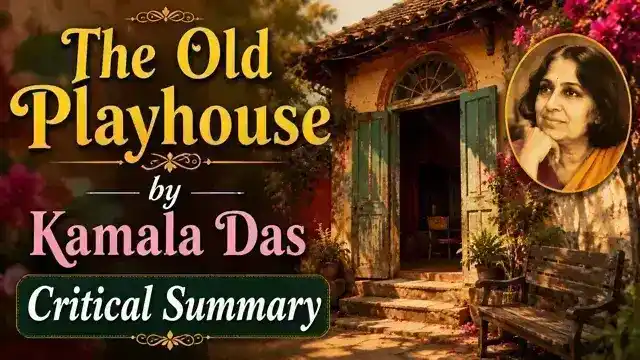
The Old Playhouse is one of the most celebrated and powerful poems by Kamala Das, one of the leading voices of Indian English poetry and Confessional poetry. Published in her poetry collection The Old Playhouse and Other Poems (1973), the poem presents a bold critique of patriarchal marriage and the emotional and psychological oppression experienced by women in a male-dominated society. Drawing upon her personal experiences, Kamala Das portrays the painful reality of a wife whose individuality, freedom, and identity are gradually suppressed by her self-centred husband. Through vivid imagery, rich symbolism, and intensely personal expression, the poem exposes the hollowness of a relationship based on domination rather than love and mutual respect. Ultimately, The Old Playhouse is not merely a personal confession but a universal statement on female identity, self-realisation, and the struggle for liberation from oppressive social norms, making it one of the finest feminist poems in Indian English literature.
Critical Summary:
The poet compares herself to a swallow and her husband to a captor who wanted to tame her and keep her under his control by the power of his lovemaking. He wanted her not only to forget all the comforts she might have enjoyed in her parental home before she got married to him but also to forget her very nature and her innate love of freedom by keeping her in a state of subjection.
She had come to her husband to learn what she was and, by learning what she was to learn to develop her personality and her potential. (She was married when she was only fifteen). But her husband did not make it possible as he was a self – centred man; his egoism prevented him from letting der learn anything except his own nature and disposition. He certainly made love to her and was pleased with the response he was gratified by the tremors of her body when he made love to her. But be failed to understand that her response was purely physical and therefore, superficial, because she never experienced oneness of feeling with him. He had no notion of what love and affection meant to a wife; he merely thought of her as a sex partner and a housewife.
While having sex with her, the husband used to kiss her very hard, pressing his lips against her and letting his saliva flow into her mouth. He would press his whole body against hers with great vehemence, gratifying the sexual desire in her in the process. He succeeded fully in the physical sense in penetrating every part of her body, making his fluids mingle with hers. But he did not realize that after her sexual desires had been fulfilled, she remained emotionally dissatisfied and hungry. In the emotional and spiritual sense, he was a complete failure as it never occurred to him that his wife, in addition to sexual gratification, also needs emotional and spiritual fulfilment.
As part of her domestic duties, the poet would put saccharine tablets in her husband’s tea , and give him vitamins at specified times . Her husband was a hard taskmaster; he was so conceited and egoistical that, with the passage of time, she lost her own identity as a human being; she became a slave to his wishes and whims. Eventually, she felt that her own personality, instead of developing, was reduced in stature, almost to nothingness. She even lost her own will and her thinking faculty. She mumbled incoherently whenever he asked her something. This began to jar and the poet started longing for the inconveniences of life before her marriage. She felt suffocated in her husband’s house in which his room was always lit by the artificial light of electric lamps and the windows were always shut. Even the air – conditioner in his room provided no relief to her feeling of suffocation. The house reeked of her husband’s masculine breath. Even the flowers placed in vases seemed to have lost their natural fragrance and acquired the odour of her husband’s sweat. She no longer heard the singing of the birds outside; she began to feel that her mind was like an old and forsaken theatre – hall which was no longer in use. She was then inclined, rather determined to free herself from the prison her husband’s house had become for her. She longed to free herself from her loveless life of domesticity.
Her husband is physically strong and, like a strong man, he always uses the same technique of keeping his wife physically and sexually satisfied but denying her the love and emotional fulfilment she desperately needs; this is killing her slowly. She compares herself to Narcissus who was love in with his own reflection that he saw in a pool of water, which subsequently haunted him, causing him agony and heartache as he could not enjoy a sexual union with himself. The poet is tortured by the intensity of her desire for love that she never got from her husband. It is only by obtaining a release from her husband’s tyranny that she can end this torture. This release may be obtained through suicide if no other way out can be found.
Critical Analysis:
Introduction:
“The Old Playhouse” is one of the most powerful and representative poems by Kamala Das, included in her collection The Old Playhouse and Other Poems (1973). The poem is a bold feminist protest against patriarchal domination and an intensely personal exploration of an unhappy marriage. Written in the confessional mode, it portrays a woman’s emotional, psychological, and physical suffocation under the authority of a self-centred husband. Through vivid imagery, symbolism, and irony, Kamala Das exposes the destruction of female identity within a male-dominated marital relationship and asserts a woman’s desire for freedom, self-respect, and individuality.
The Poem as a Confessional Work:
“The Old Playhouse” is a classic example of confessional poetry. Kamala Das openly draws upon her personal experiences of marriage and emotional dissatisfaction. She fearlessly reveals intimate details of her relationship, breaking traditional social taboos surrounding women’s private lives. However, the poem goes beyond autobiography and represents the collective suffering of countless women living under patriarchal oppression.
Critique of Patriarchal Marriage:
The central concern of the poem is the unequal nature of marriage in a patriarchal society. The husband attempts to “tame” the speaker just as one might imprison a bird. He expects complete obedience and wants her to forget her former identity, dreams, and freedom. Marriage, instead of becoming a relationship of companionship and mutual growth, turns into an institution of domination and control.
The speaker had entered marriage hoping to understand herself and develop her personality. Instead, every lesson taught by her husband centred only on his ego, desires, and authority. The poem therefore becomes a sharp criticism of male supremacy and emotional exploitation within marriage.
Loss of Female Identity:
One of the poem’s most significant themes is the gradual loss of the woman’s individuality. The speaker becomes merely an object meant to satisfy her husband’s physical desires. Her own emotions, aspirations, and intellectual growth are ignored.
Kamala Das illustrates how patriarchal relationships reduce women to subordinate roles, depriving them of independence and self-expression. The speaker’s transformation into “a dwarf” under her husband’s “monstrous ego” symbolizes her psychological shrinking and loss of confidence.
Symbolism of the Old Playhouse:
The title itself is highly symbolic. An “old playhouse” is an abandoned theatre where performances have ceased and the lights have gone out. It represents the speaker’s inner self, which has become emotionally empty, lifeless, and neglected.
The extinguished lights symbolize the death of love, hope, creativity, and emotional fulfilment. The playhouse, once capable of producing beauty and life, now stands deserted, just as the speaker’s heart has been drained of joy.
Rich Use of Imagery:
Kamala Das employs striking imagery throughout the poem to strengthen its emotional impact.
The swallow symbolizes the woman’s natural freedom, innocence, and desire to soar independently.
The cage-like house represents domestic imprisonment.
Artificial lights replacing sunlight suggest the replacement of natural happiness with artificial existence.
Flowers smelling of human sweat indicate the corruption of beauty through physical lust and emotional decay.
The dark old playhouse symbolizes spiritual emptiness and emotional death.
These images vividly portray the gradual destruction of the speaker’s identity and emotional world.
Feminist Protest:
The poem is one of Kamala Das’s strongest feminist statements. It rejects the traditional expectation that women should silently accept male domination. Instead, the speaker openly questions the unequal power structure within marriage and demands emotional equality and personal freedom.
Unlike conventional portrayals of the obedient wife, the speaker refuses to glorify sacrifice or submission. She exposes the reality of emotional exploitation and insists that genuine love can exist only where there is mutual respect and freedom.
Psychological Depth:
The poem is remarkable for its psychological insight. Rather than focusing solely on external events, Kamala Das explores the internal suffering of a woman whose identity is slowly erased. Feelings of loneliness, alienation, frustration, and emotional suffocation dominate the poem.
The speaker realizes that physical intimacy without emotional understanding becomes empty and destructive. This psychological realism gives the poem universal appeal.
Themes:
The poem explores several interconnected themes:
1. Patriarchal oppression
2. Female identity and self-discovery
3. Emotional and psychological alienation
4. Marriage as domination rather than companionship
5. Freedom versus captivity
6. Love versus lust
7. Feminism and women’s empowerment
8. Loss of individuality
9. Search for selfhood
Style and Language:
Kamala Das writes in simple yet intensely expressive language. Her style is direct, conversational, and emotionally charged. The use of free verse allows her thoughts to flow naturally without the restrictions of traditional metre.
Her confessional tone, vivid symbolism, powerful metaphors, and sensory imagery make the poem deeply moving and intellectually stimulating. The first-person narration creates intimacy, enabling readers to experience the speaker’s emotional journey firsthand.
Relevance in the Modern World:
Although written several decades ago, “The Old Playhouse” remains highly relevant today. Many women across different societies continue to struggle against unequal relationships, emotional neglect, and patriarchal expectations. The poem continues to inspire discussions about gender equality, personal freedom, emotional well-being, and women’s rights. Its message extends beyond marriage to all relationships where one person’s identity is suppressed by another.
Conclusion:
“The Old Playhouse” is one of Kamala Das’s finest feminist and confessional poems. It presents a powerful critique of patriarchal marriage while exploring the emotional devastation caused by domination, possessiveness, and the denial of female individuality. Through memorable symbolism, vivid imagery, and psychological depth, Kamala Das transforms her personal suffering into a universal statement on women’s quest for identity, dignity, and freedom. The poem ultimately affirms that true love cannot exist without equality, mutual respect, and the freedom to remain one’s authentic self.