Introduction of the Poem:
In “Hunger” (from The Rain of Rites, 1976), the dramatic narrative, which unfolds in four taut stanzas, is based on the privations of a poor fisherman who drives his young daughter into prostitution. Hunger for food merges with the hunger for sex as the narrator – protagonist accepts the fisherman’s offer of his daughter.
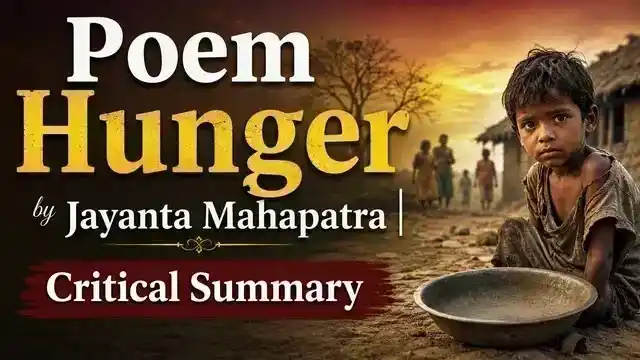
Critical Summary:
The narrator – protagonist was hard pressed for sexual gratification. The desire for having sex took hold of him; it was like a heavy load on his back. The desire was caused by the “carelessly” words of a poor and lean fisherman as he was dragging his worn – out nets on the sea beach: “Will you have her?” The fisherman spoke these words as if he were sanctifying the statement and the purpose to overcome the hunger and poverty which was writ large on his bare bones that seemed to “thrash” his eyes.
The narrator – protagonist followed the fisherman as they crossed the sands to reach the shack where the fisherman lived. The narrator – protagonist could feel the strong sex urge beating his flesh. The hope for gratification burned in his body like an itch. He followed the fisherman in complete silence. The fisherman’s body was covered with froth, which he did not care to remove in view of the urgency to escort the narrator – protagonist to his shack. He continued dragging his fishing net behind him as he guided the narrator protagonist to his shack – and his daughter.
The shack was large and dingy. The fisherman opened it as one opens a wound. The narrator – protagonist walked in as the door opened and a gust of wind came in. For many days and nights the narrator – protagonist’s skin had been scratched by palm leaves. As he entered the shack, smoke from the oil lamp seemed to penetrate the mind of the narrator – protagonist, as did its sticky soot. He started feeling guilty for taking advantage of somebody’s poverty and hunger.
The narrator – protagonist was now inside the shack, while the fisherman remained outside. He heard the fisherman’s voice telling him that his daughter had just turned fifteen and that the narrator protagonist should “feel” her. He had plenty of time as his bus left at nine. According to the narrator – protagonist, “the sky fell on me” when he reached “a father’s exhausted wile”, his trick to entice him. (The fisherman must have been using all sorts of tricks to lure the customers for his fifteen – year – old daughter.)
The girl was tall but lean and thin (on account of poverty and hunger). With practised ease, she opened her legs for the stranger. The narrator – protagonist did not speak to her as he felt the “hunger” in her too. The girl’s hunger was purely physical while the narrator protagonist’s hunger was sexual.
Critical Analysis:
Introduction:
Hunger is one of the most powerful and widely anthologized poems by Jayanta Mahapatra. First published in his acclaimed collection A Rain of Rites (1976), the poem presents a disturbing yet deeply symbolic exploration of poverty, sexual exploitation, and the moral decay caused by hunger. Set against the backdrop of a poor fishing village on the coast of Odisha, the poem intertwines two forms of hunger—physical hunger for food and psychological or sexual hunger for bodily satisfaction. Through vivid imagery, realistic narration, and emotional restraint, Mahapatra exposes the harsh realities of human existence in a society marked by deprivation and inequality.
The Dual Meaning of Hunger:
The central theme of the poem is the concept of dual hunger. On one level, hunger refers to the fisherman’s desperate need for food and survival. Unable to earn enough from the sea, he is forced by poverty to offer his young daughter to a stranger in exchange for money. This shocking act is not presented as cruelty but as a tragic consequence of extreme economic hardship.
On another level, hunger symbolizes the stranger’s sexual desire. While the fisherman seeks food to sustain life, the narrator is driven by physical passion. Mahapatra suggests that both forms of hunger are powerful human instincts, yet they differ morally. The poem ultimately reveals how material poverty can reduce human dignity, while unchecked desire can expose emotional emptiness.
Poverty and Economic Exploitation:
Mahapatra presents poverty not merely as a social condition but as a force capable of destroying moral values and family relationships. The fisherman has become so helpless that he treats his daughter as a commodity to be exchanged for survival. His statement that she is “just turned fifteen” reflects the normalization of exploitation in a society where economic desperation outweighs ethical considerations.
The poem condemns a social system that compels the poor to sacrifice their dignity for survival. The father’s actions are not glorified; rather, they reveal the devastating impact of poverty on human life. Mahapatra thus transforms a personal incident into a universal critique of social injustice.
Sexual Desire and Moral Conflict:
The stranger initially appears motivated solely by lust. However, his encounter with the young girl gradually becomes psychologically complex. As he observes her innocence and vulnerability, his physical attraction is accompanied by feelings of discomfort, guilt, and emotional uncertainty.
Mahapatra avoids presenting the narrator as either entirely evil or entirely sympathetic. Instead, he portrays him as a morally conflicted individual whose actions expose the darker aspects of human nature. This psychological realism makes the poem more disturbing because the conflict arises within ordinary human emotions rather than through dramatic events.
Symbolism in the Poem:
The poem is rich in symbolism that deepens its meaning.
1. The Sea symbolizes both livelihood and uncertainty. Although it is the fisherman’s source of income, it often fails to provide enough for survival, representing the unpredictability of fate.
2. The Fisherman symbolizes the oppressed poor who are trapped by economic hardship.
3. The Young Girl symbolizes innocence, vulnerability, and the exploitation of the powerless.
4. The Narrator represents privileged society, driven by personal desire yet emotionally detached from the suffering of others.
5. Hunger itself becomes a universal symbol of every form of human craving—physical, emotional, sexual, and existential.
Through these symbols, Mahapatra transforms a simple narrative into a profound commentary on human civilization.
Imagery and Realism:
One of the poem’s greatest strengths is its vivid imagery. Mahapatra creates an authentic atmosphere through descriptions of the seashore, fishing life, darkness, and the girl’s physical appearance. These realistic details intensify the emotional impact without becoming sentimental.
The poem’s realism lies in its refusal to romanticize poverty. Instead, it depicts harsh realities with honesty and restraint. Every image contributes to the growing sense of discomfort, forcing readers to confront the consequences of inequality and exploitation.
Psychological Depth:
The poem explores the complexities of the human mind rather than offering simple moral judgments. The fisherman struggles between parental responsibility and economic necessity. The narrator experiences a conflict between desire and conscience. Even the silent presence of the girl communicates fear, innocence, and helplessness.
Mahapatra’s psychological insight allows readers to understand each character’s circumstances while still questioning the morality of their actions. This balance between empathy and criticism gives the poem remarkable emotional depth.
Social Criticism:
Hunger functions as a powerful social protest against poverty, gender exploitation, and social inequality. The poem exposes the condition of marginalized communities whose lives remain invisible to the privileged classes. Women and young girls emerge as the greatest victims of economic deprivation, becoming objects of exchange in a patriarchal society.
Rather than directly preaching reform, Mahapatra allows the tragic situation itself to expose the failures of society. His criticism is therefore subtle yet profoundly effective.
Style and Technique:
Mahapatra employs a simple, conversational style that enhances the poem’s realism. The narrative unfolds like a short story, yet every detail carries symbolic significance. His use of irony is particularly effective. The title Hunger initially appears to refer only to physical starvation but gradually expands to include sexual desire, emotional emptiness, and moral decay.
The restrained language, understated emotions, and absence of melodrama make the poem even more powerful. Mahapatra trusts readers to recognize the horror hidden beneath ordinary conversation.
Universal Significance:
Although rooted in the socio-economic conditions of rural India, Hunger possesses universal relevance. Poverty, exploitation, inequality, and the conflict between instinct and morality exist across cultures and historical periods. The poem raises enduring questions about human dignity, social responsibility, and the ethical consequences of economic injustice.
Its exploration of basic human desires makes it meaningful to readers everywhere, regardless of geographical or cultural background.
Conclusion:
Hunger is a profound and disturbing exploration of the relationship between poverty, desire, and human morality. Through the story of a fisherman, his young daughter, and a stranger, Jayanta Mahapatra reveals how hunger in its various forms can erode innocence, dignity, and ethical values. The poem combines psychological realism, powerful symbolism, vivid imagery, and subtle social criticism to expose the harsh realities of human existence. Ultimately, Hunger stands as one of the finest achievements of Indian English poetry, compelling readers to reflect on the social inequalities and moral dilemmas that continue to shape human life.