Introduction of the Poem:
“My Cat” is a witty, ironic, and satirical poem by Nissim Ezekiel, one of the pioneers of modern Indian English poetry. In this poem, Ezekiel presents an unconventional portrait of his pet cat, who refuses to behave like the lively, affectionate, or instinctive cats commonly found in literature and everyday life. Right from the opening lines, the poet contrasts his cat with the mysterious and symbolic cats of the French poets Paul Verlaine and Charles Baudelaire, emphasizing that his own cat is neither mystical nor charming but simply indifferent, lazy, and emotionally detached.
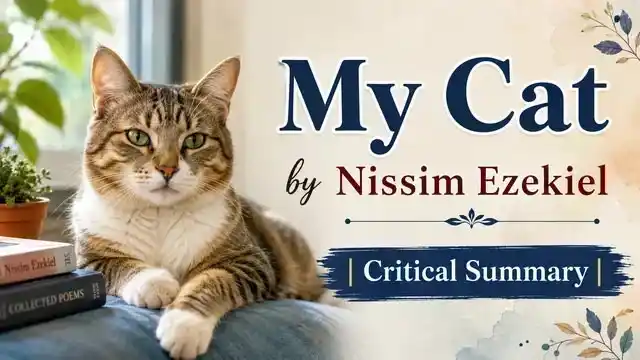
Through humour, understatement, and irony, the poem explores themes of individuality, alienation, boredom, and the unpredictable nature of relationships between humans and animals. Although the poem appears light-hearted on the surface, it subtly reflects the frustrations and contradictions of domestic life, making it a fine example of Ezekiel’s ability to combine everyday experience with psychological insight and comic realism.
An early poem, My Cat appeared in Ezekiel’s first anthology, Sixty Poems (1953). Here the poet describes an unusual cat he had as a pet when, during his student days in England (1948-52), he lived in a basement room in London.
Critical Summary:
Ezekiel’s pet cat in his basement room in London is not an ordinary, typical cat. It is neither devilish nor inscrutable like the cats of Verlaine or Baudelaire. Though she is equally comfortable sitting on a chair or in someone’s lap, it does not like to be petted or caressed, nor does it flirt with its owner.
Its one mood is that of extreme boredom as it always keeps yawning and sleeping. Its sense of smell is impaired as it doesn’t sniff at the fish stored in the pantry. It also does not enjoy lapping up milk as other cats do. In this respect, it behaves more like a sheep than a cat.
This cat considers it below its dignity to chase a rat, or play with balls of wool or bare its claws to visitors as the other cats do. It is immune to hatred as well as love, the two emotions dominant in human beings as it likes to remain neutral and passive to the goings on around. The poet is so sick of this pet that he plans to drown it in a river one day.
Critical Analysis of the Poem:
Introduction:
“My Cat” is a humorous yet thought-provoking poem by Nissim Ezekiel, one of India’s most distinguished modern poets writing in English. The poem presents an unconventional portrait of a pet cat that refuses to behave like an ordinary feline. Instead of being affectionate, playful, or independent in familiar ways, the cat appears completely indifferent to everything around her. Through irony, wit, and understated humour, Ezekiel explores themes of boredom, alienation, emotional detachment, and the unpredictability of living beings.
An Unconventional Cat:
The poem opens with a comparison between the speaker’s cat and the famous literary cats of the French poets Paul Verlaine and Charles Baudelaire. Unlike their mysterious, symbolic, or supernatural cats, Ezekiel’s cat possesses no extraordinary qualities. She is “neither diabolic nor a sphinx,” indicating that she is neither evil nor mysterious. However, she is equally unusual because she refuses to display the normal behaviour expected of a domestic cat.
Rejection of Natural Instincts:
The poet humorously lists the cat’s strange habits. She does not enjoy being petted, never hunts rats, ignores fish, dislikes milk, and even avoids playing with balls of wool. These are all instinctive characteristics generally associated with cats. By rejecting these natural behaviours, the cat becomes almost absurd, leading the poet to remark that she is “less cat than sheep.” This comparison emphasizes her passivity and lack of energy, creating gentle comic irony.
Theme of Boredom and Emotional Detachment:
One of the central themes of the poem is boredom. The cat remains in a constant state of indifference. She yawns, walks away, and spends most of her time sleeping. She neither expresses affection nor hostility toward anyone. This emotional neutrality symbolizes detachment from worldly desires and relationships. The cat exists in her own isolated world, untouched by the ordinary emotions that govern both humans and animals.
Humour and Irony:
Humour is one of the poem’s greatest strengths. The poet creates comedy by describing a cat that behaves in the exact opposite way readers expect. The ironic comparison with literary cats, the amusing statement that she is “less cat than sheep,” and the catalogue of her unusual habits all contribute to the poem’s light-hearted tone. Beneath this humour, however, lies a subtle reflection on individuality and the impossibility of fully understanding another living creature.
Defiance of Animal and Human Laws:
The poet observes that the cat “defies all animal and human laws of love and hate.” This is one of the poem’s most significant ideas. The cat neither loves nor hates anyone; she simply remains indifferent. Her behaviour challenges the emotional patterns that usually define relationships among both humans and animals. Ezekiel suggests that some individuals cannot be easily categorized or understood because they refuse to conform to accepted norms.
The Shocking Ending:
The poem concludes with the startling line, “One night I’ll drown this cat.” This ending surprises the reader after the poem’s calm and humorous tone. The statement should not necessarily be interpreted literally. Instead, it reflects the speaker’s momentary frustration and helplessness in dealing with the cat’s complete indifference. The exaggerated threat intensifies the irony and leaves the poem with a memorable dramatic effect. It also highlights the conflict between human expectations and the stubborn independence of another living being.
Language and Style:
Ezekiel employs simple, conversational language that makes the poem accessible and engaging. His style is marked by clarity, precision, and gentle satire. The vivid descriptions, ironic comparisons, and realistic observations create an entertaining yet meaningful portrayal of the cat. The poem’s controlled structure and smooth rhythm reinforce its understated humour while allowing deeper themes to emerge naturally.
Conclusion:
“My Cat” is far more than a simple description of a household pet. Through an ordinary domestic situation, Nissim Ezekiel explores the complexity of behaviour, the limits of human understanding, and the uniqueness of individual personality. The poem combines humour, irony, and psychological insight to portray a cat whose indifference becomes both amusing and symbolic. Its memorable ending and subtle exploration of alienation make it an excellent example of Ezekiel’s modern poetic craftsmanship.