Introduction of the Poem:
Looking for a Cousin on a Swing is one of the most remarkable poems by A. K. Ramanujan, a distinguished Indian poet known for his insightful exploration of human emotions, memory, identity, and cultural traditions. The poem presents a sensitive portrayal of adolescent awakening, focusing on the narrator’s recollection of a seemingly innocent childhood experience that gradually reveals the complexities of desire, emotional intimacy, and self-discovery.
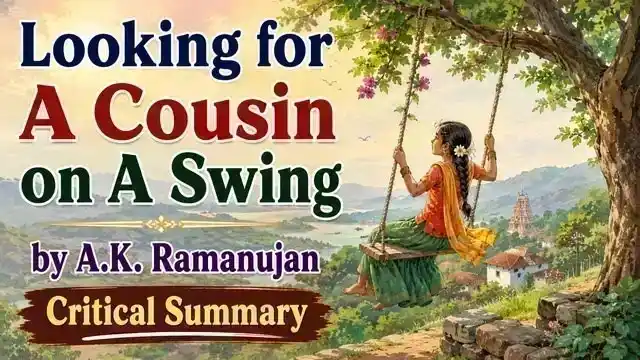
Set against the backdrop of a traditional Indian family environment, the poem explores the transition from childhood innocence to the awareness of adult sexuality. Through vivid imagery, symbolic language, and reflective narration, Ramanujan delicately examines the conflict between natural human instincts and the social conventions that regulate them. Rich in psychological depth and lyrical simplicity, Looking for a Cousin on a Swing stands as an excellent example of Ramanujan’s ability to transform personal memory into a universal exploration of love, innocence, guilt, and the complexities of human relationships.
In this poem, a young woman recalls how she would sit on a swing when she was four or five years old with her cousin, who was six or seven. Now she looks for swings in the suburb of a city and is filled with desire for her cousin.
Critical Summary:
When the protagonist was a small girl of four or five, she used to sit on a swing with her male cousin who was six or seven at that time. They used to enjoy the experience as the swing moved at great speed from one side to the other as someone pushed it. With every “lunge of the swing” she would feel the physical closeness of the cousin perched on her lap. This experience of physical contact intensified with every thrust and penetrated to her heart, stirring it to its very depths. After the ride on the swing, the cousins would climb a tree. The tree was not very tall but it was full of leaves which resembled the leaves of a fig tree. At that time, the girl and her cousin enjoyed this pastime in an “innocent” manner.
Now when the girl has grown into a young woman, she lives in a thickly – populated city which has fifteen suburbs. She wistfully recalls the thrill of her childhood experience as she looks for that swing in her new habitat. But her longing for her cousin’s company on the swing is no longer that “innocent”. She now desires to experience something more – probably to have sex with her cousin – as she looks at the ” crotch ” of a tree bursting “under every leaf” scattering numerous “scarlet figs” even if someone suddenly sneezes.
The poem depicts the psychology of a small child who, as a young woman now, looks for a lot more than the “innocent.” Pleasures of her childhood with her cousin, who must be a grown – up young man.
Critical Analysis of the Poem:
Introduction:
“Looking for a Cousin on a Swing” is one of A.K. Ramanujan’s most celebrated poems exploring the complexities of memory, childhood innocence, awakening sexuality, and the conflict between traditional morality and natural human emotions. Through simple yet symbolic imagery, the poet presents the recollection of a woman’s first experience of physical attraction toward her cousin during childhood. The poem examines how an innocent childhood incident leaves a lasting emotional impression and continues to influence adult life. Ramanujan masterfully blends psychological insight with vivid natural imagery to portray the universal journey from innocence to maturity.
Childhood Innocence and the Awakening of Desire:
The poem begins with the recollection of a childhood experience when the girl, only four or five years old, sits on a village swing while her slightly older cousin sits closely behind her. As the swing moves back and forth, she unknowingly experiences a strange physical sensation that awakens feelings she cannot yet understand. The repeated movement of the swing becomes a metaphor for the first stirrings of sexual awareness. Although both children are too young to comprehend these emotions, the experience remains deeply embedded in the girl’s memory.
The Symbolism of the Swing:
The swing is the central symbol of the poem. On one level, it represents childhood play and carefree innocence. On a deeper psychological level, its rhythmic movement symbolizes emotional excitement, sensual awakening, and the transition from childhood to adulthood. The swinging motion mirrors the oscillation between innocence and desire, memory and reality, and the unconscious and conscious mind. Throughout the poem, the swing becomes a symbol of a lost emotional experience that the woman continues to search for throughout her life.
Memory and Psychological Impact:
The poem highlights the extraordinary power of memory. Although the childhood incident appears insignificant, it leaves a permanent psychological impression on the woman. As an adult, she repeatedly recalls the moment and unconsciously searches for the emotional intensity she experienced during her childhood. Her inability to forget the incident demonstrates how early emotional experiences shape an individual’s identity and desires.
Village versus Modern City:
Ramanujan creates a meaningful contrast between the peaceful village and the crowded modern city. The childhood experience occurs in the natural surroundings of the village, where innocence and intimacy coexist with nature. In contrast, the woman later searches for the symbolic swing “in cities with fifteen suburbs,” suggesting the emptiness and emotional isolation of urban life. Despite modern surroundings, she cannot recover the simplicity and emotional authenticity of her childhood experience.
The Symbolism of the Tree and Scarlet Figs:
The tree filled with leaves and imagined scarlet figs carries rich symbolic significance. Trees traditionally symbolize growth, fertility, and the cycle of life. The “scarlet figs” suggest ripeness, passion, fertility, and mature sexuality. The humorous image of the tree appearing ready to burst “if someone suddenly sneezed” emphasizes the overwhelming abundance of life and desire. These natural images reinforce the theme of emotional and physical maturation.
Conflict between Innocence and Social Morality:
One of the poem’s central concerns is the conflict between natural human feelings and social expectations. The woman repeatedly “tries to be innocent about it,” indicating her struggle to reconcile her childhood memory with the moral values imposed by society. Since the attraction involves a cousin, cultural norms create feelings of embarrassment and guilt. The poem does not condemn the experience but presents it as a natural part of psychological development.
Use of Imagery and Language:
Ramanujan’s language is remarkably simple yet deeply suggestive. He avoids elaborate descriptions and instead relies on vivid imagery drawn from nature, such as the swing, the leafy tree, and the scarlet figs. These images carry multiple layers of meaning, blending physical reality with psychological symbolism. The conversational tone and free verse style make the poem appear effortless while conveying profound emotional complexity.
Themes:
The poem explores several interconnected themes:
1. Childhood innocence and experience
2. Awakening of sexuality
3. Memory and nostalgia
4. Psychological development
5. Nature as a symbol of human emotions
6. Conflict between desire and social conventions
7. The search for lost innocence
8. The contrast between rural simplicity and urban life
Conclusion:
“Looking for a Cousin on a Swing” is a subtle and psychologically rich exploration of childhood memory and emotional awakening. A.K. Ramanujan transforms an apparently ordinary childhood incident into a profound meditation on innocence, desire, memory, and identity. Through symbolic imagery, restrained language, and sensitive psychological insight, the poem reveals how early experiences continue to shape adult consciousness. Its universal themes and artistic simplicity make it one of Ramanujan’s finest achievements in modern Indian English poetry.