Introduction of the Poem:
The Railway Clerk is one of Nissim Ezekiel’s most celebrated dramatic monologues, portraying the frustrations, disappointments, and aspirations of an ordinary middle-class government employee. Through the voice of a railway clerk, Ezekiel presents a realistic and satirical picture of the everyday struggles faced by the common Indian office worker. The speaker complains about his monotonous job, financial hardships, lack of promotion, poor working conditions, and family responsibilities, while also revealing his dreams of a better life and his desire for appreciation.
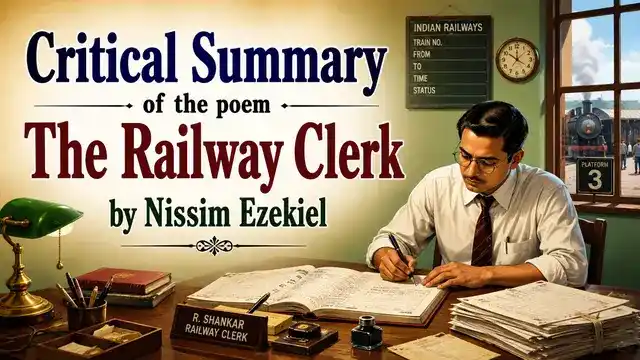
Written in Indian English, the poem deliberately employs colloquial speech and non-standard grammar to capture the authentic voice of the common man. Beneath its humour and irony, The Railway Clerk offers a poignant commentary on bureaucracy, social inequality, corruption, and the challenges of middle-class existence in post-independence India. The poem is a fine example of Ezekiel’s ability to transform ordinary experiences into powerful social criticism, making it one of the most significant works in modern Indian English poetry.
In this monologue from Ezekiel’s Collected Poems (1989), a railway clerk expresses his discontent and unhappiness at the kind of life he has to lead and the difficulties and problems he faces. Even though he carries out the orders of his superiors, he is criticized when anything goes wrong. It is a realistic poem which is full of humour and pathos. Although it deals with the day – to – day problems and grievances of an ordinary railway clerk, the chief source of humour in this poem arises out of Ezekiel’s use of English exactly in the manner in which an Indian railway clerk would use it:
“I never neglect my responsibility,
I discharge it properly,
I do my duty.
But who appreciates?
Nobody, I tell you.”
In the use of Indian English, The Railway Clerk bears comparison with Goodbye Party for Miss Pushpa T.S.
Critical Summary:
The railway clerk’s leave application has been rejected twice during the current year. He’s overburdened with work, yet he is not paid any overtime. Besides, his wife is always demanding more money to meet the household expenses and he doesn’t know where to get this additional money from. His work is such that no one offers him any bribe, though his more fortunate colleagues do get bribes. Since he is not a graduate, there are no prospects of promotion for him in this present job.
The railway clerk wishes that he were a bird instead of an overworked, disgruntled human being. He has never neglected his duties, yet no one has ever appreciated his dedication and devotion to work. What is worse, he has to work at a desk that is too small for the efficient performance of his duties. The fan overhead has been out of order for the last couple of months and it has not been repaired. His office is situated at a long distance from his residence in Borivli (Mumbai). As a result, he cannot properly look after his children who have started neglecting their studies. His mother – in – law is ill and he has to bear her medical expenses. He wonders how long the present state of affairs can go on.
Once a week when he goes to see a movie, the railway clerk feels quite happy. His friends are the only source of comfort and consolation in his life; he meets them occasionally for a chat and they discuss the problems of the country. Some of his friends think of going abroad but he cannot do so because of his circumstances.
Critical Analysis of the Poem:
Introduction:
“The Railway Clerk” is one of Nissim Ezekiel’s finest dramatic monologues that realistically portrays the life of an ordinary Indian middle-class government employee. Through the voice of a railway clerk, the poet presents the frustrations, anxieties, financial hardships, and emotional struggles faced by countless salaried workers in post-independence India. The poem combines humour, irony, realism, and social criticism to expose the inefficiency, corruption, and monotonous routine of the bureaucratic system. Written in Indian English, the poem captures the authentic speech patterns of the common man, making it one of Ezekiel’s most memorable social satires.
A Dramatic Monologue of an Ordinary Clerk:
The poem is written as a dramatic monologue in which the railway clerk directly narrates his problems to an unseen listener. He repeatedly tries to justify himself by saying, “It isn’t my fault,” suggesting that despite being honest and hardworking, he is unfairly blamed for everything. His continuous complaints reveal his helplessness, disappointment, and emotional exhaustion.
The speaker appears sincere rather than rebellious. Instead of demanding justice, he simply narrates his daily struggles, allowing readers to sympathize with his situation.
Portrait of the Indian Middle-Class Employee:
The railway clerk represents the typical middle-class government employee who struggles to maintain his family on a limited salary. He receives neither overtime nor promotion despite working honestly. His leave applications are rejected, and his financial condition grows worse each day.
The poem reflects the insecurity of salaried workers whose lives are trapped between increasing responsibilities and stagnant income. Ezekiel successfully transforms one clerk into a symbol of millions of ordinary employees.
Criticism of Bureaucracy:
One of the poem’s central concerns is its criticism of the bureaucratic system. The clerk performs his duties faithfully but receives no recognition. Promotions depend on educational qualifications rather than experience or dedication. Honest workers remain unnoticed, while dishonest employees prosper.
The broken fan, cramped desk, and excessive workload symbolize the neglect of lower-level government employees. The office becomes a place of frustration rather than professional satisfaction.
Exposure of Corruption:
The poem subtly exposes the widespread corruption in government offices. The clerk regrets that no one offers him bribes because of the nature of his job, whereas other clerks are in a “fortunate position” to earn illegal income.
This ironic statement reveals how corruption has become so common that honest earnings appear insufficient. Ezekiel does not glorify corruption but shows how poverty and inequality tempt ordinary people to envy those who receive bribes.
Financial Hardships and Domestic Responsibilities:
The clerk’s greatest concern is money. His wife constantly asks for more money, but his salary cannot meet the family’s needs. He supports not only his wife and children but also his bedridden mother-in-law.
His children neglect their studies, and his long journey from Borivli adds to his daily difficulties. These personal details create a realistic picture of middle-class domestic life filled with endless responsibilities and financial pressure.
Psychological Frustration and Escapism:
Continuous hardships make the clerk emotionally exhausted. His wish to become a bird symbolizes his desire to escape from the burdens of life and experience freedom.
However, he finds temporary relief in watching a film once a week and spending time chatting with friends. These small pleasures help him forget his worries for a short time but cannot permanently solve his problems.
Irony and Humour:
Although the poem deals with serious social issues, it contains gentle humour and irony. The clerk’s repetitive complaints, awkward expressions, and simple logic create comic effects. However, beneath this humour lies deep sadness.
For example, he considers himself unlucky because no one offers him bribes, exposing the moral decline of society. Similarly, he repeatedly insists that he performs his duty properly, yet no one appreciates him. The humour therefore strengthens rather than weakens the poem’s tragic impact.
Use of Indian English:
A distinctive feature of the poem is Ezekiel’s deliberate use of Indian English. Expressions such as “I am never neglecting my responsibility,” “I am discharging it properly,” and “how long this can go on?” imitate the spoken English of educated Indians.
The grammatical peculiarities are intentional artistic devices rather than mistakes. They give authenticity to the speaker’s voice and make the character believable. Ezekiel transforms Indian English into a powerful medium for portraying everyday Indian life.
Symbolism:
Several symbols enrich the poem’s meaning:
1. The railway clerk symbolizes the struggling Indian middle class.
2. The broken fan represents governmental neglect and poor working conditions.
3. The small desk symbolizes limited opportunities and professional confinement.
4. The bird symbolizes freedom from worldly burdens.
5. Money symbolizes the endless financial pressures that dominate modern life.
These symbols deepen the poem’s social and psychological significance.
Major Themes:
The poem explores several important themes:
1. The hardships of middle-class life.
2. Bureaucratic inefficiency and neglect.
3. Corruption in public institutions.
4. Financial insecurity.
5. Lack of appreciation for honest work.
6. Family responsibilities.
7. Psychological frustration.
8. The desire for freedom and escape.
9. Friendship as emotional support.
10. Social realism.
Language and Style:
Ezekiel’s language is simple, conversational, and realistic. Instead of using poetic ornamentation, he reproduces the natural speech of an ordinary clerk. The free verse form allows the speaker’s thoughts to flow spontaneously, making the poem sound like an actual conversation.
The repetition of words such as “money” and “I am” effectively conveys the clerk’s anxiety, frustration, and emotional burden. The straightforward style enhances the realism and emotional power of the poem.
Social Significance:
Beyond the personal story of one railway clerk, the poem reflects the condition of India’s urban middle class during a period of economic uncertainty and bureaucratic expansion. It exposes the gap between honest labour and fair reward while highlighting the emotional cost of financial insecurity and administrative indifference.
The poem remains relevant today because many employees continue to experience similar problems of work pressure, inadequate salaries, delayed promotions, and work-life imbalance.
Conclusion:
“The Railway Clerk” is a remarkable social satire and realistic character study by Nissim Ezekiel. Through the simple yet moving voice of a railway employee, Ezekiel exposes the struggles of the Indian middle class, the flaws of bureaucracy, the prevalence of corruption, and the emotional burden of family responsibilities. His masterly use of Indian English, irony, realism, and dramatic monologue transforms an ordinary office worker into a universal symbol of the honest but underappreciated common man. The poem’s enduring relevance lies in its compassionate portrayal of everyday human suffering, making it one of Ezekiel’s most powerful and memorable works.