Introduction of the Poem:
While in “Dhauli” Mahapatra deals with a significant historical omission, in “Grandfather” (1983) the disasters of the Orissa famine of 1866 are viewed from a biographical perspective. The poet tries to recreate and re – enact the harrowing experience of his grandfather, Chintamani Mahapatra, who was compelled to convert to Christianity on account of hunger and starvation during the famine. Mahapatra tries to relieve that critical moment by retrieving his grandfather’s “yellowed diary” and his asking him many questions. This, too, is a poem about “hunger” and what it might do to its victims. The grandfather died, however, metaphorically as a Hindu. In the end, the poet desperately attempts to know his true identity and sense of belonging in the “social order”.
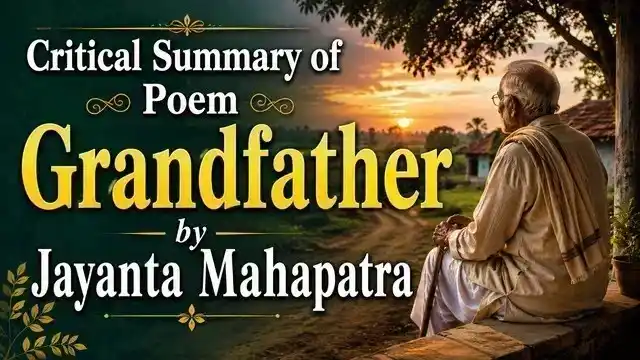
Critical Summary:
The poet retrieves his grandfather’s diary written during the Orissa famine over a hundred years ago. Its pages had become yellow due to the lapse of time and the grandfather had written about his travails and tribulations at that time. The poet tries to listen to the grandfather’s “voice” and “cramped cry” as he stumbles upon the diary.
The diary unfolds the untold misery inflicted by the famine. The sun was unduly hot; there were cracks in the barren earth; and there was all – round silence as the grandfather suffered the pangs of hunger and starvation. There was not a single cloud in the sky, nor was there any hope of rain. Famine had devoured the natural laughter of peasants.
The grandfather did not know what to do as the dead, empty trees stood on the banks of the dried – up river. He was unable to drag his famished body, trying to fight drowsiness. He was probably moving stealthily like a jackal in search of food. But the situation was grim.
Did the old grandfather sense the approach of his own death amidst the rustling of tamarind trees? Death stalked all around. Did he hear its cries break out in fits of unnatural laughter as it sought thousands of men, women and children to feed itself upon? What did the treacherous and deceptive laughter of death mean to him?
The poet asks his grandfather how old he was at that time. Of course, he felt hunted and stalked by death like thousands of others in the land. Did he turn a coward when the “real animal”, i.e., hunger, pierced through his bones? He deserted his family (an act of cowardice) as well as his faith (Hinduism). Both were precious possessions, but he buried them deep in the earth as hunger gnawed at his entrails.
The imperishable, insatiable hunger wrecked his body. In such dire circumstances, faith was hardly of any consequence. His rejection of the ancient faith (Hinduism) must have raised qualms of conscience as the grandfather decided to lead a “separate life” when he embraced Christianity. Perhaps, he opted for spiritual death over physical death due to hunger and starvation. The “web” or the instinct for survival forced the grandfather to change his faith.
“The separate life” as a converted Christian at least helped the grandfather to survive in those hard times. No one knew what the old man felt at that time when he embraced Christianity. Now in better times, when the rains are pouring in torrents as if mocking the aridness during the famine more than a hundred years ago, the poet and his son speak of the famine in hushed voices. They hardly mention it although it is deeply etched on their psyche as if on a stone.
There is a great gulf of conscience between the poet and his son, as they think differently. The son is young; he is bright and optimistic. Maybe he wants to return to the glory of the original faith Hinduism. Maybe he thinks of the past when the family broke away from their faith as a great loss to the family. Both the poet and his son look at the past, but they are at a loss. The poet’s son looks upon the old man’s act as a desertion while the poet views it as a compromise to survive.
There is a new dawn on the horizon, the poet tells his grandfather. The old man could not perhaps visualize it a hundred years ago. His suffering during the famine and his subsequent conversion to Christianity is just an invisible piece of information on the black – board of memory. It has made his progeny survive and grow. He wishes the grandfather were alive to see and know him and his children. This would have not been possible if the old man had not changed his faith.
The move that the grandfather made, the great leap from one faith to another in order to survive, has now become an integral part of the family psyche. They wish they had known more about the grandfather. They also wish to know what it was like to be near one’s death and to compromise one’s dignity and faith to strike a compromise between faith and hunger.
The grandfather earned his dignity by embracing Christianity, a dangerous move. That was his last, and perhaps, the only chance to survive. But, the poet thinks, it was grossly unfair and “blindly terrifying”. The poet wishes that they had not to wake up with smiles in the middle of some “social order” under which the victims and the converts were provided food and shelter. The poem end on a note of regret as the poet finds himself lost – and torn between the two worlds of Christianity and “the vast and dominant amphitheatre outside with the preponderance of rites and festivals which represented the way of life of our own people.”
Critical Analysis of the Poem “Grandfather”:
Introduction:
Grandfather is one of Jayanta Mahapatra’s most personal and historically significant poems. It explores the tragic memory of the devastating Orissa Famine of 1866 through the life of the poet’s grandfather, who converted to Christianity to escape starvation. The poem is not merely a family history but a profound meditation on hunger, faith, identity, guilt, survival, and the lingering effects of colonialism. By revisiting his grandfather’s painful past, Mahapatra examines how historical trauma shapes both individual identity and collective memory.
Historical Background:
The poem is rooted in the catastrophic Orissa Famine of 1866, one of the worst famines in Indian history. Extreme drought, administrative failure, and widespread starvation forced thousands of people to abandon their homes, beliefs, and traditions merely to survive. Mahapatra’s grandfather, Chintamani Mahapatra, embraced Christianity under such desperate circumstances. The poet revisits this painful family history to understand the emotional and moral cost of survival.
The Conflict Between Hunger and Faith:
The central conflict of the poem lies between physical survival and religious faith. Mahapatra repeatedly questions whether faith can sustain a starving person. His grandfather’s conversion is presented not as an act of betrayal but as an unavoidable human response to unbearable suffering. Hunger emerges as a force stronger than religious identity, compelling people to sacrifice even their deepest beliefs.
Exploration of Identity Crisis:
The poem reflects Mahapatra’s lifelong struggle with identity. As a descendant of a converted Christian family living in a predominantly Hindu society, the poet experiences a sense of cultural displacement. He belongs fully neither to Christianity nor to traditional Hindu society. This inherited uncertainty creates an emotional conflict that runs throughout the poem and becomes one of its most powerful themes.
Memory and the Search for the Past:
The poet reconstructs his grandfather’s experiences by reading the “yellowed diary,” a symbol of fading yet enduring memory. Through this diary, Mahapatra attempts to bridge the gap between generations and understand a tragedy that still influences his family’s identity. Memory becomes both a source of knowledge and a burden, reminding the poet that the past continues to shape the present.
Psychological Depth:
Rather than condemning or glorifying his grandfather’s decision, Mahapatra portrays it with remarkable psychological complexity. He asks a series of rhetorical questions that reveal empathy rather than judgment. The grandfather’s silence and absence intensify the emotional impact, leaving both the poet and readers searching for answers that history cannot fully provide.
Theme of Colonialism:
The poem indirectly critiques colonial rule by exposing the social conditions that forced vulnerable people into religious conversion. Mahapatra suggests that famine was not merely a natural disaster but also a consequence of colonial neglect. His grandfather’s conversion therefore reflects the human cost of imperial policies rather than a simple change of religious belief.
Tone and Mood:
The tone of the poem is reflective, sorrowful, questioning, and compassionate. Mahapatra neither accuses nor excuses his grandfather. Instead, he mourns the tragic circumstances that left no honorable choice. The mood remains sombre throughout, creating a deep emotional connection between history and personal memory.
Style and Technique:
The poem is written in free verse, allowing Mahapatra to express natural reflection and emotional complexity. Its conversational structure, rhetorical questions, fragmented memories, and symbolic language mirror the poet’s uncertain search for identity. The absence of definitive answers enhances the poem’s realism and emotional power.
Autobiographical and Historical:
Grandfather is a remarkable example of autobiographical and historical poetry. Mahapatra transforms a private family tragedy into a universal meditation on survival, identity, and human resilience. The poem demonstrates that history is not confined to textbooks but continues to live within families and individuals. Its emotional honesty, symbolic richness, and philosophical depth make it one of the finest poems in Indian English literature. The poem does not offer easy moral judgments; instead, it invites readers to understand the painful choices imposed by extreme suffering.
Conclusion:
Grandfather is a deeply moving exploration of memory, history, and identity. Through the story of his grandfather’s conversion during the Orissa Famine, Jayanta Mahapatra examines the devastating consequences of hunger and colonialism while questioning the meaning of faith, belonging, and human survival. Rich in symbolism, emotional intensity, and historical awareness, the poem stands as a timeless reflection on the sacrifices people make to preserve life and the enduring legacy of those sacrifices across generations.