Introduction:
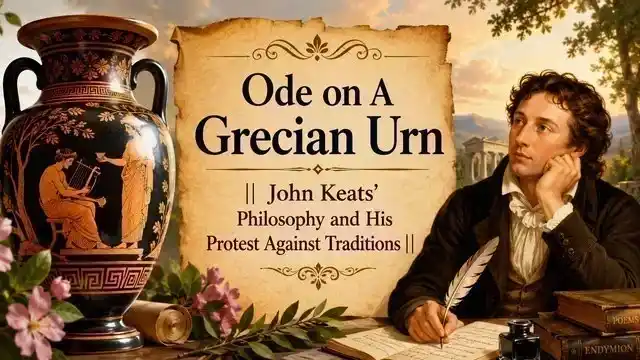
John Keats’ Ode on a Grecian Urn (1819) is one of the finest achievements of English Romantic poetry and a profound expression of the poet’s artistic, philosophical, and aesthetic vision. Written during the most creative period of his career, the poem explores the eternal relationship between art and life, beauty and truth, permanence and transience, imagination and reality. Through his contemplation of an ancient Grecian urn decorated with timeless scenes of love, music, sacrifice, and celebration, Keats transforms a silent work of art into a powerful symbol of immortality and universal human experience. The poem reflects his belief that while human life is fleeting and filled with pain, sorrow, and change, art possesses the unique power to preserve beauty forever.
Keats’ Philosophy of Beauty, Art, and Truth:
The ode is equally significant as a reflection of John Keats’ philosophy of life and art. Unlike poets who sought moral instruction or social reform through literature, Keats believed that the highest purpose of poetry was the creation and appreciation of beauty. His famous declaration, “Beauty is truth, truth beauty,” encapsulates his conviction that beauty itself reveals the deepest form of truth accessible to human beings. This philosophy is closely associated with his theory of Negative Capability, which encourages the acceptance of uncertainty, mystery, and imagination rather than rigid logic and dogmatic reasoning. In Ode on a Grecian Urn, Keats presents art as a realm where beauty remains eternally fresh, untouched by the decay and suffering that inevitably accompany human existence.
Keats’ Protest Against Traditional Literary Conventions:
The poem also represents Keats’ subtle yet powerful protest against the literary, philosophical, and social traditions that dominated earlier ages. Rejecting the rigid rules of Neoclassicism, the emphasis on reason, and the didactic purpose of poetry, Keats embraced the Romantic ideals of imagination, emotion, individual perception, and creative freedom. Instead of presenting poetry as a vehicle for moral preaching or political propaganda, he celebrated the autonomy of art and the richness of aesthetic experience. His admiration for Greek art does not signify a return to classical restraint but rather an appreciation of its timeless beauty and symbolic depth, which he reinterprets through the Romantic imagination.
The Contrast Between Eternal Art and Mortal Life:
Furthermore, Keats challenges conventional attitudes toward time, mortality, and human fulfillment. The lovers depicted on the urn can never kiss, yet their love never fades; the musician’s melodies are never heard, yet they remain eternally sweet; the trees never lose their leaves, preserving an everlasting spring. These paradoxes reveal Keats’ belief that artistic perfection exists beyond the limitations of ordinary life. Although real life is subject to change, ageing, and death, art captures an ideal world where beauty remains permanently alive. Thus, the poem presents both the triumph and the limitation of art, inviting readers to reflect on the contrast between eternal artistic perfection and the impermanence of human existence.
The Ode as a Celebration of Beauty and Imagination:
In essence, Ode on a Grecian Urn is far more than an appreciation of an ancient artifact; it is a philosophical meditation on the enduring value of beauty, imagination, and artistic creation. It embodies John Keats’ Romantic vision, his aesthetic philosophy, and his rejection of restrictive literary conventions and rationalistic traditions. Through its rich symbolism, sensuous imagery, and profound reflections, the poem continues to inspire readers across generations, affirming Keats’ enduring belief that art transcends time and that beauty remains one of humanity’s highest and most meaningful truths.
The Urn as the Symbol of Truth and Eternal Beauty:
In this great ode, Keats presents an ideal philosophy of beauty based on truth. The urn represents it. The urn has a Grecian shape. It attracts the poet very much. It presents two lively pictures engraved on the urn. The pictures have the blessing of eternity. Nothing engraved in the pictures is subject to change. It reflects the basic instincts of mankind. The man’s instinct to enjoy the beauty and love of a woman by force and sacrifice of the humble and innocent ones in the name of religion without understanding what true religion is . The urn is a cold pastoral for it is silent. Its pictures have a natural background. Time or old age decays everything but it has spared the urn. The poet believes the urn will always exist to inspire the mankind to understand truth, true beauty and true joy. The urn will always convey the universal message that “beauty is truth and truth beauty”. If truth is ugly it is false and if beauty is not true is it ugly. In human life beauty and truth can never be separated. If a man understands this idea, his mind will never be confused. He will never be attracted by falsehood and ugliness. He will be able to distinguish between true beauty and apparent beauty as well real truth and apparent truth.
“cold Pastoral !
When old age shall this generation waste,
Thou shalt remain, in midst of other woe
Than ours, a friend to man, to whom thou sayst,
‘Beauty is truth, truth beauty’— that is all
Ye know on earth, and all ye need to know.”
Keats’ Protest Against Evil Traditions and False Beliefs:
Keats opposes evil traditions. He does not like unjust traditions and superstitious. In “Ode on a Grecian Urn” he opposes the tradition of sacrifice. He calls the priest mysterious for he is going to commit an unholy deed. A priest ought to be noble and merciful by nature but this priest has no mercy for the young innocent calf. The poet condemns those people also who support the priest and declares that a curse will fall on the town it will always remain desolate. In this poem he breaks the traditional admiration for fulfilled love. He proves that unfulfilled love is a blessing. In music he prefers songs of no tune which may not be heard for heard songs lose the sweet freshness.
“Heard melodies are sweet, but those unheard
Are sweeter; therefore, Ye soft pipes, play on;
Not to the sensual ear, but more endear’d,
Pipe to the spirit ditties of no tone.”
Keats’ Concept of Unfulfilled Love as Eternal Love:
Traditionally that love in regarded as fortunate in which the lover is united with the beloved. But Keats regards that love as blessed in which the lover fails in kissing his beloved for this love, according to the poet, will always remain warm young, beautiful and enjoyable.