Introduction:
The Waste Land (1922) stands as the defining achievement of T. S. Eliot and one of the greatest landmarks of twentieth-century English literature. Published in the aftermath of the World War I, the poem embodies the intellectual, cultural, moral, and spiritual crisis of the modern age. It is widely regarded as the supreme expression of literary Modernism, presenting a fragmented vision of civilization devastated by war, industrialization, materialism, and the collapse of traditional religious and moral values. Through its intricate structure, symbolic richness, and extensive use of myth and literary allusions, The Waste Land redefined the possibilities of modern poetry and established Eliot as the foremost poetic voice of his generation.
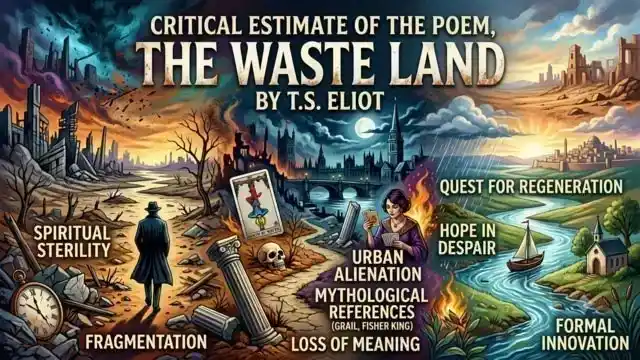
The poem portrays modern civilization as a spiritual “waste land”—a barren world characterized by alienation, sterility, despair, moral degeneration, and the loss of meaningful human relationships. The title itself is deeply symbolic, deriving from the medieval legend of the Fisher King and the Holy Grail, where the infertility of the land reflects the spiritual sickness of its ruler. Eliot transforms this ancient myth into a universal metaphor for the condition of twentieth-century humanity, suggesting that modern society suffers from a profound crisis of faith, identity, and cultural continuity. Although the poem depicts a world overwhelmed by fragmentation and decay, it simultaneously seeks the possibility of regeneration through spiritual discipline, self-knowledge, and cultural renewal.
A distinctive feature of The Waste Land is Eliot’s use of what he termed the “mythical method.” Inspired by James George Frazer’s The Golden Bough and Jessie L. Weston’s From Ritual to Romance, Eliot employs myth not merely as ornamentation but as a structural principle that unifies the fragmented experiences of modern life. This technique received remarkable appreciation from James Joyce, whose own experimental fiction influenced Eliot’s artistic vision. Later, T. S. Eliot himself described the mythical method as a means of “controlling, ordering, and giving shape and significance to the immense panorama of futility and anarchy which is contemporary history.”
The poem’s innovative form is equally significant. Rejecting the linear narrative and coherent voice of traditional poetry, Eliot adopts fragmentation, multiple speakers, shifting perspectives, dramatic monologue, symbolic imagery, free verse, and abrupt transitions. Its dense network of references to classical mythology, the Bible, Buddhism, Hindu philosophy, Dante, Shakespeare, and other literary traditions reflects the fractured consciousness of modern humanity while simultaneously affirming the continuity of cultural memory. The juxtaposition of diverse voices and civilizations creates a poetic mosaic that mirrors both the chaos and the hidden unity of human experience.
Critics have consistently recognized The Waste Land as the central text of Modernism. F. R. Leavis regarded Eliot as the poet who restored seriousness and intellectual discipline to English poetry, considering The Waste Land a decisive break from Romantic subjectivity. Cleanth Brooks praised the poem’s organic unity, arguing that its apparent fragmentation conceals a carefully structured pattern of irony and symbolism. Edmund Wilson described it as the most important poetic expression of the disillusionment experienced by post-war Europe. Likewise, I. A. Richards admired Eliot’s extraordinary ability to fuse emotion and intellect, making the poem a model of complex modern sensibility.
At the same time, The Waste Land has generated considerable critical debate. F. R. Leavis celebrated its cultural seriousness, whereas George Orwell questioned the excessive obscurity that characterized much of Modernist poetry. Feminist critics have examined the poem’s representation of women, while postcolonial scholars have explored its engagement with Eastern philosophy and Western cultural decline. Such diverse interpretations demonstrate the poem’s extraordinary richness and its capacity to sustain multiple critical approaches across generations.
The concluding section of the poem offers a vision of hope amidst desolation. Drawing upon the Brihadaranyaka Upanishad, Eliot introduces the Sanskrit injunctions “Datta” (Give), “Dayadhvam” (Sympathize), and “Damyata” (Control), culminating in the benediction “Shantih Shantih Shantih.” These concepts suggest that redemption is attainable not through material progress but through spiritual discipline, compassion, self-restraint, and inner peace. Thus, while The Waste Land vividly depicts the crisis of modern civilization, it ultimately gestures toward the possibility of moral and spiritual regeneration.
In essence, The Waste Land is not merely a poem about post-war despair but a profound philosophical exploration of the fragmented condition of modern existence. By combining myth, symbolism, religious traditions, psychological insight, and innovative poetic techniques, Eliot transformed modern poetry into a vehicle for cultural criticism and spiritual inquiry. Its unparalleled artistic complexity, intellectual depth, and enduring relevance have secured its position as one of the greatest masterpieces of world literature and an indispensable text for advanced literary study.
“The Waste Land” is the most important and the greatest achievement of T. S. Eliot. It symbolises the modern civilization which is compared to a waste land. It was written in 1921 and published in 1922. At the time of its composition, Eliot was a philosopher poet through and through. He was also a lover of esoteric poetry. Having viewed the modern materialistic civilization from the viewpoint of spiritualism and Christian Existentialism, he has represented his reaction in the form of this poem entitled The Waste Land.
Critical Estimate of the Poem
Theme of the Poem:
The Waste Land offers a criticism of life in the sense of an interpretation of its problems. In this poem there is a painful consciousness of the sickness and the fever and the fret of contemporary civilization. It goes beyond a mere diagnosis of the spiritual distempers of the age. It is a lament over man’s fallen nature, a prophecy and a promise. One of the important themes of the poem is a vision of dissolution and spiritual drought. This spiritual drought arises from the degeneration, vulgarization and commercialization of sex. Another important theme of the poem is sexual perversion among the middle – class people. This is seen in the mechanical relationship of the typist and the clerk. The typist gives herself to the clerk with a sense of total indifference and apathy. There is neither repulsion nor any pleasure.
Rhythm and Versification:
The poem except for the quotations consists of iambic verse lines of unequal length characterized by striking speech rhythms. Here and there the poet has employed thyme for a sudden tightening, for a cumulative insistence, or for an abrupt change of mood. In conversational passages the speech rhythms get down to colloquial level. But when Tiresias meditates, the rhythm rises to the level of noble thoughts. On the whole, Eliot’s versification and rhythms are highly striking.
A Stream of Consciousness:
The poem consists of fragmentary passages, literary quotations and allusions. There is an apparent lack of logical relationship among them. The reason is that the whole poem is a stream of consciousness in verse of one personage, Tiresias. He is the protagonist. He is almost immortal, blind and bisexual. He is the hidden poet and much learned. He calls memories, meditates, etc.
The Title:
The title of the poem is said to have been suggested by Miss Weston’s book From Ritual to Romance. Eliot had read in it of the waste land of King Fisher whose kingdom had been laid waste by his own sexual sins and those of his soldiers. This suggested to the poet the title of the poem, for to him all Europe appeared to be a spiritual waste land, laid waste by the sexual sins of the modern man.
The Epigraph:
The epigraph is drawn from Petronius’ satire Satyricon. This satie narrates the story of the sibyl of Cumae. In Greek mythology, sibyls were women of prophetic power, that of Cumae being the most famous of them. She was the beloved of Apollo who granted her the gift of immortality, but without eternal youth. The result was she grew old and withered with the passing of time and longed for death.
A Fine Document of Social Criticism:
This poem presents a series of trains of thought in the mind of a social observer. The primary theme which stirs Eliot’s poetry into intellectual movement is the barrenness of man’s contemporary spiritual estate. We feel that in this poem the poet has taken upon himself the burden of experiencing the world for his generation. The Waste Land along with The Hollow Men is considered as the most convincing presentation of social aimlessness.
The Use of Subjective Symbols:
Eliot has used a good number of subjective symbols in the poem. The first cardinal symbol is the Waste Land symbol. It stands for the modern materialistic civilization. The second cardinal symbol is ‘rock’. It first stands for matter and then for materialism. The third cardinal symbol is ‘water’. It stands for selfless love of man and God, and represents it as the water of human kindness and compassion. The fourth cardinal symbol is ‘unreal city’. It stands for the modern society of unsympathetic, selfish, people of sophisticated manners.
Bases of Symbolism:
The doctrine of spiritualism asserts that in the universe all the material forms are unreal. The immaterial soul is the only reality and it has real existence apart from matter. The doctrine of Christian Existentialism holds that man must raise his soul above the sins of the flesh and the temptation to worldly wealth. For the path of upright life leads the soul of God. But the doctrine of materialism denies the independent existence of the soul as apart from the matter. It also strictly prohibits noble spiritual pursuits, declaring them to be useless.
The Mythical Background:
Miss Weston’s book supplied him with the legend of the Grail and the Fisher King, and from The Golden Bough he derived his knowledge of a number of vegetation and fertility myths and rituals, especially those connected with Attis, Adonis and Osiris.
Diction and Language:
Eliot makes frequent use of new words, strange instances and subtle allusions in most of his poems. The very chaos of allusions recalls memories from Dante, Jacobean drama, Buddhism, mythology, anthropology. The Golden Bough, From Ritual to Romance and the Upanishads, very effectively convey even to the uninitiated reader, the sense of the barrenness and decay of a chaotic civilization. One is struck by the vigour and beauty of much of the details, the ironic pictures of modern manners, the superb mingling of satiric vulgarity and sensuous delicacy, prophetic earnestness, variety of imagery and rhythm. Repetition of images is another of the devices used in the poem and it is the means of carrying on the symbolism from section to section. Words are but imperfect medium to communicate the complexity of the civilization that Eliot is trying to portray. Eliot tried to create new concepts assisted by echoes of tradition, the feeling for syllabic and rhythm or what he called auditory imagination.
Conclusion:
Finally it can be observed that The Waste Land is the most notable single poem of the modern age. It is lament over man’s fallen nature, a prophecy and a promise