Introduction:
Charles Dickens is universally acclaimed as one of the greatest novelists in English literature and an unparalleled interpreter of human life. Among his many literary achievements, his extraordinary portrayal of childhood occupies a unique and enduring place. Dickens possessed an exceptional ability to understand the emotions, fears, hopes, innocence, and resilience of children, presenting them with remarkable realism, sympathy, and psychological insight. His own difficult childhood, marked by poverty, hardship, and child labour, profoundly influenced his imagination and enabled him to depict the sufferings and aspirations of young characters with rare authenticity.
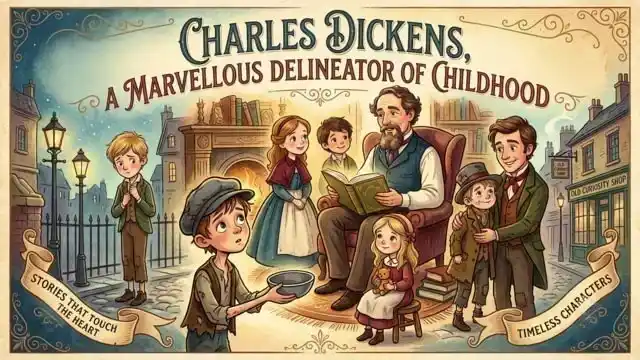
Unlike many writers of his age who treated children merely as minor or decorative figures, Dickens made them central to his narratives. His child characters are not only realistic and emotionally compelling but also serve as powerful symbols of innocence, moral purity, and the social injustices of the Victorian era. Through unforgettable figures such as Oliver Twist, David Copperfield, Little Nell, Pip, Tiny Tim, and Paul Dombey, Dickens explores themes of neglect, exploitation, love, education, family, hope, and moral growth. These characters evoke deep compassion while exposing the cruelty of child labour, abusive institutions, social inequality, and the indifference of society towards the young.
Dickens’s depiction of childhood extends beyond sentimentalism. He portrays children as individuals possessing intelligence, emotional depth, courage, and remarkable powers of endurance. Even when confronted with poverty, loneliness, or oppression, his young protagonists retain their essential goodness and inspire readers through their perseverance and humanity. His vivid descriptions, realistic dialogue, and profound psychological understanding make his child characters among the most memorable creations in world literature.
Therefore, Charles Dickens is rightly regarded as a marvellous delineator of childhood. His sensitive portrayal of children’s joys and sorrows, combined with his passionate criticism of Victorian social evils, transformed the literary representation of childhood and established him as one of the greatest champions of children’s rights and dignity in English literature. His works continue to inspire readers across generations, reminding humanity of the importance of compassion, justice, and the protection of every child’s innocence and potential.
Presenting a Real Picture of Childhood:
No novelist has shown the same power of entering into the child’s point of view as Dickens. In fact none of the English novelists have superseded him as the describer of childhood: The pictures of childhood in his novels are very real and life-like. It has been rightly said that Dickens did not merely describe a child but he himself became a child for the time-being.
Capability of Deep Insight:
It has been rightly said that Dickens is fully capable of deep insight into and convincing portrayal of childhood. His treatment of childhood and child-heroes always shows that he has a thorough understanding of the children. Although he becomes a child while writing of child-life, yet it is only as an adult remembering childhood that he writes. Childhood enchants him, holds him in is magic-spell. Not a single impression is left out, not a single memory is forgotten. Everything appears fresh and lively. His impressions of childhood are quite convincing. He felt quite at case while dealing with the mind and life of a child.
Childhood, the Major Theme:
Therefore the major theme of his novels is always childhood. Some critics have said that Dickens is ‘Capital at a baby’. Perhaps they are right, for Dickens is invariably successful in drawing a child character. In fact, while describing a child, Dickens himself became a child for the time-being. George Orwell, while reading David Copperfield, felt that its opening chapters were written by a child. It was a great compliment to the novelist’s genius as a novelist of childhood.
His Greater Concentration on the Serious and Pathetic Side:
An important aspect of the portrayal of childhood in Dickens’ novels is that there is a greater concentration on the serious and pathetic side. Dickens has a natural sympathy for this aspect, for he himself was exposed to the full horrors of the life in regency London in the cruelest possible way at Warren’s Blacking Factory. He was so deeply shocked by this horrified experience that he never spoke about it. Consequently, he developed a natural sympathy for the neglected poor orphans. There is a great autobiographical note in his treatment of childhood.
Portraying Oliver’s Life Very Realistically:
In Oliver Twist, Dickens portrays the life of Oliver very realistically. The inhuman situation of the work house where children were most cruelly treated has been realistically painted. Mrs. Mann, the Caretaker of the work house misappropriated the funds received for the children. The food supplied in the work house consisted of three meals of thin gruel a day, with an onion twice a week, and a half a roll on Sundays. This drove the boys to such extremities of hunger that one of them hinted darkly that unless he had an extra basin of gruel everyday he might eat the boy who slept next to him. The boys believed him and, in their fear, determined to get for him the extra gruel. Lots were cast as to who should make the demand for more gruel and it fell to Oliver. Thus Dickens portrays very sincerely the ordeals faced by unfortunate children in work houses.
Child’s Craving For Affection:
Dickens has been able to depict some important traits of the child’s mind. For example, a child always craves for affection from anyone who comes in his contact. Oliver Twist, who has lost his parents, craves for parental affection all the more. Oliver yearns for a sympathetic look and gets emotionally attached to anyone, whether it is Nancy, Mr. Brownlow, Mrs. Bedwin, Mrs. Maylie, Rose or Harry Maylie, who appear to be loving him. Along with this longing for affection is his natural innocence that makes him think of everyone as innocent. He believes even the Artful Dodger and Fagin to be innocent and persists in his belief till the reality rudely shocks him out of the world of illusion.
Child’s Curiosity:
Oliver possesses child-like curiosity. He at once responds to it with an intensity that it could be impossible to see among the grownups. He quickly forgets the previous experience and moulds himself to get in true with the new one. His early experiences in the work house, at Mr. Sowerberry’s, in Fagin’s den, are ghastly and nightmarish. But he quickly tides over them and fits in the Brownlow’s family as if he had always belonged there.
Thus Oliver Twist reveals that Dickens is fully capable of deep insight into the convincing portrayal of childhood.