Introduction of the Poem:
Thomas Hardy’s “Channel Firing” is one of the most remarkable anti-war poems of the early twentieth century. Written in 1914, on the eve of the First World War, and first published in The Times in May of that year, the poem reflects Hardy’s deep anxiety about the growing militarism and political tensions in Europe. Although it was composed before the outbreak of the war, the poem prophetically anticipates the unprecedented destruction and suffering that would soon engulf the world. Through a unique blend of satire, irony, symbolism, and supernatural imagination, Hardy exposes the madness of war and questions humanity’s repeated failure to learn from the lessons of history.
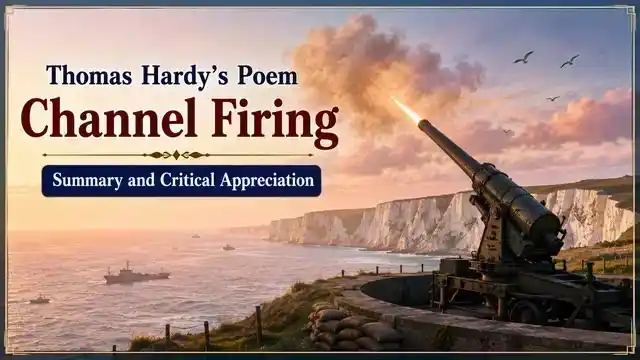
The title, “Channel Firing,” refers to the practice of conducting naval gunnery exercises in the English Channel. Hardy transforms this ordinary military event into a powerful symbolic incident. The thunderous sound of naval guns is so intense that it awakens the dead lying peacefully in their graves. Believing that the Day of Judgment has arrived, the dead rise in fear, only to discover that the terrifying noise is merely another military exercise preparing nations for future wars. This ironic situation highlights the absurdity of human civilization, where preparations for destruction have become more frequent and alarming than divine judgment itself.
The poem is narrated primarily from the perspective of the dead, with God also appearing as a speaker. This dramatic technique allows Hardy to contrast eternal spiritual values with humanity’s obsession with warfare. God remarks with bitter irony that people have become so accustomed to war that even the sound of the Last Judgment would scarcely surprise them. The dead, representing innocent victims of the past, realize that mankind has not progressed morally but continues to repeat the same cycle of violence and bloodshed. Thus, Hardy presents war not as an act of heroism but as a tragic consequence of human ignorance, pride, and ambition.
One of the poem’s greatest strengths lies in its rich use of irony. Instead of celebrating patriotism or military glory, Hardy ridicules the blind enthusiasm for armament and conflict. The peaceful dead are disturbed by the living, suggesting that the horrors created by humanity are more frightening than death itself. The poem also contains elements of black humour and satire, making its criticism of militarism even more powerful. Hardy’s prophetic vision proved tragically accurate when the First World War broke out only a few months after the poem’s publication.
Thematically, “Channel Firing” explores war, death, human folly, moral degeneration, religious symbolism, and the failure of civilization to achieve lasting peace. Hardy suggests that scientific and technological advancements have not been accompanied by moral progress. Instead of using knowledge to build a peaceful world, humanity employs it to create increasingly destructive weapons. The poem therefore serves as a timeless warning against militarism and the destructive consequences of nationalism and political aggression.
From a literary perspective, the poem is admired for its dramatic monologue, vivid imagery, conversational tone, and effective use of symbolism and irony. Hardy combines realistic details with supernatural elements to create a powerful imaginative vision that appeals both emotionally and intellectually. His simple yet expressive language makes the poem accessible, while its philosophical depth invites readers to reflect on the nature of war and human destiny.
“Channel Firing” stands as one of Thomas Hardy’s finest anti-war poems and a prophetic masterpiece of modern English literature. It condemns the futility of war, exposes the moral blindness of humanity, and urges readers to recognize the value of peace before irreversible destruction occurs. More than a century after its publication, the poem remains profoundly relevant, reminding us that unless humanity abandons its fascination with violence, the cycle of conflict and suffering will continue indefinitely.
The poem entitled “Channel Firing” is an eerie poem. It is related to the atrocities of war. It was published shortly before the beginning of World War I. This poem is a dialogue among the dead who wake up to hear the sound of roaring of gunnery practice in English Channel. In this poem, there are religious implications which are more difficult to analyse. Throughout the poem both God and the dead seem to be in agreement that men are guilty of perpetuating war. The poet, in the poem, points out that every nation is making its best efforts to invent destructive methods so that it may be able to suppress the weak nation. Every mighty nation is still in dispute with other. The powerful nations do nothing for the welfare of the humanity. This poem presents the fact that the people have lost all human qualities. They, instead of spreading the message of peace, love and humanity, are making preparations to bring bloodshed. No holy man can mend the ways of people. The sermons and the lessons of morality are meaningless for them.
Summary of the Poem:
The Disturbance of the Dead by the Firing Practice:
The speaker who is one of the dead buried in a church depicts the state before the World War I. The First World War was about to take place. The great preparations were going on before waging the war. The soldiers with their guns and cannons were making firing practice in English Channel. They were busy in day – night practice. At one night, the soldiers started firing practice with their modern and heavy guns. When a large number of heavy guns growled fire at one time, a great sound of roaring was heard. This sound of roaring disturbed the eternal peace of the dead who were lying in their graves and sleeping soundly. The dead or the corpses were startled by the sound of roaring of the guns. Their coffins buried in the ground of the church were badly shaken by the loud sound. Indeed this sound was unbearable and confusing. This sound created a kind of terrific vibration. It shattered the structure of wooden strips which enclosed the space, around the altar of a church for the clergy and choir. It also shook the other articles inside the church. The dead who woke up by hearing the sound of roaring thought that the day of judgement had approached and it was God’s loud call in the form of roaring. The dead were sleeping soundly in order to awake on this day and they were sure that it was day of judgement and God called them to present before Him. It was the day when God had to decide future destiny. The dead were ready to register their attendance before god. (It is believed that on the day of judgement all the dead or corpses wake up and present before God in order to get reward for their deeds. On this day God decides their fate).
The Dead Mistake the Gunfire for the Day of Judgement:
When the army soldiers started their firing practice in English Channel at night, a sound of roaring was heard. This roaring sound produced a kind of terrific vibration. The coffins of the dead buried in the ground, were shaken by the loud sound of roaring. The dead who were lying in their coffins peacefully and comfortably, startled to hear this roaring. They considered this roaring the loud call of God for the day of judgement. They were assumed that the day of judgement had approached, so they at once sat up to show their eagerness for this day . With the waking up of the dead at mid – night, the whole atmosphere seemed to be frightening and gloomy. When something spooky happen, the wolves and the hunting dogs become active. They felt the presence of the dead in the atmosphere and they began to cry loudly. In the church there was a table on which bread and wine were kept for the participation in Lord’s suffer. The mouse was sitting on the table and enjoying the pieces of bread , but as soon as it heard the roaring , it was badly frightened and due to utter fear it dropped the piece of bread . The small creeping creatures went back into their holes which they built in the mounds.
God Explains the Real Cause of the Roaring Sound:
The cow which was reared in the ground of the church in order to keep the grass short was grazing the grass with great joy. The saliva falling of the mouth of the cow showed that she was enjoying grazing green grass. It seemed as if it was aware of the fact. It knew that the firing practice produced the sound of roaring. The atmosphere remained frightening awesome and gloomy until God presented the truth. The dead, who mistook the roaring of the firing practice as the call of God, woke up from their eternal sleep knowing the day of judgement. God consoled them by saying that it was not His call nor it was the day of judgement. He (God) added that the sound of roaring which they (the dead) heard, was coming from the English Channel where the soldiers were practising of firing. Further God told them that no change took place in this world. This world and the nature and tendency of its people were still in the same state as they used to be when the dead went below to their graves. God clearly declared that the day of judgement had not approached yet, hence they must go again into their grave and wait for His call.
God’s Criticism of War-Loving Nations:
Every nation is participating in the race of the competition of being strong and powerful. Every nation is making its best efforts to invent destructive methods so that it may be able or efficient to suppress the weak nation or country by using destructive weapons in the war. Every mighty nation is still in dispute with other. Mostly the developed countries always remain great eager to display their power. They always remain busy in war preparations. They like to see more and more blood in Thomas Hardy 205 the battlefield. Indeed the people of these nations have become much crazy after the power and war. They have grown completely mad. Indeed these powerful nations and its people do nothing for the welfare of the humanity. They do not follow the way of Christ or the preachings of Christ. They do nothing that may bring happiness for human beings. Their deeds do not fulfil the ways of God. They have lost their mission for which they have been created. The people of these nations have lost all human qualities. They, instead of spreading the message of peace, love and humanity, are making preparation to bring bloodshed. God tells the dead that the people of these nations are not better than they. The dead are helpless because they cannot practise the preachings of Christ.
The Fate of the War-Makers on the Day of Judgement:
God keeps on observing tendency and nature of the nations of the world. Some of the nations always remain busy making the preparations of the war. They are always trying to find out new destructive methods which can bring great bloodshed and slaughter. They are ever engaged to create war – like situations. The nations which are strong and powerful are always at dispute with other nation. They are curious to wage war against the weak nation. By waging war and suppressing the weak nation, they get opportunity to display their power. God tells the dead that it is the happiest thing in the favour of those who are responsible for gunnery practice that it is not the day of judgement. He adds that if it were the day of judgement they would become the victims of God’s wrath and punishment and they instead of remaining busy in fire practice, would have been appointed on the work of cleaning the floor of Hell. In this way, they have to suffer a lot and their heinous deed would be punished.
God’s Judgement on the Sinful World:
When God Finds that the human beings of this world are completely engaged in shameful activities without knowing the consequences of their deeds, he feels pity for them and laughs at their ignorance. God tells the dead that the people do not know that they, by committing such heinous acts, are making their secured place in Hell. When God ends this sinful world, there would be more excitement on the day of judgement. There would be a huge crowd before God on the day of judgement. Under the impact of malicious feeling for the people, God says that he would not feel least sorrow after making an end of this world. For God, the end of this world seems to be very necessary. The people of this world have lost humanly virtues endowed by God. They are now full of hatred, anger and violence. They are fond of playing with human lives. They like to see more and more blood – shed and human killing. They have forgotten their missions with which they have been sent on the earth. In fact they deserve God’s hard punishment. God thinks that eternal rest seems more suited to the human condition. In such circumstances when this world is plunged into bloodshed, anarchy and violence, it becomes essential for God to provide an eternal rest to the people of this world.
The Dead Return to Their Graves with Doubts About Humanity:
When the dead, on hearing the sound of roaring of the firing practice woke up with great surprise and thought this roaring the call of God on the day of judgement, God consoled them by saying that it was not his call, but it was the sound of roaring of the firing practice going on in English Channel at night. He also told them that it was the preparation before waging the war. He (God) made a long discussion about the people of the world. When God’s discussion is over, the dead decide to lay down again in their dark graves. They wish again the sound and peaceful sleep until the day of judgement approaches. In meanwhile one of the dead feels great discomfort at the conflicting nature of the people of the world. He greatly wonders whether the people would achieve sensibility and would be able to appreciate humanly virtues. He thinks whether the people would carry out the message of God. He thinks whether the people would ever learn the lesson of peace, love, humanity, brotherhood and neighbourhood. In fact it would always be as confusing as when that dead person was alive.
The Dead Parson’s Regret and the Failure of His Preaching:
One of the dead expresses his opinion about the nature and tendency of those who are always busy creating war – like situations. He thinks that these wars – makers perform a great role to bring destruction for mankind. These people are involved in merciless slaughter and blood – shed. In order to get the better consequences of war, they do not hesitate to sacrifice many innocent people. The dead wonders and thinks whether these war – makers would ever achieve sanity. Perhaps, in his opinion, it was impossible. All the dead listened him and one of them shook his head in the approval of his observation. There was another dead who had been serving in a church as a parson for forty years. He had seen delivering sermons for forty years. In this way, he spent a holy life for the welfare of mankind. He had been making his best efforts to bring the people on the path of morality. But it was regrettable that he could not success to bring the change in nature and tendency of the war – makers. His lesson of love and peace proved to be futile for them. Now he greatly regrets at the wastage of forty years of his life. The dead parson wishes that it would have been better had he spent his days on earth in merry – making. He wishes he would have just smoked and drank instead of preaching.
The Final Reflection on Humanity and the Inevitability of War:
In fact there were many questions which were lingering in their minds but every question was unanswerable. They thought whether humanity would ever learn from its past mistakes and whether the war makers would ever attempt to make the life on earth better and happier. But all these questions drowned as the roaring of the guns started again. The roaring of the guns had already announced the approach of war. Those who were the war – makers and encouraged the wars were greatly curious to attack their enemy. They had great enthusiasm for the war. Hence, they insisted on much firing practice. They wanted to display their power in war. They were also determined to suppress their enemy. The sound of the roaring guns could be heard away from the sea or border as Stourton, Camelot and Stonehenge. These three places were geographically far apart. In poet’s opinion they also symbolised the different ages that war had taken place. These places represented 19th century, the time of King Alfred the Great; to the legendary times of King Arthur of Camelot; and even further back, to the Neolithic times of druids.
A Powerful Anti-War Poem:
The central theme of Channel Firing is the futility and horror of war. Hardy condemns mankind’s fascination with military power and exposes the devastating impact of war on both the living and the dead. The soldiers’ practice firing in the English Channel is so violent that it disturbs the graves of the dead, suggesting that modern warfare has become so destructive that even death offers no peace. Hardy presents war as an endless cycle of violence that humanity refuses to abandon despite centuries of suffering.
Critical Appreciation of the Poem:
Introduction:
The poem “Channel Firing” is an eerie poem. It is a poem about the atrocities of war. It was published shortly before the beginning of World War I. It is a dialogue among the dead who are awakened by the naval ‘great guns’ firing artillery in the English Channel. It (the poem) seems almost prophetic. It not only decries the barbaric nature of war — an institution so vile and obnoxious that in this poem it awakens the dead – but also questions our inability to break our addiction to that institution. Less clear, however, is the answer to a question Hardy seems to be posing is it our plight to be perpetually engaged in quests for power and vengeance, rendering us unworthy of God’s call to judgement, or it is our plight that a sneering, uncaring god for sakes us in our time of need? The religious implications of this poem are more difficult to analyse than the political and social implications because they are more subtle. Throughout the poem both God and the awakened skeletons seem to be in agreement that men are guilty of perpetuating war.
A Powerful Anti-War Poem:
The central theme of Channel Firing is the futility and horror of war. Hardy condemns mankind’s fascination with military power and exposes the devastating impact of war on both the living and the dead. The soldiers’ practice firing in the English Channel is so violent that it disturbs the graves of the dead, suggesting that modern warfare has become so destructive that even death offers no peace. Hardy presents war as an endless cycle of violence that humanity refuses to abandon despite centuries of suffering.
Prophetic Vision of the First World War:
One of the most remarkable aspects of the poem is its prophetic nature. Although written before the First World War officially began, Hardy accurately sensed the growing political tensions and military preparations across Europe. The poem predicts that the world is moving toward a catastrophic conflict. His vision proved tragically accurate when World War I broke out later in 1914, making Channel Firing one of literature’s most significant prophetic poems.
Irony and Satire:
Irony is the poem’s strongest literary device. The dead mistakenly believe that the sound of naval guns is the Last Judgment, expecting the end of the world. Instead, they discover that it is merely another military exercise. This ironic contrast reveals that mankind has made war so common that even the terrifying sounds traditionally associated with divine judgment are now ordinary military activities.
Hardy also employs satire to ridicule politicians, military leaders, and nations that proudly prepare for war while claiming to uphold civilization and peace. The poem suggests that humanity has failed to learn from history and continues to glorify violence.
The Voice of the Dead:
An unusual and striking feature of the poem is Hardy’s use of the dead as speakers. The dead soldiers, buried in churchyards, are awakened by the thunder of naval guns and believe that Judgment Day has arrived. Their conversation creates a haunting atmosphere and allows Hardy to compare earthly warfare with divine judgment.
The dead represent wisdom gained through experience. Having already witnessed the horrors of life and war, they recognize the absurdity of humanity’s endless conflicts. Their peaceful rest is disturbed not by God but by human violence, emphasizing the unnatural character of modern warfare.
Religious Symbolism and Biblical References:
Hardy uses several biblical images throughout the poem. References to Judgment Day, Gabriel’s trumpet, God, and the resurrection of the dead create a strong religious framework. However, Hardy ironically reverses traditional Christian expectations.
Instead of the Last Judgment being announced by heavenly trumpets, it is confused with the roar of modern naval guns. Even God appears almost amused by humanity’s foolishness, remarking that people continue preparing for war rather than spiritual salvation. This inversion questions humanity’s moral priorities and exposes its misplaced values.
Contrast Between Divine Judgment and Human Destruction:
The poem draws a sharp contrast between God’s final judgment and mankind’s endless wars. Divine judgment is associated with justice, truth, and moral accountability, while human warfare represents chaos, destruction, and meaningless violence.
Hardy suggests that humanity has become so accustomed to war that it has replaced spiritual concerns with military ambition. Instead of fearing divine punishment, people fear enemy nations and devote themselves to developing increasingly powerful weapons.
Theme of Human Folly:
Hardy repeatedly emphasizes human foolishness. Nations continue inventing deadlier weapons despite knowing the terrible consequences of war. Scientific and technological progress, instead of improving human life, has been misused to create more efficient methods of destruction.
The poem argues that civilization has advanced materially but not morally. Human intelligence has produced modern battleships and powerful guns, yet humanity remains incapable of achieving lasting peace.
Death and the Loss of Peace:
Death usually symbolizes eternal rest, but Hardy challenges this traditional idea. The explosions of naval guns awaken the dead from their graves, suggesting that modern warfare destroys even the peace of death. The dead cannot escape the violence created by the living.
This image powerfully illustrates the far-reaching consequences of war, which affect not only soldiers on the battlefield but also future generations and collective human memory.
Tone and Mood:
The poem maintains a serious, ironic, and deeply pessimistic tone. Its mood shifts between mystery, fear, satire, and tragic reflection. The eerie conversation among the dead creates a supernatural atmosphere, while God’s comments introduce bitter irony.
Hardy expresses disappointment with human civilization, portraying mankind as incapable of learning from history. Despite religious teachings and past disasters, people continue preparing for larger and more destructive wars.
Use of Dramatic Monologue and Dialogue:
Although not a traditional dramatic monologue, the poem is highly dramatic because it consists of conversations among the dead and between the dead and God. These dialogues make the poem vivid and engaging while allowing Hardy to present different perspectives on war, religion, and human behavior.
The dramatic structure also intensifies the poem’s emotional and philosophical impact.
Imagery and Symbolism:
Hardy employs vivid imagery throughout the poem. The roaring naval guns, trembling graves, frightened skeletons, sleeping churchyard, and the imagined resurrection create unforgettable visual and auditory effects.
Important symbols include: Channel Firing – symbolizes military aggression and preparation for war. The Churchyard – symbolizes peace, memory, and eternal rest. The Dead – symbolize historical experience and moral wisdom. God – symbolizes divine judgment and moral authority. The Naval Guns – symbolize modern technology used for destruction rather than progress.
These symbols deepen the poem’s philosophical meaning and strengthen its anti-war message.
Language and Style:
Hardy’s language is simple yet highly expressive. He combines everyday speech with biblical diction, creating a unique mixture of realism and religious symbolism. The conversational style makes the philosophical ideas more accessible while maintaining dramatic intensity.
The poem’s rhythmic movement, vivid descriptions, irony, and symbolic language contribute to its lasting literary power.
Universal Relevance:
Although inspired by the political situation before World War I, Channel Firing remains universally relevant. Wars, military conflicts, nuclear threats, and global tensions continue to challenge humanity today. Hardy’s warning that civilization risks destroying itself through violence remains as meaningful in the twenty-first century as it was in 1914.
The poem reminds readers that true human progress depends not only on scientific advancement but also on moral wisdom, compassion, and peace.
Conclusion:
Thomas Hardy’s “Channel Firing” is a timeless masterpiece of anti-war literature that combines prophecy, irony, religious symbolism, and dramatic imagination to expose the madness of war. By awakening the dead with the sound of naval gunfire and contrasting human violence with divine judgment, Hardy presents a powerful criticism of militarism and humanity’s failure to learn from history. The poem’s vivid imagery, philosophical depth, dramatic dialogue, and universal message make it one of Hardy’s greatest achievements. Even today, Channel Firing serves as a compelling reminder that war brings only destruction, while peace remains the highest aspiration of civilized humanity.