Introduction:
Thomas Gray as a Great Transitional, Romantic, and Classical Poet of the Eighteenth Century is one of the most significant figures in the history of English literature. Although he wrote comparatively few poems, his literary achievement is remarkable for its depth of thought, artistic perfection, and emotional richness. Gray occupies a unique position in the eighteenth century because his poetry forms a vital bridge between the rational, polished spirit of the Neo-Classical Age and the imaginative, emotional, and nature-loving ideals of the Romantic Movement. For this reason, he is rightly regarded as a transitional poet.
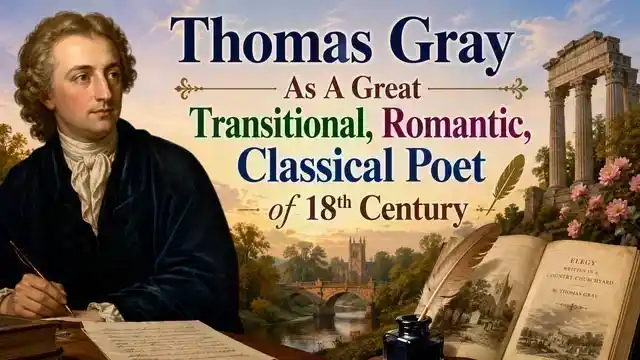
As a Classical poet, Gray inherited the eighteenth-century ideals of order, balance, restraint, elegance, and meticulous craftsmanship. His poems exhibit refined diction, polished style, learned allusions, and adherence to artistic discipline. At the same time, he anticipated the Romantic spirit through his profound love of nature, sympathy for ordinary people, fascination with solitude, melancholy, medievalism, imagination, and deep emotional expression. These qualities distinguish him as one of the important forerunners of English Romanticism.
Gray’s masterpiece, “Elegy Written in a Country Churchyard,” perfectly illustrates this harmonious blend of classical perfection and romantic sensibility. It reflects universal human emotions, celebrates the dignity of humble rural life, and meditates on mortality with philosophical depth and poetic beauty. Thus, Thomas Gray stands as a remarkable literary figure whose poetry successfully unites the finest elements of Classicism and Romanticism, making him one of the greatest transitional poets of the eighteenth century.
Elements of Romanticism:
Gray has a deep faith in romanticism. Gray is a great transitional poet who displays romantic qualities like interest in natural inspired music and poetry, common man, high imagination, strong emotions supernatural. Besides, he shows classical qualities also.
Interest in Common Man:
In ‘The Bard’ he challenges Royal authority and stands with Welsh bards. His sympathies are always for the common, the poor, the sufferer and the helpless. He accounts for the miseries of common people. In ‘The Progress of Poesy’ he writes that unfortunate mankind suffers from hard labour miserable poverty and intolerable pains. There are deadly diseases, heart breaking sorrows, untimely deaths and no shelter against injustice of misfortunes.
“Disease, and Sorrow’s weeping train,
And Death, sad refuge from the storms of Fate!”
In ‘Elegy’ also he pleads for unfortunate farmers who suffered on account of poverty and want of proper opportunity in spite of their great talent.
“Full many a flower is born to blush unseen
And waste its sweetness on the desert air.”
Interest in High Imagination:
To soar high on the viewless wings of imagination is a romantic quality, and Gray has deep interest in it. Gray’s faculty of imagination is very high. ‘The Bard’ is an ideal example to prove that. It is the poet’s own invention of imagination that an old bard was somehow left alive and he was allowed to curse the king for such a long period. He went on cursing Edward’s generation after generation and no soldier killed him. The sight of ghosts of dead bards is another example of imagination. In “The Progress of Poesy” it is the poet’s own invention of imagination that Milton became blind for he tried to violate human limits. He made an extraordinary flight on his wings of inspired imagination. He tried to know the mystery of the Universe. He appeared in front of the Almighty. Milton dared to see the almighty and watch his activity. He suffered from loss of sight caused by witnessing dazzling light. It was his destiny to be blind forever.
“The living Throne, the sapphire-blaze,
Where Angels tremble, while they gaze,
He saw; but blasted with excess of light,
Closed his eyes in endless night.”
Interest in the Supernatural:
Romantics take a deep interest in what is uncommon or strange. It is therefore they take interest in the supernatural. Gray’s interest in the supernatural is exposed in “The Bard” when the ghosts of dead bards appear before the old bard.
Elements of Classicism:
Being a transitional poet, Gray shows his faith in classicism also. Gray is a great transitional poet who displays romantic qualities. Besides, he shows classical qualities like use of poetic diction, sensuous art, myth-making and symbolism. He takes interest in complex structure of odes. He has a strong faith in classical traditions.
Use of Poetic Diction:
Romantics believe in simple language really spoken by common people but Gray has no faith in it. Gray uses dignified language in his poems. ‘The Bard’ is an ode. Accordingly the poet uses dignified language decorated with artistic ornaments. In the following line he uses the figure of speech alliteration:
“Frowns o’er old Conway’s foaming flood.”
Likewise in ‘The Progress of Poesy’ the poet uses the figure of speech alliteration:
“Awake, Aeolian lyre, awake,
And give to rapture all thy trembling strings.”
Gray uses archaic words and indirect expressions. In ‘The Bard’ for poetry he uses Poesy and for Pindar’s lyre he uses the phrase Aeolian lyre. He refers to Shakespeare and Milton in a highly dignified language. In ‘The Progress of Poesy’ for Welsh he uses ‘Cambria’ and for wife he uses the phrase ‘half of the heart’. He refers indirectly to Shakespeare and Milton. Gray’s style becomes artificial when he employs artistic devices of myth making and symbolism. For example he takes interest in personifications in excess. In ‘Elegy’ it is found frequently in expressions like: Let not Ambition…Nor Grandeur hear…Can Honour’s voice…But Knowledge to their…
Interest in Myth-making and Symbolism:
Gray has great interest in myth-making. For example in ‘The Progress of Poesy’ the poet makes a myth of Milton’s blindness. He imagines that Milton became blind for he tried to violate human limits. He made an extraordinary flight on his wings of inspired imagination. He tried to know the mystery of the Universe. He went beyond the earth to heaven and hell that are surrounded with flames. He appeared in front of the almighty. It is a truth that even angels tremble in fear before the Almighty who sits on a throne producing the dazzling shine. Milton dared to see the almighty and watch his activity. He suffered from loss of sight caused by witnessing dazzling light. Gray takes interest in symbolism. For example in ‘Elegy’ he writes about the misfortunes of poor villagers in the following words:
“Full many a gem of purest ray serene,
The dark unfathomed caves of ocean bear:
Full many a flower is born to blush unseen,
And waste its sweetness on the desert air.”
Here gems and flowers are symbols of poor farmers. Gray’s art of myth-making and symbolism is remarkable.
Sensuous Art:
Gray’s sensuous art enables him to draw lively pictures in words. For example the poet asks to look at his chariot of poetry running in speed for it is driven by two fast horses. It is great example of the poet’s sensuous art. In fact these horses represent Dryden’s use of couplets in his poetry. Dryden perfected these couplets and made them popular enough to be adopted by a generation of poets.
“Behold, where Dryden’s less presumptuous car,
Wide o’ver the fields of Glory bear
Two Coursers of ethereal race,
With necks in thunder cloath’d, and long-resounding pace.”
Thus, Gray is a great transitional poet who displays romantic qualities like interest in natural inspired music and poetry, common man, high imagination, strong emotions. Besides, he takes interest in classical qualities like use of poetic diction, sensuous art, myth-making, symbolism, complex structure of odes and classical traditions.