Introduction:
The World Is Too Much With Us is one of the finest sonnets by William Wordsworth (1770–1850), the greatest poet of the Romantic Age in English literature. The poem was composed around 1802 and was later published in Poems, in Two Volumes (1807). It reflects Wordsworth’s deep concern over the growing influence of materialism, industrialization, and commercialism, which, according to him, have alienated human beings from the beauty and spiritual significance of nature. Written in the form of a Petrarchan (Italian) sonnet, the poem expresses the poet’s disappointment with a society that values wealth and worldly possessions more than the natural world.
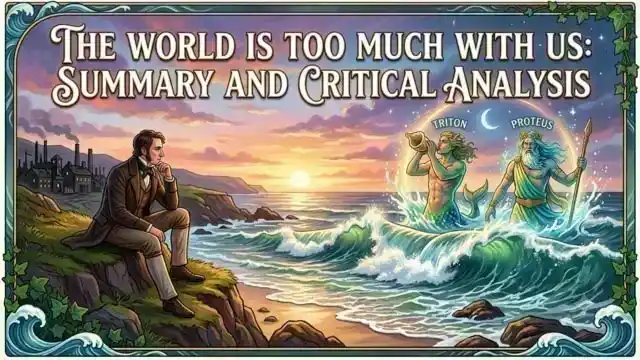
The central theme of the poem is the conflict between material progress and spiritual fulfillment. Wordsworth argues that modern people have become so occupied with earning and spending that they have lost their ability to appreciate nature’s beauty and divine presence. As a devoted worshipper of nature, he believed that nature is not merely a source of physical pleasure but also a teacher, guide, and spiritual force capable of elevating the human soul. The poem strongly criticizes the mechanical and commercial spirit of the Industrial Revolution, which has weakened humanity’s emotional and spiritual connection with the natural environment.
In this sonnet, Wordsworth laments that people have “given their hearts away,” sacrificing their inner sensitivity for material gain. He mourns the loss of reverence for the natural world and longs for a time when humanity felt a closer relationship with nature. In one of the poem’s most striking expressions, he even declares that he would rather be a Pagan than a modern person devoid of spiritual awareness because ancient pagan beliefs allowed people to perceive divinity in nature. Through references to the sea-god Proteus and the sea-deity Triton, Wordsworth emphasizes his desire to regain a sense of wonder and spiritual vision.
The poem is rich in Romantic ideals, highlighting imagination, emotion, simplicity, and the healing power of nature. It also reflects Wordsworth’s belief that excessive attachment to material possessions leads to spiritual emptiness, whereas communion with nature brings peace, wisdom, and moral strength. Although written in the early nineteenth century, the poem remains remarkably relevant today, as modern society continues to struggle with consumerism, environmental degradation, and the increasing separation of human life from the natural world.
Thus, The World Is Too Much With Us is not merely a criticism of materialistic civilization but also a passionate appeal to restore humanity’s lost relationship with nature. Through its powerful imagery, emotional intensity, and philosophical depth, the poem stands as one of Wordsworth’s most memorable works and a timeless reminder that true happiness and spiritual fulfillment lie not in wealth and possessions but in living harmoniously with the natural world.
Summary of the poem
Stanza 1:
Now-a-days the people run after money. Every time they think of it. Earning and spending it has been their sole aim. In this way, much of their power is wasted. They find no time to look at and appreciate the objects of Nature that are made for them. Alas, they have bargained their hearts to money. It is certainly a mean thing. People, engrossed in materialism, have no love left for this sea which is lying unclothed, with the moonlight falling directly on her. The winds that will be crying the whole day are quite calm now just like the unmoving flowers during the night. This beautiful scene, too, does not affect the worldly men. They have no liking for such charming scenes of Nature.
Stanza 2:
No natural scene brings any comfort to the people. The poet, showing his disgust to such people, says that it would have been far better if he were even a Pagan, away from this Christianity (who has made people so money-minded). By being a Pagan he, sitting on this meadow, might see several gods and goddesses in Nature thereby feeling less lonely. Then he might also see sea-god Proteus, coming out of the sea and hear old Triton pacifying the turbulent waves by blowing his conch.
Critical Analysis of the Poem:
Introduction of the poem:
The poem “The World Is Too Much With Us” was first published in 1807 and later on included in “Miscellaneous Sonnets”. It is based on the poet’s actual observation of life. This is one of the most famous sonnets of Wordsworth. He wrote this poem in reaction against the ugliness of the growing materialism of the nineteenth century. He wrote it with a view to give a clarion call to people to go back to Nature. He deplores the gross materialism and spiritual downfall of human beings. Wordsworth was really disappointed to see the evil effects of the Industrial Revolution. The increasing materialism replaced love of Nature, and man was getting more and more materialistic. The same ideas have been very aptly depicted by the poet in the sonnet.
Thought-Content:
The poet has condemned the materialistic tendencies of his age for they made people heartless and insensitive to everything that was beautiful and wholesome in life. People became so much occupied with the art of getting and spending that they were completely alienated from Nature and Art. They gambled away their natural powers for sordid things. The beauties and messages of Nature became meaningless to them in the face of gross materialism. They were completely blind to the beauty of the moon, the sea and the calm evening. The beautiful scenes of Nature failed to make an appeal to their stony hearts. The poet was so much disgusted with the fever and the fret of his age that he preferred to give up Christianity and embrace the Greek Paganism with its worship of Nature inhabited by gods and goddesses. He would, then, establish a spiritual communion with Nature and not feel alienated.
Form:
The sonnet is fashioned after the Miltonic sonnet. As such, it consists of two parts: the octave and the sestet. The octave has two quatrains and the sestet two tercets. There is a pause at the end of each quatrain. The turn of thought falls after the octave. The rhyme-pattern of this sonnet is as follows: abbaabbacdcdcd.
Diction:
The poem is remarkable for its lyrical flow, poetic beauty and excellence of craftsmanship. The graphic picture of the sea baring her bosom to the moon and the winds upgathered like sleeping flowers, the appropriate use of the Greek mythological allusions, and the simplicity and monosyllabic nature of words—these are some noticeable features of this poem. The poem composed under the laws of poetic beauty and poetic truth has high seriousness in thought and grandeur in diction and style.
Moral lesson of the poem:
This poem shows Wordsworth’s disgust with the materialistic world and its ways, and expresses his essential faith in the greatness of Nature.
An attack of gross Materialism:
The sonnet is a sea-sathing attack on the gross materialism and ironiquent moral and spiritual decay of the people of his times. The poet laments:
“The world is too much with us; late and soon,
Getting and spending, we lay waste our powers,
Little we see in Nature that is ours;
We have given our hearts away…….”
Love for Nature:
These lines testify how much Wordsworth loved Nature. Here he reminds us that Nature has something for us which no worldly thing can provide. He says that Nature gives us spiritual pleasure and peace.
Conclusion:
Thus, we can say that the world is too much with us in one of the very important poems of Wordsworth written on Miltonic sonnet patterns.