Introduction:
Dramatic irony is one of the most remarkable artistic techniques employed by William Shakespeare in The Merchant of Venice. It occurs when the audience possesses knowledge that the characters in the play do not, creating suspense, humour, emotional intensity, and deeper meaning. Shakespeare masterfully uses dramatic irony to expose the contrast between appearance and reality, reveal the weaknesses of human judgment, and emphasize the themes of love, friendship, justice, mercy, prejudice, and fate. Through this technique, the audience anticipates the consequences of the characters’ actions long before the characters themselves become aware of the truth.
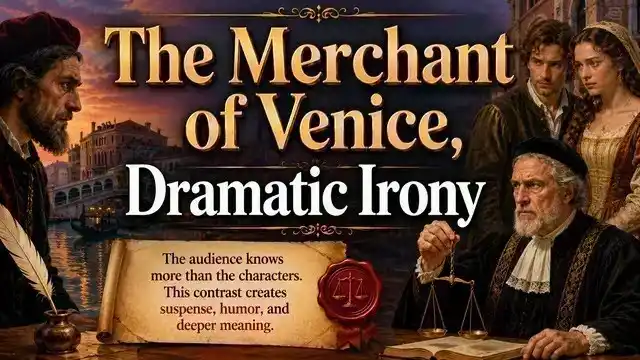
From the opening scenes to the final act, The Merchant of Venice is filled with situations in which the audience knows more than the characters. Antonio confidently signs Shylock’s bond without realizing the disastrous consequences that await him, while the audience senses the danger hidden behind Shylock’s seemingly reasonable agreement. Similarly, Bassanio chooses the correct casket without fully understanding Portia’s earlier hints, and later fails to recognize Portia and Nerissa when they appear disguised as the learned lawyer and her clerk. The audience, however, is fully aware of their true identities, making these scenes both entertaining and dramatically effective. Even the famous courtroom scene derives much of its power from dramatic irony, as the audience knows that Portia’s disguise conceals the very person who will rescue Antonio from certain death.
Shakespeare also employs dramatic irony to deepen the moral and psychological dimensions of the play. Characters frequently misjudge one another on the basis of outward appearances, while the audience perceives the hidden reality. Shylock believes he is on the verge of achieving his long-awaited revenge, but the audience gradually realizes that his triumph will soon turn into defeat. Likewise, the ring episode becomes highly amusing because the audience knows that Bassanio and Gratiano unknowingly give away the rings to their own wives in disguise, creating comic tension and preparing for the humorous resolution in Belmont.
Thus, dramatic irony serves not merely as a source of entertainment but as a powerful dramatic device that enriches the structure and meaning of The Merchant of Venice. It heightens suspense, strengthens characterization, reinforces the central themes, and keeps the audience intellectually and emotionally engaged throughout the play. Shakespeare’s brilliant handling of dramatic irony transforms ordinary incidents into memorable dramatic moments, making The Merchant of Venice one of the finest examples of his theatrical craftsmanship.
Meaning and Importance of Dramatic Irony:
The device makes the drama real as it brings it nearer to life. The life is full of ironies. It also teaches the moral lesson of humility and gentleness. It is a device which a dramatist makes use in a play frequently in order to make some part of a scene or some conversation very effective. It is called dramatic because, dramatist is frequently in habit of using it. If it is used in a tragedy, it is known as “tragic irony”; if it is used in comedy, it is known as comic irony. When the turn of events contradicts the hope and expectation we have an instance of “dramatic irony” in a play. A character may boast of something but has to bite the dust is a case of dramatic irony. The fate jeers and mocks at the character and the character himself stands bewildered and confounded.
Dramatic Ironies in the Play:
The Play The Merchant of Venice abounds in the instances of dramatic ironies as the master dramatist has made an excellent use of this device to make the play artistically grand and realistic. When Shylock incorporates the words “an equal pound of flesh in his bond the dame fortune frowned on him and smiled on Antonio. Portia exploits the expression and asks Shylock to cut “an equal pound of Antonio’s”, neither more nor less. The words recoiled on him and throw him off balance and he never recovered. In this way, the words incorporated to ruin Antonio demolish Shylock himself. Similarly, we have innumerable instances in Trial Scene itself. When the trial seems to proceed in Shylock’s favour, Shylock’s joy and admiration incarnate and calls Portia Deniel etc. But all these epithets prove ironical when the trial takes the abrupt turn by Shylock’s own doing Gratiano hunts them back at Shylock and the confounded Jew is overwhelmed.
Similarly the Princess of Morocco and Arragon have an overweigh estimate of their worth and virtue but their rewards are ironical. Many of their utterances are also ironical. The Prince of Morocco considers himself “a golden mind” and when he opens the golden casket he finds a “death’s head”-ironical. Similarly the silver casket promises to give what the chooser deserves and the Prince of Arragon deserves a blinking idiot.
There are three main varieties of dramatic irony:
1. The Irony of Action.
2. The Verbal Irony.
3. The Prophetic Irony.
1. The Irony of Action:
A character in the play performs an action in the full belief that he is acting properly; he performs the act because he does not know certain facts which, however, are known to the audience. The audience knows that the belief of the character is mistaken. Here we have the irony of action or the irony of incident. This variety is illustrated by The Merchant of Venice.
In Act IV, scene I Bassanio sends his ring after the young lawyer who has saved the life of Antonio, because he believes that the lawyer is a male; but the audience knows that the lawyer is Portia, Bassanio’s wife. This gives a pleasant frame of mind to the audience. Gratiano does an action which is similar to Bassanio’s action, He gives the ring to the lawyer’s clerk, thinking that the clerk is a male; but the audience knows that the clerk is Nerissa. Here we have the irony of action or incident.
2. The Verbal Irony:
A character speaks something in ignorance of certain facts which are known to the audience. This variety is also illustrated in The Merchant of Venice. In Act IV, scene I Bassanio says—
“I am married to a wife
Which is as dear to me as life itself;
But life itself, my wife, and all the world,
I would lose all, ay, sacrifice them all
…………to deliver you.”
Here we have the verbal irony because he speaks these sentiments when, as he thinks, his wife is absent; but the audience knows that his wife is present because the lawyer is Portia.
Similarly in Act V, scene I, Gratiano describes the lawyer’s clerk to whom he had given the ring as-
“A Kind of boy, a little scrubbed boy,
No higher than thyself….. .etc.”
Here Gratiano does not know that he is describing his wife; he does not know that the clerk was Nerissa; but the audience knows it. Here Gratiano speaks something in ignorance of certain facts which are known to the audience. Hence we have verbal irony here.
3. The Prophetic Irony:
Prophetic irony, also known as dramatic foreshadowing, is a literary device in which a character unknowingly predicts future events through words or actions. The audience understands the hidden meaning of these statements, while the speaker remains unaware of their true significance. In The Merchant of Venice, William Shakespeare skilfully employs prophetic irony to create suspense, deepen characterization, and reinforce the themes of justice, mercy, love, fate, and appearance versus reality. The play is filled with remarks that later prove to be remarkably true, making the unfolding events appear both inevitable and dramatically satisfying.
Meaning of Prophetic Irony:
Prophetic irony occurs when a character makes a statement that unknowingly foretells future events. These predictions are not deliberate prophecies; rather, they gain significance only after subsequent events unfold. Shakespeare uses this technique to keep the audience engaged while highlighting the unpredictable workings of destiny.
Examples of Prophetic Irony in The Merchant of Venice:
1. Antonio’s Mysterious Sadness
At the beginning of the play, Antonio says:
“In sooth, I know not why I am so sad.”
Antonio cannot explain his sadness, yet it foreshadows the severe misfortunes awaiting him. His ships are believed to be lost, he becomes unable to repay Shylock’s loan, and he faces the terrifying possibility of losing a pound of his flesh. His unexplained melancholy anticipates the suffering that dominates the central conflict of the play.
2. Bassanio’s Borrowing of Money
Bassanio tells Antonio that if he is provided with money, he will recover both the old debt and the new one:
“To you, Antonio, I owe the most, in money and in love.”
Although Bassanio sincerely believes his plan will succeed, his borrowing indirectly places Antonio in deadly danger. What appears to be an ordinary financial arrangement becomes the cause of the famous bond with Shylock. His confidence ironically foreshadows the crisis.
3. Antonio’s Confidence in His Ships
Antonio confidently declares that his wealth is secure because his ships are spread across different seas and ports. He believes there is little chance of losing everything at once.
Ironically, almost all reports later indicate that his ships have been wrecked, leaving him unable to repay Shylock. His confidence in worldly fortune is shattered, demonstrating the uncertainty of material wealth.
4. Shylock’s Bond
When Shylock proposes the bond requiring a pound of Antonio’s flesh, he calls it:
“This is a merry bond.”
The phrase appears humorous and harmless at first. However, it later becomes the basis of a life-threatening legal dispute. What is presented as a friendly joke transforms into a deadly demand, making the statement prophetically ironic.
5. Portia’s Prayer Before the Casket Test
Before Bassanio chooses among the three caskets, Portia expresses both hope and fear because she genuinely loves him.
Although she cannot predict the outcome, her words foreshadow Bassanio’s successful choice of the lead casket, resulting in their marriage and the eventual resolution of many conflicts.
6. Morocco’s Choice of the Gold Casket
The Prince of Morocco chooses the gold casket believing that:
“Who chooseth me shall gain what many men desire.”
His belief that external beauty represents true worth proves entirely false. Inside he finds a skull and a disappointing message. His choice prophetically illustrates one of the play’s central lessons—that appearances are deceptive.
7. Jessica’s Escape
Jessica tells Lorenzo that she is ashamed of being Shylock’s daughter and hopes for a happier future with him.
Her escape indeed leads to a new life as Lorenzo’s wife, but it also becomes the beginning of Shylock’s emotional collapse. Her departure foreshadows the complete destruction of Shylock’s domestic happiness.
8. Portia’s Speech on Mercy
Portia declares:
“The quality of mercy is not strain’d.”
This speech appears to be a moral appeal to Shylock. When he refuses mercy, he himself later requires mercy from the Venetian court. Thus, his rejection of mercy prophetically leads to his own downfall.
9. Gratiano’s Warning to Shylock
Gratiano repeatedly criticizes Shylock for his cruelty during the trial.
His harsh comments foreshadow that Shylock’s insistence on strict justice will ultimately turn against him, resulting in the loss of his wealth, his religion, and his legal rights.
10. Antonio’s Final Good Fortune
Throughout the trial Antonio appears certain to die. However, after the judgment, news unexpectedly arrives that several of his ships have safely returned.
The apparent certainty of tragedy gives way to unexpected happiness, fulfilling the play’s pattern of ironic reversals.
Functions of Prophetic Irony in the Play:
1. Creates Suspense:
Prophetic irony builds anticipation by allowing the audience to sense that significant events are approaching.
2. Strengthens the Theme of Fate:
The repeated foreshadowing suggests that human beings cannot completely control their destiny.
3. Reveals Character:
Characters unknowingly expose their strengths, weaknesses, hopes, and fears through statements that later become true.
4. Reinforces Moral Lessons:
The play repeatedly teaches that greed, revenge, pride, and excessive confidence often lead to ruin, while mercy, wisdom, and humility bring happiness.
5. Unifies the Plot:
The various prophetic statements connect the different episodes of the play, making the conclusion appear natural and dramatically satisfying.
Critical Appreciation:
Shakespeare’s use of prophetic irony is one of the finest artistic features of The Merchant of Venice. Nearly every major character unknowingly contributes to the foreshadowing of future events. Antonio’s sadness, Bassanio’s confidence, Shylock’s “merry bond,” Portia’s hope, and the casket inscriptions all prepare the audience for later developments. These prophetic moments heighten dramatic tension while emphasizing the themes of justice, mercy, appearance versus reality, fortune, and divine providence.
Unlike direct prophecy, Shakespeare’s prophetic irony emerges naturally through ordinary conversation. This subtle technique makes the play psychologically convincing and dramatically powerful. The audience enjoys the irony of recognizing meanings that the characters themselves cannot foresee.
Conclusion:
Prophetic irony is an essential dramatic technique in The Merchant of Venice. Shakespeare masterfully uses seemingly ordinary remarks to foreshadow later events, thereby creating suspense, enhancing characterization, and reinforcing the play’s moral and philosophical themes. Through prophetic irony, the playwright demonstrates that human beings often speak truths about their future without realizing it, making the play both intellectually engaging and artistically memorable.