Introduction:
The Family Reunion is one of T. S. Eliot’s most profound and intellectually challenging verse plays, first performed in 1939. It marks a significant stage in Eliot’s dramatic career, blending elements of Greek tragedy, Christian theology, modern psychology, and poetic symbolism into a powerful exploration of the human condition. The play revolves around Harry, Lord Monchensey, who returns to his ancestral home, Wishwood, for his mother’s birthday after the mysterious death of his wife. As the story unfolds, Harry confronts haunting memories, feelings of guilt, spiritual anguish, and a compelling desire for redemption, while his family remains trapped in conventional values and emotional sterility.
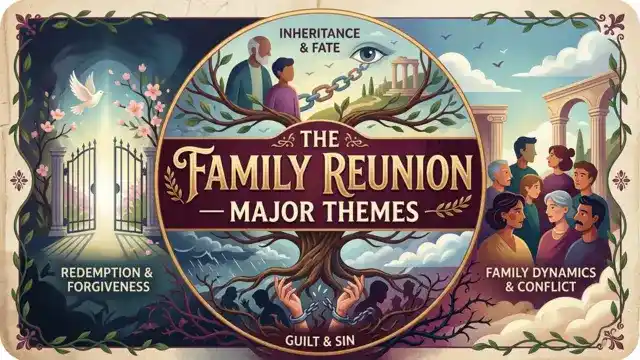
The major themes of The Family Reunion are deeply philosophical and spiritual, reflecting Eliot’s belief that modern humanity suffers not only from psychological conflicts but also from a profound spiritual emptiness. Through Harry’s inner journey, Eliot explores themes such as guilt and sin, crime and punishment, spiritual awakening, redemption, alienation, the conflict between worldly obligations and divine vocation, family relationships, fate, tradition, and the search for identity and meaning. The play presents the idea that true liberation can only be achieved through self-realization, repentance, and acceptance of one’s spiritual destiny rather than through material success or social acceptance.
Eliot also employs the myth of Orestes, biblical symbolism, and the concept of the Furies (Eumenides) to connect ancient Greek tragedy with Christian ideas of forgiveness and salvation. Unlike classical tragedy, where destiny is often determined by external forces, The Family Reunion emphasizes the individual’s inner moral struggle and the possibility of spiritual transformation through divine grace. The family members represent the stagnant values of the modern aristocracy, whereas Harry emerges as a seeker of higher truth, ultimately choosing a path of spiritual commitment over worldly comfort.
Thus, The Family Reunion is not merely a domestic drama but a profound religious and psychological study that examines the complexities of human conscience and the quest for spiritual fulfillment. Its major themes reveal Eliot’s conviction that suffering, when accepted with faith and humility, becomes a means of purification and redemption. Consequently, the play stands as one of the finest examples of modern poetic drama, offering timeless insights into the relationship between guilt, faith, destiny, and the ultimate purpose of human life.
Three Major Themes in the Play:
First, there is the theme of sin and expiation and atonement for that sin through suffering. Secondly, there is the theme of the oneness of time, the continuity of the past, the present, and the future, a theme which constantly recurs in the works of Eliot. Thirdly, there is the theme of spiritual loneliness and isolation and the difficulty of communicating these spiritual states. The three themes have been closely interrelated and merged and fused.
The Central Theme of Sin and Expiation:
The central theme of the play is the theme of sin and expiation. Harry, Lord Monchensey kills his wife (or at least he imagines that he has killed her) by throwing her over the rails into the sea. Ever since he has suffered from a haunting sense of guilt and has not known even a moment’s rest or peace of mind either by day or night. He is ever conscious of being followed or pursued. He feels that certain unknown eyes ever watch him and pursue him. He returns to Wishwood in the hope of escaping the eyes, and finding some rest and mental peace there. But the eyes, the Furies, the goddesses of revenge, pursue him here also. Through Agatha, his spiritual mother and guardian, he comes to know of the real nature of his sin. It is an inherited sin and not his sin alone. His father had made various attempts at killing his mother when she was with child with him. It was Agatha who saved the life of his mother, and his own life. Harry now realises that the family is under a curse, and he must suffer and expiate, and thus redeem his family. He is tempted by Mary to love and marry her and lead a comfortable life on the material plane. But Harry elects to suffer and expiate. However, we must acknowledge that this choice is made without – any inner – conflict. We are not given any idea of Harry’s struggle to overcome the temptation that is offered to him, a struggle which always precedes any crucial decision. This absence of conflict weakens the dramatic effectiveness of Harry’s choice.
The Theme of the Continuity of Time, the Oneness of the Past and the Present:
Closely integrated with this theme of sin and expiation is the theme of the continuity of time , the oneness of the past and the present . Time is a continuous flow and the division of time into the past and the present is artificial. The present is the moment of interaction of the past and the future. The present is determined by the past, and the future is constantly with us in the present in the form of our hopes and aspirations. Amy tries to obliterate the past, but to no avail. During Harry’s absence for eight long years nothing is changed in the home. Everything is at the same place. Nothing is moved and shifted. The uncles and aunts are directed to behave as if nothing had happened, and nothing had changed. But Harry is altogether a changed man. He committed the crime eight years ago, but he suffers for it deep spiritual anguish in the present also. Moreover, his own crime is but a repetition of the crime of his father in wishing to kill his mother. Even since the family has been under a curse, and he must suffer and expiate in the present and thus redeem his family from that curse, so that the crime is not repeated in the future, and future suffering is avoided.
The Theme of Isolation and Spiritual Loneliness:
The theme of the sense of isolation and the impossibility of communications is quite recurrent in Eliot’s works; The Family Reunion is no exception to this. It treats the hero as a bird sent flying through the purgatorial flame. This theme of the essential loneliness of the individual is revealed even amidst the family-gathering is a forced or laboured idea. They are all prepared voices, not individuals who know each other in the family set – up. It is just like the theatre; a make believe world cut out of darkness by judicious prearrangement of spot-lights, in which all appearance and reality far beyond our power of comprehension. It begins as a kind of make-believe and make-believing makes it real. Harry cannot express his mysterious situation either by speech or action. Harry thus strikes us by his similarity to Hamlet.
Like Hamlet, he too is conscious of the cursed spite of destiny that brought him into the midst of times which are out of joint but he is not convinced that he was born to set it right. The actual action of the play is the realization of Harry that he is the conscience of his unhappy family and how he dedicated himself to expiate the sins of his family and save himself and others.
His exit begins another story of martyrdom. In this respect the play can be said to deal with the Christian doctrine of the atonement and the mysterious exchange of sin and suffering in the spiritual world through which mankind partakes in that mystery.