Introduction:
T.S. Eliot’s The Family Reunion (1939) is one of the most significant verse dramas of the twentieth century, renowned for its profound use of symbolism to explore the complexities of human guilt, spiritual suffering, alienation, sin, redemption, and the quest for divine grace. Drawing inspiration from Greek tragedy, Christian theology, and modern psychological thought, Eliot transforms ordinary characters, places, and events into powerful symbols that convey deeper philosophical and spiritual meanings. Rather than presenting reality in a purely literal manner, he employs symbolism to reveal the hidden conflicts of the human soul and the eternal struggle between worldly existence and spiritual awakening.
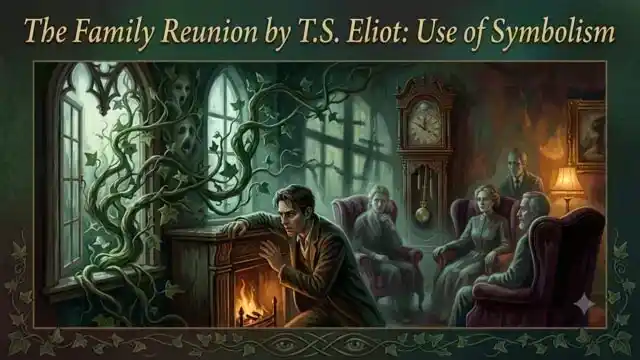
The play revolves around Harry, Lord Monchensey, whose return to his ancestral home, Wishwood, marks the beginning of an intense journey of self-discovery. Haunted by guilt over his wife’s mysterious death and pursued by supernatural forces, Harry gradually realizes that his suffering is not merely personal but spiritual. Through symbolic elements such as Wishwood, the Eumenides (Furies), the family reunion itself, the staircase, the closed house, and Harry’s spiritual pilgrimage, Eliot illustrates the conflict between material life and divine purpose. These symbols elevate the play beyond a domestic family drama and transform it into a profound exploration of humanity’s search for moral responsibility and spiritual salvation.
Eliot’s symbolism is deeply rooted in Christian mysticism and the classical tradition. The Eumenides, borrowed from Greek mythology, symbolize the relentless pursuit of guilt and conscience, while Harry’s eventual acceptance of his destiny represents the Christian concept of redemption through suffering. Wishwood symbolizes the spiritual stagnation and moral decay of the aristocratic family, whereas Harry’s departure at the end signifies liberation from worldly attachments and the beginning of a higher spiritual mission. Thus, every major character, setting, and event functions as a symbolic representation of universal human experiences rather than merely serving the dramatic plot.
Furthermore, Eliot employs symbolism to emphasize the inadequacy of modern materialistic civilization and the necessity of spiritual renewal. The external action of the play remains minimal, but its symbolic structure creates a rich inner drama that reflects the psychological and religious dilemmas of modern humanity. The symbols invite readers and audiences to look beyond the visible world and contemplate the eternal questions of sin, repentance, faith, sacrifice, and divine grace.
In conclusion, symbolism is the central artistic technique that gives The Family Reunion its depth, complexity, and universal significance. Through an intricate network of symbolic characters, settings, myths, and religious imagery, T.S. Eliot transforms a family gathering into a timeless spiritual drama that examines the human condition and the possibility of redemption. His masterful use of symbolism not only enriches the aesthetic quality of the play but also establishes The Family Reunion as one of the finest examples of symbolic drama in modern English literature.
The use of Symbolism:
Juxtaposition of Past and Present:
A basic symbolism reinforced by other devices is used for the conscious creation of the field of the present out of the past. A direct statement of the interrelationship between the past, present and future occurs in the words of Harry:
Harry’s Home, the Scene of Action:
Harry’s home, significantly called Wishwood is the scene of action. If nothing changed in time one might repeat an earlier experience and Harry might find his other self in boyhood at home.
Rose-Garden, another Symbol:
The rose – garden is part of the flower and garden imagery which Eliot has used from beginning to the end of his career as a writer. The rose garden dialogue of Harry and Agatha will appear enigmatic unless related to this garden imagery in Eliot’s poetry and especially to the symbolic rose garden of Ash Wednesday and Burnt Norton. Agatha recalls the fleeting moment of ecstasy when:
I only looked through the little door
When the sun was shining on the rose garden.
The Furies, Symbols of Harry’s Sense of Guilty:
Harry’s haunting sense of evil is objectified at Wishwood in the form of the Furies. These are the beings he has fled from as he comes back to his rose – garden only to find that they are directly in front of him. The Furies are symbols which remind him always of his guilt and his duty to expiate his sin. Harry now sees that he must pursue them that he cannot escape the guilt they symbolise, but must accept it as the basis of his self-purification.
The Utter Darkness Symbolising Harry’s Strenuous Path:
Harry’s action of leaving his home makes his Wishwood another Chapel Perilous in The Waste Land, a place where one must die to be reborn. In the original Chapel Perilous the lights of the Chapel are gradually extinguished during the night’s vigil , this rite is performed on the candles of his mother’s birthday-cake. The utter darkness that concludes the play also symbolises the dark and strenuous path that Harry has to pursue in order to work out his salvation and that of his family for the ultimate family-reunion.
River and the Sea, Symbols Constituting the Imagery:
Apart from the basic or incidental symbolism, there are other symbols constituting the imagery. The sea symbolises the unity of past, present and future. It represents the collected body history; its confused surface makes no distinction between individual epochs.
The Symbols of the Eyes:
The symbol of the eyes is another important symbol which is repeated throughout Eliot’s poetry. In The Family Reunion the eyes represent the Furies, the objectification of Harry’s guilt:
In Itly from behind the nightingales thicket
The eyes stared at me, and corrupted that song.
At the close of the first part, Agatha closes the action with a reference to the eye which is on the Monchensey house, and converts it. There it is meant to suggest the family – curse which is handed down through the generations. Harry is the object of this watchful eye because he is the conscience of his unhappy family.
The Symbol of the Stair:
The symbol of the stair establishes the play’s connection with Ash Wednesday. The bewildered chorus incapably understanding the situation of the play expresses their bafflement:
We do not like to climb a stair,
and find that it takes us down.
The Spring Season, Symbol of Sacrifice:
The spring season is symbolic of a season of sacrifice. Harry represents the spirit of the New Year. He is conscious of a spiritual reality which brings him in conflict with his worldly mother.
Fire, the Mythical Symbol:
Amy is an old woman near death, the time of the action is late March, the time of the spring fertility-ceremonies and, in corresponding Christian terms of Easter. Amy’s instructions to make fire suggest the sacrificial fire used for the cooking of the old god, as well as being the mystical symbol for purgatorial flames.
Hot Bath Symbolising the Ritual Purgation:
The act of curing her son’s spiritual sickness with a hot bath by Amy is symbolically the ritual of purgation. Dr. Warburton is called in to diagnose Harry’s state in medical terms.
The Members of the Chorus Symbolising Worldly Values:
The members of the chorus use theatrical imagery to express their role in the play. They continually see themselves as unwillingly playing parts assigned to them by Amy. They are like amateur actors who have not been assigned their parts. They stick to their worldly values. They want to be reassured of their normal life, but gradually they become aware that a great spiritual drama is being enacted before their eyes.