Introduction:
Alfred Tennyson stands among the greatest poets of the Victorian Age not only because of the depth of his thought and the musical beauty of his verse, but also because of his extraordinary gift for creating vivid and lifelike pictures through words. He possesses a remarkable art of pictorial painting, transforming ordinary scenes of nature, human emotions, legendary landscapes, and dramatic situations into living images before the reader’s eyes. His poetry appeals not merely to the intellect but also to the imagination, enabling readers to visualize every scene with remarkable clarity and realism. This exceptional descriptive power has earned him the reputation of being one of the finest pictorial artists in English poetry.
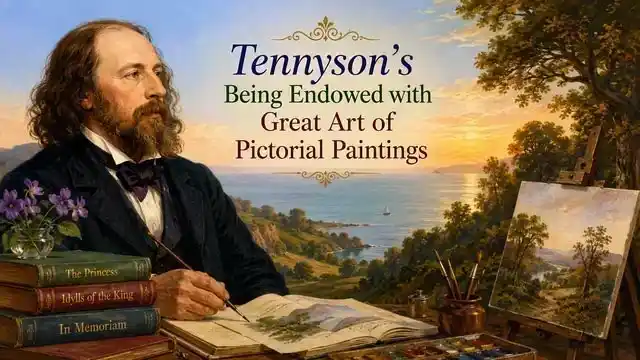
Tennyson’s pictorial imagination is distinguished by its richness of detail, precision of observation, and artistic arrangement of images. Whether he describes the tranquil beauty of a flowing brook, the grandeur of mountain landscapes, the melancholy of autumn woods, or the splendour of a royal palace, every picture is painted with the delicacy and accuracy of a master painter. His descriptions are filled with vibrant colours, light and shade, movement, sound, and atmosphere, making his poetry resemble a series of beautifully crafted paintings. Each image contributes to the emotional tone and thematic significance of the poem.
Nature occupies a central place in Tennyson’s pictorial art. Unlike many earlier poets who merely admired nature’s beauty, Tennyson observes it with scientific accuracy as well as artistic sensitivity. His landscapes are not vague or generalized but are composed of minute and realistic details that reveal his keen eye for natural phenomena. Flowers, rivers, forests, birds, clouds, stars, and seasons are depicted with such precision that they appear as living realities. At the same time, these natural scenes often symbolize the emotional condition of his characters or reinforce the philosophical ideas expressed in his poetry.
One of the most striking features of Tennyson’s pictorial genius is his ability to create dramatic visual scenes. In poems such as The Lady of Shalott, The Lotos-Eaters, Ulysses, Morte d’Arthur, and Idylls of the King, readers encounter magnificent castles, enchanted islands, peaceful valleys, stormy seas, glittering armour, and heroic landscapes that seem to unfold like scenes in a historical or romantic painting. His descriptions possess a cinematic quality, allowing each event to unfold with vivid visual intensity while maintaining emotional depth.
Tennyson’s mastery of pictorial painting is further enriched by his perfect harmony of imagery, diction, and musical rhythm. His carefully chosen words create not only visual impressions but also evoke sounds, textures, colours, and movements that engage multiple senses simultaneously. This fusion of visual beauty with melodious language gives his poetry an enduring artistic charm and aesthetic appeal. His verses demonstrate that poetry can function like painting, creating permanent images in the reader’s imagination through the medium of language.
Moreover, Tennyson’s pictorial descriptions are never mere decorative ornaments. Every image serves a deeper artistic purpose by intensifying mood, revealing character, symbolizing philosophical ideas, or advancing the narrative. His visual artistry reflects his profound understanding of both external nature and the inner world of human experience. Consequently, his poetry achieves a perfect balance between artistic beauty and intellectual significance.
Thus, Tennyson’s extraordinary gift for pictorial painting remains one of the defining characteristics of his poetic genius. Through his vivid imagery, exquisite descriptions, and artistic craftsmanship, he transforms language into living pictures that continue to fascinate readers across generations. His unparalleled ability to paint scenes with words firmly establishes him as one of the greatest pictorial poets in English literature and a true master of poetic imagination.
A Gifted Poet with Unrivalled Powers:
Tennyson was a great pictorial artist. He was gifted with unrivalled powers of picturing a scene, a landscape, a person in words marked with clarity and vividness. This art of pictorial painting was learnt by the poet quite early in his life by keeping Keats’s pictorial paintings as his models. His art was essentially picturesque and he used words as the painter employs his brush for conveying the impression of a scene in all its vivid glory and colour. Leaning aside Shakespeare, Spenser, Keats no poet was able to draw such gorgeous pictures of landscapes as Tennyson did. Nearly all Tennyson’s poems, even the simplest, and rich in ornate description of natural scenes, his method is to seize upon appropriate details, dress them in expressive and musical phrases, and thus throw a glistening image before the reader’s eye.
Depiction of Nature:
The Princess is rich in pictures of beauty and loveliness. The finest pictorial painting of landscape is seen in The Lotos Eaters where the poet draws the picture of the island in all the richness of nature’s scenery. It was a land of streams in which the Lotos Eaters found themselves:
“A land of streams! some, like a downward smoke,
Slow-dropping veils of thinnest lawn, did go;
And some thro’ wavering lights and shadows broke,
Roling a slumbrous sheet of foam below.”
In the poem Ulysses, the picture of the sea is clear enough to create the impression that we are standing at the shore:
“There gloom the dark, broad seas.”
In Come into the Garden, Maud, an astonishing description of beauty of the sky has been presented when the lover asks the beloved to come for the whole night is passed in waiting and now it is dawn. The morning breeze is blowing. Venus, the planet of love has lost its brightness. The stars which were shining like flowers of golden daffodils are fading in the light of the day:
“For a breeze of morning moves,
And the planet of Love is on high,
Beginning to faint in the light that she loves
On a bed of daffodils sky.”
In the poem Break, Break, Break, the movement of sea waves is recorded so nicely that the whole picture seems to be our own experience:
“Break, break, break,
At the foot of thy crags, O sea!
But the tender grace of a day that is dead
Will never come back to me.”
Presenting Vivid Depiction of Cities and People:
In the poem Ulysses, the poet presents detailed picture of domestic life and uncivilized people. Ulysses thinks that there is no use ruling over a barren and craggy land and uncivilized people and administering unsuitable laws to them. He feels that he would stagnate if he continues to live with his old wife in his dull home, and he would wear out if he continues to govern his people who simply make money, eat and sleep and have no ambition for higher things of life.
In the poem Break, Break, Break, the poet describes the world which goes unchanged. It is completely indifferent to the loss and grief of the poet. He envies the happy lot of the sailor lad and the fisherman’s boy who are playing and singing with a complete indifference to the poet’s grief. The stately ships are sailing towards their harbour and making the poet more sad by contrast:
“O well for the fisherman’s boy,
That he shouts with his sister at play!
O well for the sailor’s lad,
That he sings in his boat on the bay!”
And
“And the stately ships go on
To their heaven under the hill;
But O for the touch of a vanish’d hand,
And the sound of a voice that is still!”
Sensuous Pictures:
Sense of Sound:
In The Lotos Eaters, the perfection of his art is introduced when he describes the intoxicating atmosphere of the land of the lotos-eaters:
“There is sweet music here that softer falls
Than petals from blown roses on the grass.”
Sense of Touch:
In the poem Break, Break, Break, the poet is grieved for his friend who would never come back to him. The poet will never feel the consoling touch of his friend:
“But O for the touch of a vanish’d hand.”
Sense of Taste:
In Ulysses, the poet refers to Ulysses’ bravery when he claims :
“And drunk delight of battle with my peers.”
Here the sense of taste is employed. It is used in this image also:
“I will drink Life to the lees.”
In Lotos Eaters, the word picture of apple is full of sweet taste:
“The full-juiced apple, waxing over-mellows,
Drops in a silent autumn night.”
Sense of Smell:
In Come into the Garden, Maud, the poet repeatedly refers to flowers of rose and jasmine and our sense of smell becomes active:
“And the musk of the rose is blown.”