Introduction:
John Keats’s “Ode on a Grecian Urn” is one of the greatest achievements of English Romantic poetry, celebrated for its extraordinary imagination, profound emotional depth, and rich philosophical insight. Written in 1819, the poem transforms an ancient Grecian urn into a living symbol of eternal beauty, artistic perfection, and the timeless relationship between art and human life. Through his vivid imagination, Keats breathes life into the silent figures engraved on the urn, making them appear as if they exist in a world beyond the limitations of time, change, and death. The poem is not merely a description of a work of art; it is an imaginative journey that explores the mysteries of beauty, love, youth, happiness, and immortality.
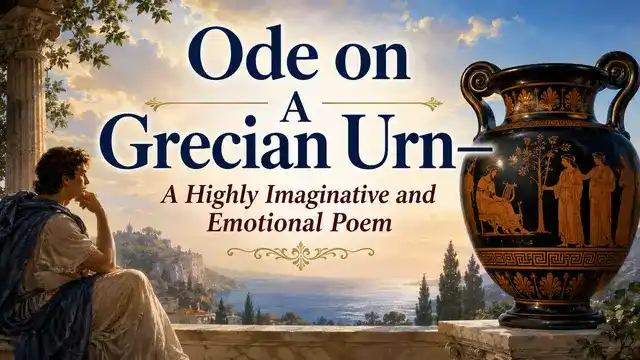
As a Romantic poet, Keats firmly believed in the creative power of imagination. In this ode, his imagination enables him to enter the world depicted on the urn and emotionally participate in its scenes. He visualizes passionate lovers who will forever remain young, musicians whose melodies will never cease, joyous celebrants participating in an everlasting festival, and a sacrificial procession that continues eternally. Although these figures are motionless in reality, Keats’s imaginative vision transforms them into living characters whose beauty and emotions transcend the passage of time. His ability to animate lifeless art reflects the Romantic ideal that imagination possesses the power to reveal deeper truths than ordinary perception.
The poem is equally remarkable for its emotional intensity. Keats responds to the urn not with detached observation but with heartfelt admiration, wonder, joy, longing, and quiet melancholy. He delights in the eternal youth and beauty preserved in the artistic world while simultaneously recognizing the tragic reality of human existence, where love fades, beauty declines, and life inevitably ends. This contrast between the permanence of art and the transience of human life creates a powerful emotional atmosphere throughout the poem. The reader experiences both the happiness of immortal beauty and the sadness of mortal limitations, making the poem deeply moving and universally appealing.
Keats also combines imagination and emotion with philosophical reflection. The famous concluding statement, “Beauty is truth, truth beauty,” suggests that genuine artistic beauty embodies an eternal truth beyond the reach of ordinary human experience. The Grecian urn becomes not merely an artistic object but a symbol of humanity’s enduring search for permanence in a world governed by change. Thus, imagination in the poem is not an escape from reality but a means of discovering deeper spiritual and aesthetic truths.
In conclusion, “Ode on a Grecian Urn” is a highly imaginative and emotional poem because it transforms a silent piece of classical art into a vibrant and everlasting world filled with beauty, love, music, and philosophical meaning. Keats’s rich imaginative power, profound emotional sensitivity, and masterful poetic craftsmanship elevate the poem into a timeless meditation on the relationship between art, beauty, and human existence. It remains one of the finest examples of Romantic poetry, inspiring readers with its imaginative vision and emotional resonance across generations.
Keats’ High Imagination:
Keats’ faculty of high imagination comes to light in his great odes. In Ode on A Grecian Urn for example, he imagines that the piper, the lover, the lady and the tree engraved on the urn have the blessings of eternity. The piper will never tired and his songs will never be outdated, the lover’s passion for his beloved will remain unabated, the beloved will never be old and ugly and the tree will enjoy everlasting spring.
“Fair youth beneath the trees, thou canst not leave to
Thy song, nor ever can those trees be bare;
Bold lover, never, never canst thou kiss,
Though winning near the goal – yet do not grieve;
She cannot fade, though thou hast not thy bliss,
For ever thou will love, and she be fair! “
Keats is highly impressed by the Greek beauty of the urn. It is a model creation of true beauty which is never decayed by the passing of time. Displaying high imagination, he makes a myth of its long – lasting beauty that the urn is a bride of quietness. It is a unique quality of this bride that her chastity is still unravished. She is yet a virgin. He imagines that the urn is foster – child of silence and slow – time; the two most destructive forces in the world which decay even massy iron built gates and huge mountains. They have spared the urn from decay perhaps because of their foster love for it Keats imagines that the urn is like a historian.
“Thou still unravished bride of quietness,
Thou foster – child of silence and slow time,
Sylvan historian who canst thus express
A flowery tale more sweetly than our rhyme.”
Emotions in the Poem:
Keats’ Ode on A Grecian Urn is a highly emotional poem. The poem appreciates strong emotions of the piper, lover and the beloved. The piper is never tired, the lover never disappointed and the lady never defeated. The handsome young man will never be old. He will never be tired. His songs will always be fresh and the tree will never lose its leaves. Everything engraved on the urn will always remain the same. The lover will never be able to kiss his beloved . But it is not a matter to feel disappointed for the lover’s passion will never decline and the beloved will always remain attractive. Their passion will never decay with the passing of time.
“Fair youth, beneath the trees, thou canst not leave
Thy song, nor ever can those trees be bare,
Bold lover, never, never canst thou kiss,
Though winning near the goal— yet do not grieve.
She cannot fade, though thou hast not thy bliss.
For ever thou wilt love, and she be fair! “
The piper will never be tired. He will always compose new songs of everlasting charm and joy. The lover too has blessing of ever fresh love. It will always remain warm and passionate. It is superior to human love which is momentary. Human love depends on, carnal desires. When once it is fulfilled the sense of surfeit takes place. No more interest is left in repeating the animal action of copulation which leaves the heart, sorrowful and fed up leading to a burning forehead and dry tongue.
“More happy love! More happy, happy love!
For ever warm and still to be enjoy’d.
For ever panting and for ever young
All breathing human passion far above
That leaves a heart high sorrowful and cloy’d
A burning forehead, and a parching tongue.”
The poet always hears the laments of the innocent. The cow is lowing at the skies. The poet hears the soundless cry of the cow and feels pity for it.