Introduction:
William Wordsworth is one of the greatest Romantic poets in English literature, and his poetry is distinguished by its profound love for nature. Unlike the poets of the Neo-Classical Age, who emphasized reason, intellect, and artificiality, Wordsworth regarded nature as a living, spiritual, and divine force that shapes the human mind and soul. For him, nature was not merely a source of scenic beauty or physical pleasure but a moral guide, a spiritual companion, a healer, a teacher, and a source of everlasting joy. Wordsworth’s philosophy of nature reached its highest expression in Lines Composed a Few Miles above Tintern Abbey (commonly known as Tintern Abbey), published in 1798 in the landmark collection Lyrical Ballads.
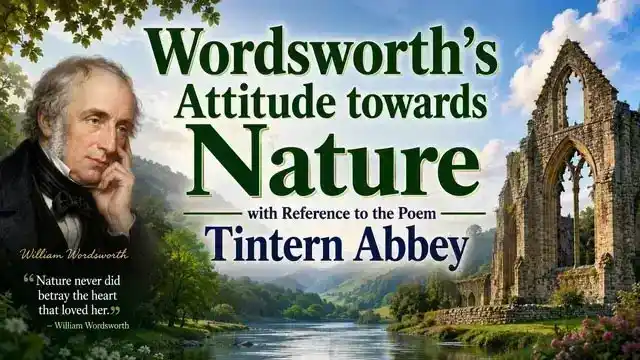
Tintern Abbey is one of Wordsworth’s most celebrated autobiographical and philosophical poems. Written after the poet revisited the banks of the River Wye five years after his first visit, the poem records the growth of his relationship with nature from youthful excitement to mature spiritual understanding. It traces the evolution of his perception of nature through different stages of life, revealing how his appreciation deepened from the enjoyment of external beauty to the realization of nature as a powerful moral and spiritual force. The poem is not a description of Tintern Abbey itself; rather, it is a meditation on memory, imagination, human life, and the enduring influence of nature on the poet’s mind.
Wordsworth presents nature as an eternal source of peace, consolation, wisdom, and moral guidance. During his youth, he loved nature for its physical beauty, vibrant colours, sounds, and exhilarating experiences. As he matured, however, he discovered a deeper meaning in nature. He came to believe that nature possesses a divine spirit that permeates the entire universe and unites all living beings. This spiritual vision reflects his pantheistic philosophy, according to which God is present in every aspect of the natural world. Nature thus becomes a medium through which human beings can experience the presence of the divine and attain inner harmony.
Another significant aspect of Wordsworth’s attitude towards nature in Tintern Abbey is the importance of memory. The poet explains that the memories of beautiful natural scenes continue to nourish the human mind even when one is far away from nature. These remembered experiences provide comfort during moments of loneliness, suffering, and mental unrest. Nature leaves permanent impressions on the mind, enriching the imagination and elevating the moral character of an individual. Thus, nature remains a constant companion that supports human beings throughout their lives.
The poem also highlights Wordsworth’s belief that nature promotes moral and emotional development. He considers nature to be “the nurse, the guide, the guardian of my heart, and soul of all my moral being.” Through constant communion with nature, a person learns virtues such as kindness, sympathy, humility, patience, and love for humanity. Nature teaches silently yet effectively, shaping both the intellect and the emotions while bringing balance between the external world and the inner self.
Furthermore, Tintern Abbey reflects Wordsworth’s concern for the continuity of this spiritual relationship with nature. Addressing his sister Dorothy, he expresses the hope that she too will experience the same healing and enlightening influence of nature. He believes that nature’s blessings are universal and timeless, capable of inspiring future generations just as they have inspired him. In this way, the poem combines personal recollection with universal truth, making it one of the finest expressions of Romantic philosophy.
Tintern Abbey stands as the most complete and mature statement of Wordsworth’s philosophy of nature. It reveals his belief that nature is far more than a beautiful landscape; it is a spiritual presence, a moral teacher, a healer of the human soul, and an eternal source of wisdom and inspiration. Through this poem, Wordsworth elevates nature to the status of a divine force that transforms human life, making Tintern Abbey a masterpiece of Romantic poetry and one of the greatest poetic celebrations of humanity’s enduring relationship with the natural world.
To Wordsworth, Nature appears as a formative influence superior to any other, the educator of senses and mind alike, the sower in our hearts of the deep laden seeds of our feelings and beliefs. It speaks to the child in the fleeting emotions of early years and stirs the young poet to an ecstasy, the glow of which illuminates all is work and the rest of his life.
Nature is a safe guide to wisdom and goodness. Like others, Wordsworth’s Nature also includes hills and mountains, rivers and springs, lakes and seas, earth and sky, winds, woods, trees, plants and flowers, the sun, the moon and stars but his outlook is certainly different from the outlook of others. Wordsworth’s view of Nature is coloured by his “hyber – individualism”.
Nature, A Living Entity:
What distinguishes Wordsworth from other poets is his belief that Nature is not merely a physical phenomenon, but living entity. To him, Nature has not only life but feeling also. It is a living sentient being. Wordsworth goes even beyond that, “Nature is endowed not only with life and feeling but also with will and purpose. He ascribes to it all the attributes of humanity – life, feeling, thinking, and willing.”
Wordsworth’s Feeling A Sense of Pain towards Nature:
Like an Indian sage, Wordsworth considered it a cruel act on his part to tread on green grass for it had life and would be wounded by such a profane act. One incident may be noted in this context. When he was still a boy, in the wantonness of his boyish heart, he indulged in merciless ravage, in a grove. With his nutting crook, he brought down with a crash a branch and exulted in his act of wanton cruelty. But this wanton sport did not last long and soon he felt a sense of pain, “When he beheld the silent trees and the intruding sky, which seemed to reprove him for this act.”
Nature Endowed with Feeling:
In fact, Wordsworth believed Nature to be endowed with feeling and purpose and informed with an Active Principle. This thought is well expressed in the following lines of Tintern Abbey where Nature is described as a Being:
“Whose dwelling is the light of setting sun,
And the round ocean and living air,
And the blue sky, and in the mind of man
A motion and a spirit, that impels
All thinking things, all objects of all thought,
And rolls through all things.”
Nature, A Religion to the Poet:
Tintern Abbey is the sincerest record of Wordsworth’s attitude towards Nature. Nature is the poet’s religion. He was an admirer of Nature in the earlier years when he was an immature boy. He is still a lover and worshipper of Nature when he has attained maturity. Even in hours of weariness amid the din of towns and cities, he experienced sensation sweet; Nature brought to him:
“That blessed mood
In which the burthen of the mystery.
In which the heavy and weary weight to
of all this unintelligible world,
Is lightened.”
Nature, A Soothing Balm for the tortured Mind and Heart:
Wordsworth always looked towards Nature for pence and comfort. He found Nature a healing power, a compassionate mother. The following lines express this faith of the poet:
“How oft,
In darkness and amid the many shapes
Of joyless day light: when the fretful stir
Unprofitable, and the fever of the world,
Have hung upon the beatings of my heart—
How oft, in spirit, have I turned to thee,
O sylvan Wye! thou wanderer thro’ the woods,
How often has my spirit turned to thee!”
Nature, A Guide, Teacher and Nurse:
Thus Nature served as a healing influence on the poet’s sorrow – stricken heart. But the culmination of his love of Nature reaches when he considers Nature as his sole guardian, teacher and nurse. In Tintern Abbey, he calls Nature,
“The anchor of purest thoughts, the nurse,
The guide, the guardian of my heart, and soul
Of all my moral being.”