Introduction:
Among all William Wordsworth’s poems, Lines Composed a Few Miles above Tintern Abbey (1798), commonly known as Tintern Abbey, stands as one of the finest and most profound expressions of his philosophy of nature. Written after a revisit to the banks of the River Wye, five years after his first visit, the poem reflects the poet’s deep emotional, spiritual, and philosophical relationship with the natural world. It was first published in Lyrical Ballads (1798), a landmark collection jointly produced by William Wordsworth and Samuel Taylor Coleridge, which marked the beginning of the Romantic Movement in English literature.
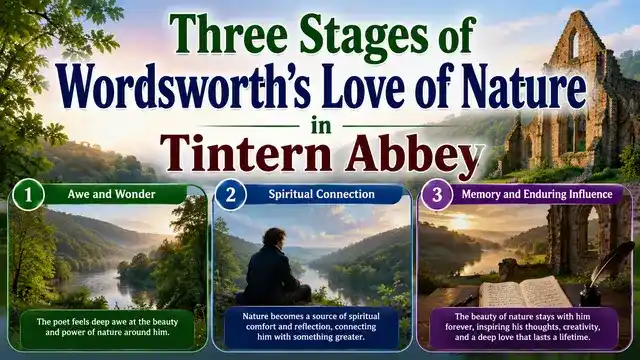
In Tintern Abbey, Wordsworth presents nature not merely as a source of scenic beauty but as a living, divine, and eternal force that nurtures the human mind and soul. His love of nature develops through different stages of life. During his youth, he delighted in the physical beauty and excitement of mountains, rivers, forests, and fields. As he matured, his appreciation became deeper and more spiritual. Nature became his teacher, guide, guardian, healer, and moral philosopher, offering comfort in times of sorrow, wisdom in moments of confusion, and peace amidst the troubles of human life.
The poem reveals Wordsworth’s belief that nature possesses a sacred power capable of elevating human thoughts and purifying the heart. Through close communion with nature, he experiences inner harmony, moral strength, and spiritual enlightenment. He feels the presence of “something far more deeply interfused” in the natural world—a universal spirit that permeates all living things and binds humanity with the universe. This mystical perception distinguishes Wordsworth from earlier poets who admired nature chiefly for its external beauty.
Another significant aspect of Wordsworth’s love of nature in Tintern Abbey is the healing influence it exerts on the human mind. The memories of natural scenes continue to inspire and console him even when he is away from them. These recollections provide emotional stability, relieve mental distress, and renew his faith in life. Thus, nature becomes a permanent source of joy and consolation rather than a temporary object of pleasure.
The poem also highlights the educational value of nature. Wordsworth believes that nature teaches compassion, humility, patience, and love more effectively than books or formal institutions. It shapes human character, strengthens moral values, and inspires noble thoughts. His affectionate advice to his sister Dorothy reflects his hope that she, too, will experience the same lifelong blessings that nature has bestowed upon him.
Thus, Tintern Abbey is not simply a descriptive nature poem but a profound meditation on the intimate relationship between man and nature. It embodies Wordsworth’s mature philosophy that nature is a divine companion, a moral guide, a spiritual force, and the greatest source of happiness and wisdom. Through this immortal poem, Wordsworth establishes himself as the supreme poet of nature and demonstrates that true communion with the natural world leads to emotional fulfillment, moral refinement, and spiritual realization.
The three stages of Wordsworth’s love of Nature:
Wordsworth’s love of Nature passed through a gradual development. It can be studied in three stages.
First Stage:
In his first stage, his attachment to Nature was that of a boy who took delight in carefree pleasures and open – air joys. At first Nature was but a playground for his “animal movements” and “coarser pleasures”. Wordsworth writes about his boyhood pleasures:
“When like a roe
I bounded o’er the mountains, by the sides
Of the deep rivers, and lonely streams,
Wherever nature led: more like a man
Flying from something that he dreads, than one
Who sought the thing he loved.”
Second Stage:
The second stage was a stage of mere sensibility, devoid of thought. Nature now appealed chiefly to his senses. He was under the imperious sway of his despotic senses, which held him in thrall and obtained for some time a complete mastery over him, so that the joy of the eye in seeing and of the ear in hearing engrossed him; and faculty of thought that analyses, breaks up the undivided whole into its component parts, and compares one thing with the other, was laid asleep. Wordsworth confesses his inability to point what then he was. He says:
“The sounding cataract
Haunted me like a passion: the tall rock,
The mountain, and the deep and gloomy wood,
Their colours and their forms , were then to me
An appetite; a feeling and a love,
That had no need of a remoter charm,
By thought supplied, nor any interest
Unborrowed from the eye.”
Gradually the “aching joys” and “dizzy raptures” disappeared, and the poet experienced yet another development in his love of Nature. He now began to find a spiritual and intellectual meaning in Nature. At this stage, Wordsworth became fully conscious of “the still, sad music of humanity, Nor harsh nor grating, thought of ample power / To chasten and subdue.” Now he found Nature pervaded by a spirit or soul:
“And I have felt
A presence that disturbs me with joy
Of elevated thoughts; a sense sublime
Of something far more deeply interfused,
Whose dwelling is the light of setting suns,
And the round ocean and the living air,
And the blue sky, and in the mind of man;
A motion and a spirit, that impels
All thinking things, all objects of all thought,
and rolls through all things.”
Final Stage:
In the last stage, Nature became the anchor of Wordsworth’s purest “thoughts” and “the nurse”, “the guide” and “the guardian” of his heart. In fact, Nature was now the “soul” of all his “moral being”.