Introduction:
Robert Frost’s “The Road Not Taken” is one of the most celebrated and widely interpreted poems in modern English literature. First published in 1916 in the collection Mountain Interval, the poem explores the universal theme of choice and its lasting consequences. Though often read as an inspiring poem about individuality and courage, Frost himself explained that it was originally written with a touch of gentle irony, inspired by his close friend Edward Thomas, who habitually regretted whichever path they did not take during their countryside walks. Thus, the poem combines the poet’s personal experiences with profound reflections on human nature, making it a timeless masterpiece.
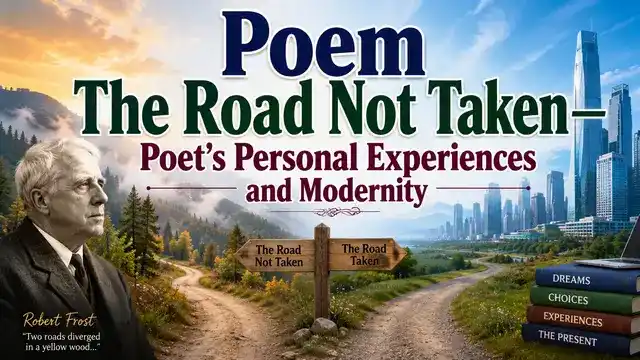
At the autobiographical level, the poem reflects Frost’s own experiences of making difficult decisions in life. Like the traveler standing before two diverging roads, Frost faced several important choices, including leaving America for England, pursuing poetry as a profession despite financial hardships, and later returning to America. These experiences gave him a deep understanding of uncertainty, hesitation, and the irreversible nature of human decisions. Although the poem arose from a specific personal incident, Frost transforms it into a universal meditation on the dilemmas that every individual encounters throughout life.
The poem is equally significant as a modern literary work because it reflects the complexities and uncertainties of the twentieth century. Unlike traditional poetry that often presents clear moral lessons or absolute truths, The Road Not Taken embraces ambiguity and psychological realism. The traveller cannot foresee the outcome of either path and must choose without complete knowledge, symbolizing the uncertainty that characterizes modern existence. Frost suggests that life offers no perfect choices; instead, individuals must create meaning through the decisions they make and accept their consequences.
Modernity in the poem is also evident in its emphasis on individual freedom, self-reliance, and personal responsibility. The traveler must rely on his own judgment rather than external guidance. This reflects the modern belief that every person shapes his or her own destiny through personal choices. At the same time, the poem acknowledges the emotional complexity of decision-making, including doubt, regret, and the tendency to reconstruct the past in ways that give life coherence and significance.
Furthermore, Frost’s simple rural setting conceals profound philosophical ideas. The two diverging roads symbolize the countless alternatives that confront people in education, career, relationships, and moral life. The impossibility of traveling both roads reminds readers that every decision involves sacrifice, while the famous concluding lines suggest that people often interpret their past choices as decisive turning points, whether or not those choices were objectively different.
Thus, “The Road Not Taken” is far more than a poem about selecting one path over another. It is a profound exploration of human freedom, uncertainty, identity, and the lifelong impact of personal decisions. Rooted in Robert Frost’s own experiences yet enriched by the concerns of modern life, the poem continues to resonate with readers across cultures and generations because it captures the universal truth that every choice shapes the course of human destiny.
Background and Real-Life Inspiration Behind the Poem:
Frost claims that he wrote this poem about his friend Edward Thomas, with whom he had walked many times in the woods near London. Frost has said that while walking they would come to different paths and after choosing one, Thomas would always fret wondering what they might have missed by not taking the other path. About the poem, Frost asserted. You have to be careful of that one. “And he is, of course correct. The poem continues to be used as an inspirational poem, one that to the undiscerning eye seems to be encouraging self – reliance, not following where others have led.”
The problem of making a choice was faced by Frost himself hence the poem may be said to be based on real life experiences. Frost, in his early life, tried to lead a settled life as a school teacher. For more than two years he helped his mother manage a small private school in Lawrence then spent two years as a student at Harvard College, hoping to prepare himself for college teaching. But again he decided that the academic atmosphere was not congenial to him and so he tried to make a successful business by raising bens and selling eggs. Occasionally he sold a poem or two. But when he could not make both ends meet financially either as a poet or farmer he turned to school teaching again at Pinkerton Academy in Derry. Subsequently he taught psychology for one year at the New Hampshire State Normal School in Plymouth. It was in 1912 that he decided to make poetry his vocation in life. He sold his farm and with his wife and four children went to England where they settled in Beaconsfield Buckinghamshire. It was a major decision which brought instant fame and success to him. Robert Frost, as Kemp points out, decided that the right direction for him in the field of poetry is towards the countryside, towards the rustic self-reliance and the Yankee shrewdness. He decided to become a spokesman of the reality of New England and this Untermeyer says, “was the choice ….. which determined his destiny and made him a poet different from other.”
The Irony and Deeper Meaning of Choice:
The poem is normally taken as a credo of the independent Yankee who takes the less travelled road because he knows that will make all the difference. But too much emphasis on this will make us miss the ironical implications inherent in the lyric. We will misjudge the depth and complexity of the piece and the real meaning will be lost upon us. The reality is that the poem conveys a poignant sadness, hunting sense of limited capacities of human – life. Kemp says, “This is not so much an exhortatory poem about choice to take the less travelled road as it is a wistful meditation on the consequences of choice for a creature whose vision runs beyond the realm of possibility. The speaker has a really imaginative mind which yearns to take the untravelled paths but finds it difficult to decide which path is actually less travelled. He wants to understand life in its totality wants to go on the frequented as well as unfrequented roads but knows it lies beyond his capabilities. This brings about a sense of frustration and yearning which is implicit in the poem’s many images— “I could not travel both”, ” long I stood”, “as far as I could”. “I doubted if I should ever come back” etc. He keeps the frequented road for another day but knows in his heart it will not be possible for him to come back to the starting point again.
Frost as a Modern Poet Despite His Traditionalism:
Critics have termed Frost a traditionalist and conservatist suspicious of new ideas and innovations. But Lynen does not put Frost against modern poets; he puts him with the moderns though also emphasizing on his individuality. Frost’s style seems familiar, but the very strangeness of that familiarity reflects the genuinely new thought that the poetry embodies. Frost’s “traditionalism” is no limitation in his poetry. His awareness is essentially modern, if we take into consideration the presentation in his poetry of the disintegration of values and the sense of loneliness, fear and disharmony, felt by men. In the matter of style, too, Frost shows the modern traits of imagism and symbolism. Frost may not be modern in a superficial way, describing ephemeral changes and “progress”, but his poetry embodies the basic predicament of modern man, and Frost relates this to universal terms.
Modern Relevance of The Road Not Taken:
Frost may not depict the scenery of modern life – its chimney and factories, its railways, and automobiles, but he certainly deals with the basic problems and the basic facts of modern life. The modern note of frustration, loneliness, isolation and disillusionment is often struck. The poem entitled The Road Not Taken can be read on a personal as well as a universal level man is bewildered, lost and confused; he cannot find his way through the all-pervasive confusion and chaos. It depicts the confusion which prevails in modern life. The modern man does not know which way to go, and it is difficult for him to make a choice of the means he should adopt in order to come out of the present impasse. He is confused, and his life does not have a clear purpose. The protagonist in the poem (the poet himself) represents the modern man, who habitually wastes energy in regretting any choice made, but belatedly and wistfully sighs over the attractive alternative which he rejected:
“I shall be telling this with a sigh
Somewhere eyes and ages hence:
Two roads diverged in a wood, and I
I took the one less travelled by,
And that has made all the difference.”
Conclusion: Frost’s Universal Modern Sensibility:
All the arguments, all the illustrations, logically lead to the conclusion that Frost is modern not in any overt and obvious manner. He is modern through and through; but to get an idea of his modernism, one has to read through his poetry and get a proper perspective of the layers of meaning that enwrap it and the sensitivity that runs through it. All the central facts of modern experience are presented by Frost in their nakedness without their social, political and economic overtones. Thus, even as far as sensibility is concerned, Frost is modern, or perhaps one should say, of “universal” sensibility.