Introduction of the Poem:
The Road Not Taken is one of the most celebrated and widely anthologized poems by Robert Frost, one of America’s greatest twentieth-century poets. First published in 1915 in The Atlantic Monthly and later included in his renowned poetry collection Mountain Interval (1916), the poem has become an enduring masterpiece because of its profound exploration of human choice, individuality, uncertainty, and the consequences of life’s decisions. Although it appears simple on the surface, the poem possesses remarkable philosophical depth and has inspired countless interpretations across generations.
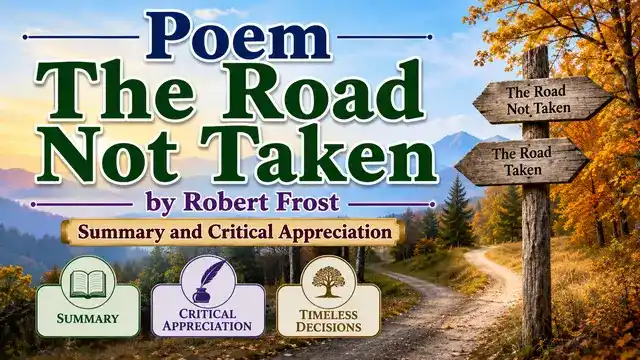
The poem is set in a peaceful autumn forest where the speaker comes upon a fork in the road and must choose between two diverging paths. This seemingly ordinary incident becomes a powerful metaphor for the important decisions people face throughout life. The speaker realizes that he cannot travel both roads and must select only one, accepting that every choice inevitably means leaving other possibilities behind. Thus, the poem reflects the universal human experience of making decisions without knowing their ultimate outcomes.
One of the greatest strengths of The Road Not Taken lies in its symbolic significance. The two roads represent the different opportunities, directions, and alternatives available in life, while the journey symbolizes the course of human existence. Frost suggests that every decision shapes a person’s future and identity. At the same time, the poem highlights the uncertainty that accompanies every choice, reminding readers that it is impossible to predict where a particular path will eventually lead.
Although many readers interpret the poem as a celebration of individualism and independent thinking, Frost himself intended it to contain a subtle irony. The two roads are described as being “really about the same,” yet the speaker later imagines that his choice “has made all the difference.” This contrast reveals the human tendency to look back on past decisions and construct meaningful narratives about them, even when the differences between the available choices were not significant at the time. Consequently, the poem is not merely about choosing the less-travelled path but also about memory, reflection, and the way people interpret their own lives.
Frost’s poetic style further enhances the poem’s appeal. His language is simple, natural, and conversational, yet rich in symbolism and philosophical insight. He skillfully combines vivid imagery of nature with profound reflections on human psychology, making the poem accessible to general readers while offering deeper meanings to literary scholars. The regular rhyme scheme, smooth rhythm, and carefully crafted structure contribute to its musical quality and lasting popularity.
In essence, The Road Not Taken is a timeless meditation on choice, destiny, individuality, and self-reflection. It teaches that life is shaped by the decisions we make, that every choice involves sacrifice and uncertainty, and that people often assign meaning to their past decisions through hindsight. Because of its universal theme, symbolic richness, and enduring relevance, the poem continues to inspire readers around the world and remains one of Robert Frost’s most admired and frequently studied works.
Summary of the Poem:
The poet had before him two roads running through an autumnal forest, which was covered with yellow leaves. The roads went to different directions. The poet being a single person could not travel on both the roads at one and the same time. This filled him with regret. For a long time he stood in a state of indecision. Then he cast his glance on one of the roads as far as he could. Beyond that the road took a turn and was lost to the poet’s view because of shrubs and bushes growing on the ground.
Next the poet glanced at the other road, which was as good and as clean as the first one. This second one was however the better one because it was covered with grass and had not suffered much damage. But in that respect they were nearly similar and both of them had not suffered much wear and tear.
On that morning both the roads were equally covered with leaves because neither of them had been trodden upon and the leaves on both of them lay unscattered. At this point, the point took a decision. He chose the second road and deferred the use of the first for some other day in future. But at the same time the poet was aware of the fact that that day in future may never come as one path leads to another and that another to yet another and so on and so forth. He doubted if he would ever be able to traverse the first, now abandoned, road.
In this stanza the poet moves from the narration of the present to the retrospection of some distant future. It is just likely that he will regret his present choice. However he will justify his present choice by telling the people that he had taken this road because it was less frequented. But then he would be moan his choice as it had made so much difference in his life.
Critical Appreciation of the Poem:
Introduction:
“The Road Not Taken” is one of the best known and the most popular lyrics of Robert Frost. According to Frost this poem was written by him about Edward Thomas, a fellow English poet, who got killed in action in World War I at Vimy Ridge: “This has something to do with the same questions of being understood and not being understood. It is one of the great ones of literary criticism. There is an old school of art that insists on the right to be understood by everybody. Some say that we may insist that we write for no audience at all. There must be an audience, an audience invisible, a blend of all the interesting people whom I have dealt with.”
Theme of the Poem:
The theme of the poem is simple: While travelling alone, the poet reached a point where the road bifurcated into two different directions. He was not able to choose the road on which he should travel. After great mental deliberation, he finally decided to leave the road which was more frequented, and move ahead on the road which was less travelled by. This choice made all the difference in his life. About the theme of the poem Louis Untermeyer says: “Robert Frost has gone his own way. He could not help it; his destination, — and perhaps his destiny— was directed by the spirit behind the man…… Once while travelling alone, Frost tells us, he stood at a point on the road, undecided which part to take. Finally, he chose one because it seemed a little less frequented, though actually there was no such difference, for ‘the passing there had worn them really about the same.’ Yet even at the moment of choice, the poet quizzically imagined that the choice was important, that he would someday tell himself he took the less travelled road:
And that has made all the difference.
The poet’s difference is in him from the beginning, long before he sets out on his career. The road that Robert Frost took was not only the ‘different’ road, the right road for him, but the only road he could have taken.”
Symbolism of the Two Roads:
The two roads symbolize the different paths, opportunities, and decisions available in life. They do not merely represent physical roads but symbolize career choices, relationships, moral decisions, and life directions.
The “yellow wood” symbolizes the autumn season, often associated with maturity, transition, and change. It represents a stage in life when important decisions must be made.
The traveler symbolizes every human being who faces uncertainty while choosing among life’s alternatives.
Reality versus Appearance:
One of the most significant aspects of the poem is that the two roads are actually almost identical. The speaker initially believes one road appears less travelled, but later admits:
“Though as for that the passing there
Had worn them really about the same.”
This reveals that people often imagine their decisions to be unique or extraordinary, while in reality the available options may be nearly equal. Frost subtly challenges the popular belief that success always comes from choosing the “less travelled” path.
Human Nature and Regret:
The poem realistically portrays human psychology. After making an important decision, people often wonder what would have happened had they chosen differently. The speaker keeps the second road for “another day,” yet realizes he will probably never return.
This reflects a universal truth that every choice closes other possibilities. Human beings naturally experience curiosity, uncertainty, and occasional regret about the opportunities they leave behind.
Individuality and Independence:
Although the roads are similar, the speaker later claims that choosing the road “less traveled by” has “made all the difference.” This statement highlights the human tendency to view our decisions as expressions of individuality.
The poem encourages readers to think independently and accept responsibility for their own decisions instead of blindly following others.
Irony in the Poem:
Irony is one of Frost’s greatest artistic achievements in this poem. At the beginning, the speaker clearly states that both roads were almost equally worn. Yet, in the future, he imagines himself saying that he took the road “less traveled by.”
This irony suggests that people often reconstruct their past experiences to give greater meaning and significance to their lives. Frost humorously exposes our tendency to create satisfying narratives about our choices.
Philosophical Significance:
The poem presents a profound philosophical reflection on free will, destiny, and personal responsibility. Human life is shaped by countless decisions, but no one can know whether a different choice would have produced better results.
Frost implies that uncertainty is an unavoidable part of life, and wisdom lies in accepting one’s chosen path with confidence rather than constantly regretting unchosen possibilities.
Optimism and Self-Acceptance:
Despite its underlying uncertainty, the poem ultimately conveys a positive message. The speaker accepts responsibility for his choice and believes that it has influenced his life significantly. Rather than dwelling entirely on regret, the poem encourages readers to move forward with determination and make the best of the decisions they have made.
Universal Appeal:
The poem remains timeless because every person must make important decisions throughout life. Whether choosing an education, career, friendship, marriage, or moral path, everyone experiences uncertainty similar to the traveler in the poem.
Its universal message transcends culture, age, and time, making it one of the most relatable poems in world literature.
Language and Style:
Frost’s language is remarkably simple, conversational, and accessible. He avoids complicated vocabulary while expressing profound philosophical ideas.
The poem follows a regular rhyme scheme (ABAAB) and is primarily written in iambic tetrameter, giving it a smooth and natural rhythm that resembles everyday speech.
Central Message:
The poem teaches that life is shaped by the choices we make. Since every decision closes off alternative possibilities, individuals must choose with wisdom, courage, and responsibility. Frost also reminds readers that people often reinterpret their past decisions, assigning them greater significance than they possessed at the time. Ultimately, The Road Not Taken is less about choosing a unique path than about the human tendency to create meaning from life’s irreversible choices.
Criticism about the Poem:
Despite the fact that this is a very famous poem of Frost, some adverse criticism has also been offered. One such critic is Yvor Winters. He says: “The Road Not Taken”, for example, is the poem of a man whom one might fairly call a spiritual drifter; and a spiritual drifter is unlikely to have either the intelligence or the energy to become a major poet. Yet the poem has definite virtues, and these should not be overlooked. In the first place, spiritual drifters exist, they are real; and although their decisions may not be comprehensible, their predicament is comprehensible. The poem renders the experience of such a person, and renders the uncertain melancholy of his plight. Had Frost been a more intelligent man he might have seen that the plight of the spiritual drifter was not inevitable, he might have judged it in the light of a more comprehensive wisdom. Had he done this, he might have written a greater poem. But his poem is good as far as it goes; the trouble is that it does not go far enough, it is incomplete, and it puts on the reader a burden of critical intelligence which ought to be borne by the poet.”
The criticism of Yvor Winters notwithstanding, the poem remains, in the words of Thompson, “an indication of Frost’s versatility.” It is characterized by simplicity, clarity, epigrammatic wisdom, and terseness. It is a personal lyric, so the conventions of the dramatic lyric— parentheses, dashes, and pauses etc. — are not employed by the poet. To say the least, this poem has made Frost a household name in English speaking countries.