Introduction:
William Wordsworth’s Lines Composed a Few Miles above Tintern Abbey, commonly known as Tintern Abbey, is one of the greatest achievements of English Romantic poetry. Published in 1798 as the concluding poem in Lyrical Ballads, it reflects the poet’s mature philosophy of nature, humanity, memory, imagination, and spiritual growth. Written after Wordsworth’s second visit to the beautiful valley of the River Wye, five years after his first visit, the poem is not merely a description of natural scenery but a profound meditation on the influence of nature upon the human mind and soul. It presents the evolution of the poet’s thoughts and emotions from youthful excitement to mature wisdom, making it one of the finest examples of autobiographical and reflective poetry.
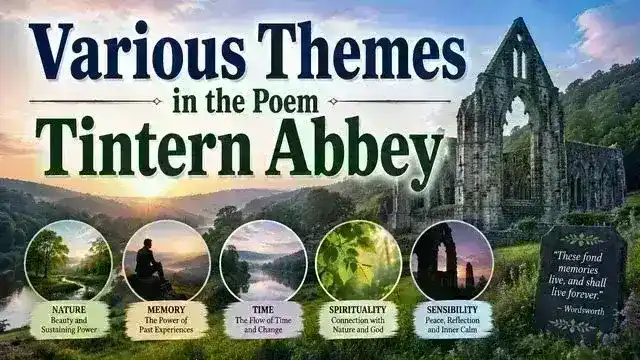
Tintern Abbey is remarkable for its rich thematic complexity. The poem explores a wide range of universal themes, including the healing and restorative power of nature, the relationship between man and the natural world, memory and recollection, spiritual enlightenment, the growth of the human mind, imagination, the passage of time, childhood and maturity, the permanence of nature amidst human change, and the importance of love and companionship. Wordsworth also emphasizes that nature is not merely a source of physical pleasure but a moral and spiritual guide that shapes human character, elevates the soul, and brings inner peace. Through his recollections of the past and his reflections on the present, he demonstrates how nature continues to nourish and inspire him even in moments of absence.
Another significant theme of the poem is the continuity of life and the transformative power of experience. Wordsworth shows that every stage of life has its own relationship with nature, and as human beings grow older, their appreciation of nature becomes deeper and more philosophical. The poem also highlights the role of memory in preserving the beauty of past experiences and providing emotional strength during difficult times. Furthermore, the affectionate address to his sister Dorothy introduces the themes of human affection, shared experience, and the transmission of spiritual values from one generation to another.
Thus, Tintern Abbey is much more than a nature poem; it is a philosophical exploration of the intimate bond between nature and humanity. Its various themes reveal Wordsworth’s Romantic vision that nature is a living, divine presence capable of educating the mind, purifying the heart, and leading individuals towards moral, emotional, and spiritual fulfilment. The poem continues to be admired for its timeless message that harmony with nature is essential for a meaningful and enlightened human life.
Tintern Abbey as a Spiritual Autobiography:
Tintern Abbey can be called a condensed spiritual autobiography of the poet. Like the Immortality Ode and Prelude, it deals with the subjective experience of the poet, and traces the growth of his mind through different periods of his life. Nature and its influence on the poet’s first visit, in 1793, to the valley of the Wye gave him an opportunity to feel the intense joy provided by natural surroundings of the place. The beauty of Nature continued to haunt his mind, and he wished to revisit the place. In 1798, he visited the banks of the Wye once again, this time in the company of his sister.
The Second Visit and a Deeper Communion with Nature:
He enjoyed the beauty of natural forms in a tranquil mood and was inspired to write a poem on that occasion. The physical sensation of delight in Nature was mixed with a sense of spiritual communion with her. Wordsworth remembers his farmer visit to the Wye, and recollects the emotions aroused in him by it. He expresses in the poem his feeling of the difference in his outlook on Nature during his first visit and that during the second. The gap of five years between his two visits has brought several changes, and the poet has hinted at these changes in his poem. Whereas when he paid his first visit, Nature was a playground for him and the objects of Nature and their colours and forms to him,
“An appetite; a feeling and a love,
That had no need of a remoter charm,
By thought supplied, nor any interest
Unborrowed from the eye.”
The Transformation of the Poet’s View of Nature:
But now, by the time of his second visit, the ‘aching joys’ and ‘dizzy raptures’ of that time have been lost, and the poet’s outlook towards Nature has changed. He has learnt:
“To look on nature, not as in the hours
Of thoughtless youth; but hearing often – times
The still, sad music of harmony.”
Thus the poet’s vision has been humanized because of his having gained experience of human life and its sorrows during the intervening years. Tintern Abbey contains an expression of Wordsworth’s feeling for Nature during various periods of his life. It tells us about his feeling of a presence in Nature that disturbs him “with the joy of elevated thoughts.” Wordsworth’s pantheistic and mystical views are expressed in the poem.
Loss of Visionary Power and the Growth of Maturity:
Wordsworth had visionary powers during his younger years. These powers enabled him to find Nature wrapped up in a heavenly beauty. But these powers have, in the grown up years, faded and been replaced by an integral vision which includes the sorrows of life and is based on an acceptance of life in all its aspects, and on a closer relationship between Nature and Man. The vision of former years, its loss in the adult years and compensation in the form of a mature outlook on Nature and Man, form an important theme of Tintern Abbey.
The Role of Imagination in Tintern Abbey:
Harold Bloom calls “Tintern Abbey” a history in little of Wordsworth’s imagination, and considers its theme to be “the nature of a poet’s imagination and that imagination’s relation to external Nature.” The imaginative element is important in Wordsworth’s poetry, and its roots lie in
“That serene and blessed mood
In which the affections gently lead us on,
Until, the breath of this corporeal frame
And even the motion of our human blood
Almost suspended, we are laid asleep
In body, and become a living soul:
While with an eye made quiet by the power
Of harmony, and the deeper power of joy,
We see into the life of things.”
Memory and Recollection as a Source of Joy:
The imaginative reconstruction of the ‘beauteous forms’ of Nature plays an important part in the poem. The poet recollects the beauty of Nature as seen by him during his first visit to the Wye valley and the emotions of joy and ecstasy aroused by that beauty. The memory of that beauty has given him joy and peace in the din of city life. Wordsworth tells us:
“These beauteous forms,
Through a long absence, have not been to me
As is a landscape to a blind man’s eye;
But oft, in lonely rooms, and mid the din
Of towns and cities, I have owed to them,
In hours of weariness, sensations sweet,
Felt in the blood, and felt along the heart;
And passing even into my purer mind,
With tranquil restoration.”
This process of recollection, which is a part of Wordsworth’s theory of poetry, forms one of the chief themes in Tintern Abbey.
Wordsworth’s Affection for His Sister:
In the later part of the poem, Wordsworth has addressed his sister and hinted at the joy felt by him in her company. He has caught from the eyes “these gleams of past existence” or a glimpse of an innocent and glorious state of life, but he fears that he may not have these gleams now that he has grown old, or in future when he will be older still. Then the recollection of this time will soothe him and his sister who will derive joy from her recollection of this time of her company with her brother. This relationship and love between Wordsworth and his sister can be said to be one of the themes of the poem.
Major Themes of Tintern Abbey:
Thus the major themes of Tintern Abbey are: (i) Nature, its noble influence, and the three stages through which Wordsworth has had to pass before arriving at his final view of Nature; (ii) Relationship and harmony between man and Nature; (iii) Acceptance of human condition and life in its various aspects; (iv) Recollections of the past as a source of joy; (v) The poet’s spiritual growth, especially in his attitude towards Nature; and (vi) loss of visionary power and the compensation of that loss in the form of a mature outlook and integral vision.