Introduction:
Alfred, Lord Tennyson’s The Lady of Shalott is one of the finest examples of Romantic poetry in Victorian literature. Although Tennyson belonged to the Victorian Age, this celebrated poem is deeply rooted in the traditions, ideals, and spirit of Romanticism established by poets such as William Wordsworth, Samuel Taylor Coleridge, John Keats, Percy Bysshe Shelley, and Lord Byron. Published in 1832 and later revised in 1842, the poem is inspired by the medieval Arthurian legend and presents a mysterious tale of an isolated lady living under an unknown curse on the island of Shalott near Camelot. Through its enchanting atmosphere, supernatural mystery, medieval setting, rich symbolism, emotional intensity, and vivid descriptions of nature, the poem embodies the essential characteristics of Romantic literature.
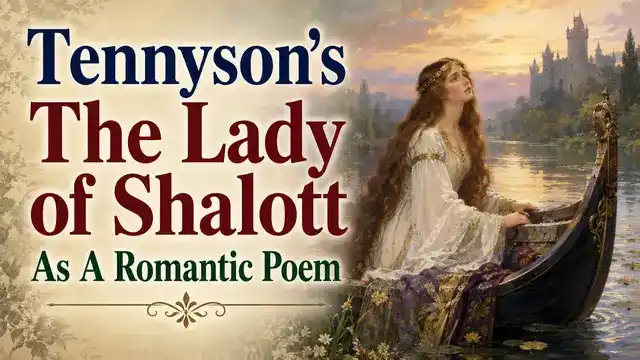
Romanticism emerged in the late eighteenth century as a reaction against the rigid rationalism, classicism, and industrialization of the Enlightenment era. It emphasized imagination over reason, emotion over logic, individual freedom over social conventions, and nature over artificial civilization. Romantic poets celebrated beauty, mystery, dreams, medievalism, the supernatural, and the inner emotional life of human beings. The Lady of Shalott reflects all these qualities in abundance. The mysterious curse, the lonely heroine, the magical mirror, the symbolic web, the idyllic landscape, and the tragic conclusion create a dreamlike world that fascinates readers with its beauty and emotional depth.
One of the most striking Romantic elements in the poem is its medieval atmosphere. Tennyson revives the legendary world of King Arthur, knights, castles, towers, rivers, and chivalric ideals, transporting readers into a distant past filled with romance and mystery. The isolated island of Shalott, the flowing river leading to Camelot, and the appearance of the dazzling Sir Lancelot contribute to the poem’s picturesque and imaginative setting. This fascination with the Middle Ages reflects the Romantic admiration for medieval culture, which was regarded as an age of heroism, faith, beauty, and artistic inspiration.
The poem also exemplifies the Romantic celebration of imagination and artistic creativity. The Lady spends her life weaving magical images that she sees only through a mirror, symbolizing the imaginative artist who experiences reality indirectly through art. Her decision to abandon her artistic world after seeing Sir Lancelot represents the conflict between imagination and reality, a central concern of Romantic literature. Tennyson suggests that the artist’s desire to experience real life may lead to both fulfilment and tragedy, making the poem a profound reflection on the nature of art and human existence.
Nature plays an equally significant role in establishing the poem’s Romantic character. The river, fields of barley, flowers, trees, birds, moonlight, and changing seasons are described with extraordinary beauty and sensitivity. Nature is not merely a background but an active participant that reflects the emotions and destiny of the Lady. These vivid natural images create an atmosphere of peace, mystery, and melancholy, demonstrating the Romantic belief that nature is deeply connected with human feelings and spiritual experience.
Another defining Romantic feature is the poem’s emphasis on mystery and the supernatural. The unexplained curse placed upon the Lady, the magical mirror that suddenly cracks, and the mysterious web that flies apart create an atmosphere of suspense and wonder. Tennyson deliberately avoids explaining the origin of the curse, allowing readers to experience the supernatural through imagination rather than rational explanation. This element of mystery recalls the supernatural poetry of Coleridge and enhances the poem’s romantic appeal.
Furthermore, The Lady of Shalott is filled with melancholy, emotional intensity, and tragic beauty, all of which are hallmarks of Romantic poetry. The Lady’s loneliness, her yearning for freedom, her courageous decision to pursue love, and her peaceful yet tragic death evoke deep sympathy in the reader. The combination of beauty and sorrow transforms the poem into a touching exploration of human desire, sacrifice, and destiny. Romantic poets often celebrated such emotional experiences because they believed that genuine feelings reveal profound truths about life.
Finally, the poem’s rich symbolism, musical language, lyrical beauty, and imaginative narrative firmly establish it as a masterpiece of Romantic art. The Lady, the mirror, the web, Camelot, and Sir Lancelot all possess symbolic significance, allowing multiple interpretations related to art, life, love, freedom, and society. Tennyson’s melodious verse, vivid imagery, and artistic craftsmanship create a magical poetic world that continues to captivate readers across generations.
Thus, The Lady of Shalott stands as a remarkable Romantic poem that successfully blends medieval romance, supernatural mystery, natural beauty, imagination, symbolism, and emotional depth. Although written during the Victorian period, it preserves the ideals and artistic spirit of Romanticism, making it one of Tennyson’s greatest achievements and one of the most enduring poems in English literature.
Romanticism in The Lady of Shalott:
The Lady of Shalott is a fascinating poem characterized with several elements of romanticism. Romanticism is often characterized as the ‘Renaissance of wonder’. It is also considered as synonymous with medievalism. Some critics find melancholy, some addition of strangeness to beauty, some liberalism, as the main features of romanticism. The Lady of Shalott is undoubtedly a romantic poem in the tradition of Coleridge, Keats and Southey.
The Romantic Theme of the Poem:
The very theme of the poem, The Lady of Shalott has a romantic touch. It describes in pathetic terms the helpless fortune of The Lady of Shalott, who is fated to live a lonely life . She is confined to a room in a deserted palace, always looking into a mirror to have a glimpse of what is happening in the world outside. If ever she dared to peep out of the window, she would meet her end. Thus the Lady of Shalott is leading a very miserable lonely life. The poet has brought out the melancholy element in the following lines:
Or when the moon was overhead,
Came two young lovers lately wed:
‘I am half sick of shadows,’ said
The Lady of Shalott.
The Lady’s Loneliness and Melancholy:
The lady is quite lonely and nobody is there to share her grief. Only the reapers are there, but the Lady cannot peep out:
Only reapers, reaping early
In among the bearded barley,
Hear a song that echoes cheerly
From the river winding clearly
Down to tower’d Camelot.
Picturesque Description of Nature:
The poem is full of exquisite descriptions of Nature. For example, the following scene of the fields at the sun – rise:
A bow – shot from her bower – eaves,
He rode between the barley – sheaves,
The sun came dazzling thro’ the leaves,
And flamed upon the brazen greaves
Of bold Sir Lancelot.
A red – cross knight for ever kneel’d
To a lady in his shield,
That sparkled on the yellow field,
Beside remote Shalott.
Love of Nature as a Romantic Feature:
Love of Nature was a marked feature of Romanticism. Tennyson gives natural description in the manner of the romantic poets. The poem, The Lady of Shalott begins with such a description:
Willows whiten, aspens quiver,
Little breezes dusk and shiver
Thro’ the wave that runs for ever
By the island in the river
Flowing down to Camelot.
Four gray walls, and four gray towers,
Overlook a space of flowers,
And the silent isle imbowers
The Lady of Shalott.
Romantic Diction and Poetic Imagery:
The poem abounds in such expressions and epithets as were used by poets like Keats and Shelley. The poet’s use of such expressions as ‘the lillies blow,’ ‘willows whiter,’ ‘aspens quiver,’ ‘little breezes dusk and shiver,’ ‘the wave that runs for – ever, a space of flowers,’ ‘bearded barley,’ ‘the river winding,’ ‘the moon,’ ‘the reaper weary,’ ‘uplands airy,’ ‘the river eddy whirls,’ ‘the silent nights,’ ‘bower – eaves,’ ‘the barley – sheaves,’ ‘the leaves,’ ‘the yellow field,’ ‘remote Shalott,’ ‘some branch of stars,’ ‘the golden Galaxy,’ ‘the blue unclouded weather,’ ‘burning flame,’ ‘the purple night,’ ‘the starry clusters bright,’ ‘Some bearded meteor trailing light,’ ‘sunlight,’ the bank and the river,’ ‘the water – lily bloom,’ ‘the stormy east – wind straining,’ ‘the pale yellow woods,’ ‘the broad streams,’ ‘the low sky,’ ‘the willowy hills and fields, the tide,’ ‘the water – side,’ ‘garden – wall and gallery,’ denotes the poet’s haunting passion for Nature and for lovely scenes and sights.
The Supernatural Element:
The element of the supernatural is yet another romantic element in the poem. The whole atmosphere in the poem is mysterious. The Lady’s confinement in the lonely palace is full of supernatural awe and fear. The lady is shown weaving a mysterious web:
There she weaves by night and day
A magic web with colours gay,
She has heard a whisper say,
A curse is on her if she stay
To look down to Camelot.
She knows not what the curse may be,
And so she weaveth steadily,
And little other care hath she,
The Lady of Shalott.
The Mysterious Curse and Its Fulfilment:
The Lady’s work of weaving the ‘magic web’ creates a mysterious sense of the supernatural. The Lady is not expected to peep out of the window, lest she should be doomed. But she does it and the mysterious curse comes upon her:
She left the web, she left the loom,
She made three paces thro’ the room,
She saw the water – lily bloom,
She saw the helmet and the plume,
She look’d down to Camelot.
Out flew the web and floated wide;
The mirror cracked from side to side;
“The curse is come upon me’, cried
The Lady of Shalott.
Medievalism and Love of the Past:
Romanticism is also known for love of the past. The Lady of Shalott recreates the past. The poet narrates the tale of the past. Its subject matter is medieval. It deals with the unrequited love of Elaine, here named as the Lady of Shalott and Sir Lancelot, the valiant and dazzling knight of the Arthurian romances. The unfulfilled love of the lady and the knight is the fittest subject of a romantic poem.
Conclusion:
Thus it is apt to say that “The Lady of Shalott” is romantic in theme and its treatment. It abounds in all the elements of a truly romantic poem.