Introduction of the Sonnet:
Shakespeare’s Sonnet 55, entitled “Not Marble, Nor the Gilded Monuments,” is one of the most celebrated poems in William Shakespeare’s collection of 154 sonnets, first published in 1609. Belonging to the Fair Youth Sonnets (Sonnets 1–126), this sonnet is addressed to a young man whose beauty and virtues the poet seeks to preserve forever through the power of poetry. It is a remarkable meditation on the themes of immortality, the triumph of art over time, the destructive force of time, and the enduring power of literary creation.
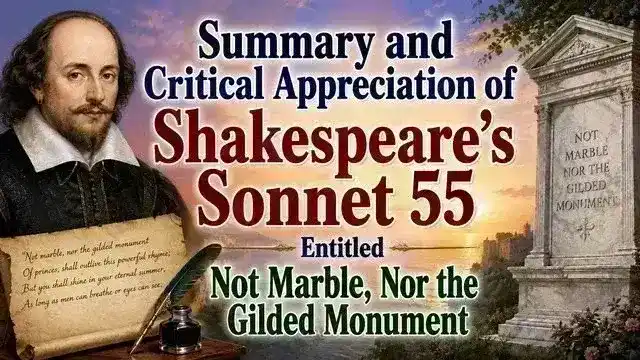
The central idea of the sonnet is that poetry possesses a greater permanence than any physical monument. Shakespeare boldly declares that magnificent marble statues and gilded monuments erected by kings and princes will eventually decay under the ravages of time, war, and natural destruction. However, the young man’s memory and beauty will remain eternally alive because they have been immortalized in the poet’s verses. Thus, Shakespeare presents poetry as an everlasting monument that can preserve human excellence long after material structures have crumbled into dust.
The sonnet also reflects the Elizabethan belief in the immortalizing power of literature. During the Renaissance, poets and artists believed that creative works could conquer death by preserving the names and achievements of individuals for future generations. Shakespeare develops this classical idea with extraordinary confidence, asserting that neither time, war, fire, nor oblivion can erase the fame bestowed by his poetry. The poem culminates in the assurance that the young man will continue to live in the hearts and minds of readers until the Day of Judgment, when he will rise again.
Structurally, the poem follows the traditional Shakespearean (English) sonnet form, consisting of fourteen lines divided into three quatrains and a concluding rhyming couplet, with the rhyme scheme ABAB CDCD EFEF GG. It is written in iambic pentameter, the characteristic metre of Shakespeare’s sonnets. The concluding couplet provides a powerful resolution by affirming that the beloved will live eternally through the poem itself.
Shakespeare enriches the sonnet with vivid imagery, striking contrasts, and persuasive metaphors. The comparison between perishable monuments and imperishable verse, the imagery of war, fire, and the passage of time, and the personification of Time all reinforce the poem’s central argument that artistic creation transcends physical destruction. These literary devices make the sonnet both intellectually profound and emotionally compelling.
Overall, “Not Marble, Nor the Gilded Monuments” (Sonnet 55) is a magnificent celebration of the eternal power of poetry. It proclaims that while wealth, political power, and monumental architecture inevitably fade with time, true art possesses the unique ability to defeat mortality and preserve beauty, love, and human memory for eternity. Through this sonnet, Shakespeare not only immortalizes the young man but also demonstrates the enduring greatness of his own poetic genius, making the poem one of the finest expressions of Renaissance humanism and literary confidence.
Summary of the Sonnet:
According to William Shakespeare, neither the marble statues of great persons or of the gods and goddesses nor the beautiful and well – decorated memorials and tombs covered with the thick layers of gold can have a longer life than his powerful sonnets which he has written in praise and honour of his friend. His sonnets have great power to survive in this mortal world until it remains in existence. All the objects of the physical world shall come within the circle of the passing time, but his sonnets shall be handed over generation by generation. The poet’s friend would always shine brightly through the words of his sonnets. The statues made of stones are covered with the thick layers of dust with the passage of time and due to great dirt, their brightness and beauty disappear, but his friend would shine and nobody would forget him. When the fierceful battles would topple down the statues and uproot the buildings created by the masons, the sonnets in which his name, memory, nature and deeds have been recorded, would not be destroyed even with the sword of the god of war nor the fire of war would burn the memory of his friend recorded in his sonnets. He would exist midst the people like a living person.
According to the poet, his loving friend would be free from man’s greatest enemy, forgetfulness. His death would overcome the forgetfulness. The poet’s sonnets would keep him alive in the minds of people. He would get immortality through the sonnets of the poet. He would survive midst the people like a living person. The poet has written a lot in the praise and honour of his friend in his sonnets. The coming generation would read his depiction in his sonnets and in this way he would always find place in their minds. The poet’s friend would be alive in the minds of the people until this world exists. The passing of time would eventually bring this world to an end on the Doomsday when he, like all dead men, would get up from his grave and when all the human beings would stand before God to face divine judgement. (It is a general belief among the Christians that the world would end on the Doomsday and on that day all the dead ones arise from the graves to get their rewards and punishment from God). The poet’s friend would never be dead but would continue to live through the poet’s sonnets. He would be remembered by those who, after reading his sonnets, would provide him suitable place in their hearts.
Critical Appreciation of the Sonnet:
Introduction:
The sonnet No. 55, entitled Not Marble, Nor the Gilded Monuments is one of those which have been regarded as master pieces in this series. Although it is not the best and the greatest of all Shakespeare’s sonnets, yet it is certainly one of the best and the greatest. The first point to be noted here is, of course, Shakespeare’s awareness of his own poetic genius and his knowledge that his poetry (in these sonnets as well as in his plays) is of such high merit that it would continue to be read forever. This idea has already been expressed in some foregoing sonnets. But what gives distinction to this particular sonnet is the manner in which Shakespeare’s awareness of his poetic greatness has been expressed. There is Shakespeare’s profound love for his friend which really prompted this sonnet. The friend stands high in poet’s estimation. In this sonnet the poet presents some facts about the mortality of every object of this world, the power of time, the nature of forgetfulness of someone after death and surviving the poetry upto the Doomsday. Besides exhibiting his genius of writing poetry, he presents the immortality of the contents of a work related to prose or poetry because these contents are read generation by generation and the readers come to know about that particular thing or person which has already disappeared long ago.
Thought – Content:
Neither marble nor ornamented monuments can stand against the power of time. They would come within the range of time sooner or later, but the poet’s friend would remain unaffected from the ravages of time. He would shine more brightly in his sonnets than those uncleaned stones that defaced with the passage of time. He would remain alive through the poet’s sonnets. The poet has written a lot in the praise of his friend in his sonnets. He has expressed sincere love for his friend through his sonnets. The wars and disputes can be able to destroy the statues and magnificent buildings, but the poet’s friend’s living monument of memory would continue to survive. His praise would find a place in the eyes of coming generation that live to the end of this world. In this way, he would live on this earth till the Day of Judgement calls him to arise.
The Intensity and Spontaneity of the Sonnet in Praise of Self:
This sonnet celebrates Shakespeare’s own poetry of which the sonnets are a striking specimen; but in this celebration of his own excellence lies also the lyrical quality of the poem. Shakespeare here becomes eloquent in self-praise; and, as the self – praise is fully justified, it is treated not as a piece of bragging but as a bit of genuine and excusable admiration of his own poetic genius. Neither marble structures nor the gilded monuments of princes shall live longer than his poetry, Shakespeare says in the opening lines of this sonnet. According to Shakespeare’s assertion, these sonnets would defend his friend ‘against death and all – oblivious enmity’. Here once again it is the intensity and spontaneity of the emotion which are most marked.
No Consistency of Thoughts:
Strict consistency of thought is not observed by Shakespeare in most of his sonnets. He does not develop or expand one single attitude as most other sonneteers do. He contradicts a view or a thought or an emotion which has been expressed in the earlier part of a sonnet, and he contradicts it as emphatically as the view has previously beer expressed. This sonnet begins with the line: “Not marbles, not the gilded monuments.” Here once again Shakespeare expresses contradictory attitudes. Marble statues and the ornate monuments of princes would have a shorter life than ‘this powerful rhyme’ (namely the sonnets written by Shakespeare). Marble statues would be overturned by wasteful war; the work of masonry would be destroyed to its very foundations during battles which are fought; but these sonnets would exist forever. Neither the sword of Mars nor the fires of war would be able to kill or burn these sonnets which would always be read by posterity. And, as Shakespeare has written these sonnets about his friend (namely the Earl of Southampton), they would serve as a permanent memorial to his friend. Thus, his friend would live on till Doomsday. There is a basic contradiction in this sonnet because Shakespeare here first expresses the view that memorials and monuments would, in course of time, be destroyed by wars or by the fires of war and by the destructive power of time. and then claims that his friend’s youth and beauty would be preserved forever in the sonnets which he has written about his friend.
Themes of the Poem:
1.The Triumph of Poetry over Material Monuments:
The central theme of Sonnet 55 is that poetry is more permanent than physical monuments. The poet begins by comparing his verse with magnificent marble tombs and gilded monuments built in honour of princes. While these grand structures will eventually decay or be destroyed, the poem will preserve the beloved’s beauty forever.
Shakespeare boldly declares that poetry possesses a lasting power beyond architecture and sculpture. Material monuments are subject to destruction, but literature remains alive in the minds and hearts of readers. This reflects Shakespeare’s confidence in the eternal value of artistic creation.
2. Time as the Great Destroyer:
Throughout the sonnet, Time is presented as a destructive force. Shakespeare personifies Time as “sluttish time,” suggesting its careless and untidy nature that gradually stains and erodes even the finest monuments.
The phrase “unswept stone besmeared with sluttish time” creates a vivid image of neglected memorials covered with dust, dirt, and decay. No matter how splendid a monument may be, time eventually reduces it to ruin.
This idea emphasizes the temporary nature of human achievements while highlighting the permanence of poetic expression.
3. The Destructive Power of War:
Shakespeare extends the theme of destruction by introducing the horrors of war. He describes how wars overturn statues and destroy magnificent buildings:
“When wasteful war shall statues overturn,
And broils root out the work of masonry.”
War is depicted as a violent force capable of reducing even the strongest structures to rubble. The references to Mars, the Roman god of war, and war’s quick fire intensify the destructive imagery.
Yet, despite these devastating forces, poetry remains untouched. Neither swords nor flames can destroy the written word or erase the memory preserved within it.
4. Poetry as the Living Record of Memory:
One of the most remarkable ideas in the sonnet is Shakespeare’s description of poetry as a “living record.”
Unlike lifeless stone monuments, poetry continues to live whenever it is read. Each new generation revives the memory of the beloved through the poem.
The written word possesses a dynamic quality that physical monuments cannot match. Poetry does not merely preserve memory—it keeps it alive and meaningful across centuries.
5. Victory over Death and Oblivion:
Another important theme is the conquest of death and forgetfulness. The poet declares:
“Gainst death and all-oblivious enmity
Shall you pace forth.”
Death is personified as an enemy determined to erase all human achievements. However, Shakespeare confidently asserts that his beloved will continue to “pace forth,” living beyond death through poetry.
The phrase “all-oblivious enmity” refers to the force of forgetfulness that usually accompanies death. Poetry alone defeats this enemy by keeping memory alive forever.
6. The Promise of Eternal Fame:
Shakespeare assures the young man that future generations will continue to admire and praise him:
“Your praise shall still find room
Even in the eyes of all posterity.”
This demonstrates the poet’s belief that literature transcends historical boundaries. Every generation that reads the poem participates in preserving the beloved’s fame.
The sonnet thus becomes an instrument of immortality, granting eternal recognition through artistic excellence.
7. The Theme of Immortality:
Immortality forms the heart of the poem. Shakespeare argues that although human beings must physically die, they can achieve literary immortality. The beloved survives not through statues or royal memorials but through immortal verse. The concluding couplet expresses this beautifully:
“So, till the Judgement that yourself arise,
You live in this, and dwell in lovers’ eyes.”
Until the Day of Judgment, the beloved remains alive within the poem and in the hearts of those who read it. This ending unites Christian belief with Renaissance humanism, combining spiritual resurrection with artistic immortality.
Renaissance Humanism:
The sonnet strongly reflects the ideals of the Renaissance. Humanists believed in the greatness of human creativity and the enduring value of literature. Rather than depending solely on divine intervention for immortality, Shakespeare presents artistic achievement as a means of transcending mortality. His confidence in poetry reflects the Renaissance celebration of human intellect and imagination.
Powerful Use of Personification:
Personification enriches the emotional intensity of the poem. Time is portrayed as careless and destructive. War becomes a violent force capable of demolishing civilizations. Death appears as an enemy seeking to erase memory. These abstract forces become living characters, making the conflict between destruction and poetry dramatic and memorable.
Rich Imagery:
Shakespeare employs vivid imagery throughout the sonnet. Marble monuments symbolize worldly glory. Dust-covered stones suggest neglect and decay. Broken statues and burning cities represent the horrors of war. The “living record” symbolizes the everlasting vitality of poetry. These striking images strengthen the poem’s central argument that literature survives when physical objects perish.
Symbolism:
The sonnet contains profound symbolic meanings. Marble and gilded monuments symbolize worldly wealth, political power, and material glory. War symbolizes violent destruction. Time symbolizes inevitable decay. Poetry symbolizes immortality and eternal remembrance. Judgement Day symbolizes ultimate resurrection and eternal life. Together, these symbols deepen the philosophical significance of the poem.
Tone and Mood:
The tone is confident, triumphant, optimistic, and celebratory. The speaker expresses complete faith in the enduring power of his poetry. Even when discussing war, death, and destruction, the overall mood remains hopeful because poetry ultimately triumphs over every destructive force.
Universal Significance:
Although the poem addresses one individual, its message is universal. Every civilization builds monuments to preserve memory, yet Shakespeare reminds readers that art often proves more enduring than stone. The sonnet continues to be read over four hundred years after it was written, confirming the truth of the poet’s claim. Thus, the poem itself serves as evidence of the immortality it celebrates.
Style and Language:
This sonnet is throughout filled to overflowing with the elixir, the ecstasy, the dithyrambic certainties. Here every image piles upto suggest that poetry enjoys an authority or exists from a dimension to which all temporal fabrications and engagements are as nothing; and the weightiest and most serious are chosen for the purpose. The two ways of eternal understanding, poetry and religion are happily balanced in final juxtaposition of ‘judgement’ and ‘lover’s eyes’. The use of words and phrases such as ‘marble’ (to mean marble statues, or monuments made of marble), ‘gilded monuments’, ‘unswept stone besmear’d with sluttish time’, ‘wasteful war’; ‘nor Mars his sword’, ‘the living record of your memory’, ‘all – oblivious enmity’, and ‘dwell in lover’s eyes’ is most appropriate and suited to the ideas being expressed.
The Poet’s Profound and Sincere Love for His Friend:
Here we find Shakespeare’s profound love for his friend which really prompted this sonnet, just as it prompted most of the others in the series. The poet’s admiration and love for his friend are genuine and sincere. In spite of mortality of this physical world he, through the source of his sonnets, made him immortal. He wishes that his friend would remain alive midst his readers upto the Doomsday. The poet has mentioned great praise of his dear friend in his sonnets. He has poured out his inner emotions and feelings to exhibit his intense love for him. Hence, it is true that no poet can write such great poetry unless they actually animate his heart.
Conclusion:
Sonnet 55 is one of Shakespeare’s finest meditations on the immortality of poetry. Through majestic language, vivid imagery, powerful symbolism, and masterful poetic craftsmanship, Shakespeare argues that neither time, war, nor death can erase the memory preserved in great literature. The poem celebrates the triumph of artistic creation over material monuments and assures the beloved of everlasting life through verse. More than four centuries after its composition, the continued admiration of this sonnet powerfully confirms Shakespeare’s prophetic belief that true poetry possesses the extraordinary power to conquer time and grant eternal fame.