Introduction:
John Donne (1572–1631) occupies a unique and distinguished place in the history of English literature as the Father of Metaphysical Poetry. He revolutionized seventeenth-century English poetry by introducing a new style that broke away from the conventional romanticism and smooth lyrical traditions of the Elizabethan age. Instead of focusing merely on beauty, love, and musical expression, Donne explored profound intellectual, philosophical, religious, and emotional experiences through poetry. His poems combine reason with passion, intellect with imagination, and wit with deep feeling, creating a distinctive poetic style that later critics termed Metaphysical Poetry.
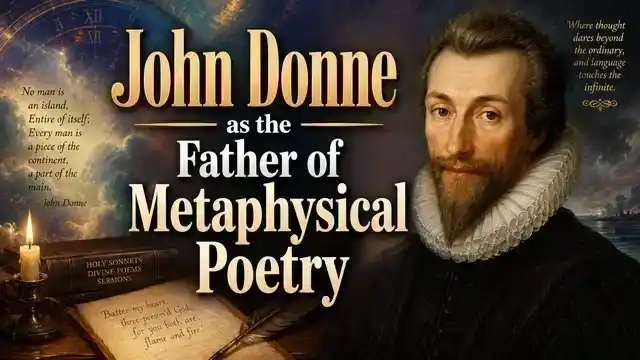
The word metaphysical literally means “beyond the physical” or “concerned with abstract reality.” Donne’s poetry goes beyond the surface of human experience to investigate the mysteries of love, life, death, God, the soul, and the universe. His poems are characterized by far-fetched metaphors (conceits), paradoxes, logical arguments, dramatic openings, colloquial language, intellectual wit, and surprising imagery. Instead of describing emotions directly, Donne persuades his readers through reasoning and ingenious comparisons, making his poetry both intellectually stimulating and emotionally powerful.
As the leader of the Metaphysical School, Donne greatly influenced poets such as George Herbert, Andrew Marvell, Richard Crashaw, Henry Vaughan, and Abraham Cowley. Although the term “Metaphysical Poets” was first used critically by Samuel Johnson, it was John Donne who established its essential features through his innovative poetic techniques and philosophical depth. His poetry reflects the spirit of the Renaissance by blending scientific discoveries, theology, philosophy, and everyday life into poetic expression.
Donne’s major collections, including Songs and Sonnets, Holy Sonnets, The Flea, The Canonization, A Valediction: Forbidding Mourning, and Death Be Not Proud, illustrate his remarkable ability to transform ordinary experiences into profound reflections on human existence. Whether dealing with earthly love or divine devotion, his poetry reveals extraordinary originality, complexity, and emotional intensity.
The twentieth-century critic T. S. Eliot revived Donne’s reputation by praising his “unified sensibility,” the rare ability to fuse thought and feeling into a single artistic experience. Modern critics now regard Donne as one of the greatest English poets because his works appeal equally to the intellect and the heart.
Thus, John Donne is rightly honoured as the Father of Metaphysical Poetry because he pioneered a new poetic tradition marked by intellectual brilliance, philosophical inquiry, imaginative conceits, and emotional sincerity. His innovative style not only transformed English poetry in the seventeenth century but also exerted a lasting influence on later generations of poets and critics, securing his position as one of the most original and enduring figures in English literary history.
A Poet of Departure and Father of Metaphysical Poetry:
John Donne is a poet of departure from the tradition of Elizabethan era. He began to write about 1592. By the time Elizabethan enthusiasm was nearly exhausted. The age of Donne comprises the last decade of the 16th century and early decades of the 17th. Donne’s poetry represents a revolt against the emotional poetry of the Elizabethan poets. The Elizabethan poetry was emotional and imaginative while Donne’s metaphysical poetry is intellectual and realistic.
Elizabethan poets used emotional images based on personal experiences but Donne’s metaphysical images are intellectually conceived and therefore critics call them conceits. His poetry is remarkable for its concentrated passion, intellectual agility and dramatic power. He writes of no imaginary shepherds and shepherdesses but of his own intellectual, spiritual and amorous experiences. His early satyres, his Songs and Sonnets, his Holy Sonnets, etc., are all different expressions of his varied experience. His poetry is marked with a tone of realism, even cynicism, but it is always forceful and startling. He is the founder of the so – called Metaphysical school of poetry of which Richard Crashaw, George Herbert, Henry Vaughan and Abraham Cowley are the other leading poets.
Opinion about Donne’s Poetry:
Donne’s poetry is not metaphysical in the true sense of the word. A metaphysical poem is long, while Donne’s poems are all short. His poetry does not expound any philosophical system of the universe; rather it is as much concerned with his emotions and personal experiences, as any other poetry. No doubt, there is much intellectual analysis of emotion and experience, but this by itself cannot be called metaphysical. The poetry of the school of Donne is not metaphysical as far as its content is concerned. According to one scholar, “Donne is metaphysical not only by virtue of his scholasticism, but by his deep reflective interest in the experiences of which his poetry is the expression, the new psychological curiosity with which he writes of love and religion.”
The Division of Donne’s Poetry:
1. His Amorous Poems:
His love poems present three chief strains: the cynical, the Platonic, and the conjugal. In the cynical strain he is harsh towards women and exposes their faithlessness and contempt. In Go and Catch a Falling Star, he claims that it is impossible to find a constant woman just as it is not possible to find a constant woman just as it is impossible to catch a falling star. In the Platonic strain, Donne’s concept of higher love finds a fine display. He expresses his faith in sexual relations also in the conjugal strain.
2. Metaphysical Poems:
John Donne’s religious poems expose his metaphysical temperament. In Holy Sonnets (V) he imagines that both the body and soul are submerged in the sea of sin. The poet makes a sharp distinction between the fire of lust and envy which is destructive and fire of zeal or piety which is truly purgative.
3. Satiric Poems:
Donne composed in all five satires but now only three are available. The First Satire deals with fashionable London society. The Second Satire takes into account weaknesses of lawyers and condemns those who enter the legal profession just to earn money. The Third Satire passes satire on those who refuse to make the effort to find truth in religion. The Fourth Satire exposes ills of the court. The Fifth Satire deals with the corruption and inefficiency of law courts.
Metaphysical Characteristics of Donne’s Poetry:
1. Poet’s Keen Interest in Presenting Novel Thoughts:
Donne was not interested in following the trodden path. He had his own thoughts and his own peculiar way of expressing them. In his Holy Sonnet on Death, he challenges the traditional belief that Death is mighty and dreadful. In The Canonization, he assures his beloved if they cannot attain immortality by their love, their death will make them immortal.
2. Fantastic Imagery:
Donne’s images are far – fetched and based on unfamiliar sources. They discover secret and mysterious relationships. In The Flea, the image of a flea leads to strange thoughts, the poet requests his beloved to mark the flea carefully and understand that what she desires to him is not of much importance. The flea has sucked her blood and afterward his blood. Thus, their bloods are mixed up. He imagines that the body of the flea is their wedding temple as well as their bridal bed.
In A Valediction: Forbidding Mourning, the poet imagines that spiritual love is pure like gold which may be beaten enough to be thin like air. But the metal does not lose its lustre and quality. When the different souls are united in love the mixed or combined new soul can’t be separated by any means. Even if their souls look separated, they are like the two feet of a compass. The beloved’s soul is the fixed foot and does not appear moving. But in fact it moves with the movement of the other foot for it is jointed at the head.
“If they be two, they are two so
As stiff twin compasses are two.
Thy soul the fixed foot, makes no show
To move, but doth, if the other do.”
3. A Reflection of His Wide Learning and Obscurity:
Donne was widely read and had deep study in Astronomy, Chemistry, Geography, Physiology and Theology. He refers to them frequently in his poems. The Extasie brings to light on the nature of soul, on psychological notions of animal spirits, on cosmology, alchemy, and chemistry. In A Valediction: Forbidding Mourning, there is present a contrast between the dangers of earthquakes and the harmlessness of irregularities of movement among the heavenly bodies. His knowledge of Geometry is exposed when he imagines that two souls are like needles of a compass. Donne uses learned and scientific allusions, but unfamiliar terms which cause obscurity. In A Valediction: Of Weeping, the poet requests his beloved to let him shed tears in her presence. His tears carry the stamp of her face. As a geographer can transform a round ball into Europe, Asia or Africa, his beloved’s tears can overflow the whole world and dissolve the heaven in the flood.
4. Rich in Affectation and Hyperbole:
In A Valediction: Of Weeping, the poet presents a comparison between a mint and his beloved’s face which coins and stamps his tears. But only the sovereign power can stamp a coin , thus he up – lifts his beloved to a sovereign figure . Later on he makes a comparison between a tear and the globe. The globe, in spite of being nothing represents continents and the world. Each tear bearing the image of his beloved represents the entire universe the whole creation.
5. Linked with the Earthly and Sublime:
Donne’s poetry is linked to both the earthly and the sublime, the material and the abstract. It is due to his tendency to fly suddenly from the material to the spiritual or the sublime, from the concrete to the abstract and vice versa. His imaginative flights are, however, controlled by his full blooded temperament and acute mind. The result is a blend of passion and thought in his poems.
6. Lyrical Strains and Expression of Emotions:
Primarily, Donne is a poet of love and of the philosophy about life and death. Most of his poems are lyrics of exquisite lyrical strains. Characteristic quality of his lyric in the expression of an emotion in a song like form is a product of the heart, not of conscious versification. For Donne did not care for accents and rhythms. Donne’s well – known lyrics are: Sweetest Love, I do not go, The Sun Rising, The Extasie, etc.
Style and Language:
Donne seeks for originality and newness, and he achieves it in different ways. He seeks it through the use of far – fetched and fantastic conceits. He uses the natural language of men not when they are emotionally excited, but when they are engaged in commerce or in scientific speculations. He uses a vocabulary with no associative value and entirely different from the poetic language of the Elizabethans. He wants to convey his meanings, exactly and precisely, and searches for verbal equivalents for emotional states, and this search often results in the use of the archaic and the strange. We do not find in him any of the sugared melody of the Petrarchan. He violates every known rule of rhyme, metre and versification. His rhythms give a jar and jolt to the reader.