Introduction:
Fire-Hymn is one of the most remarkable and philosophically profound poems by K.N. Daruwalla, one of the foremost voices in Indian English poetry. First published in his celebrated collection The Keeper of the Dead, the poem reflects Daruwalla’s characteristic concern with life, death, religion, memory, and the moral dilemmas of human existence. Drawing upon his personal experiences as a Parsi and his deep awareness of Indian cultural traditions, the poet presents a powerful meditation on the symbolism of fire and the contrasting funeral customs of Hinduism and Zoroastrianism. The poem is not merely a description of a cremation ground but an exploration of the emotional and spiritual significance of fire as both a sacred and destructive force. Daruwalla’s own Parsi background becomes central to the poem, allowing him to examine the conflict between religious belief and unavoidable human circumstances.
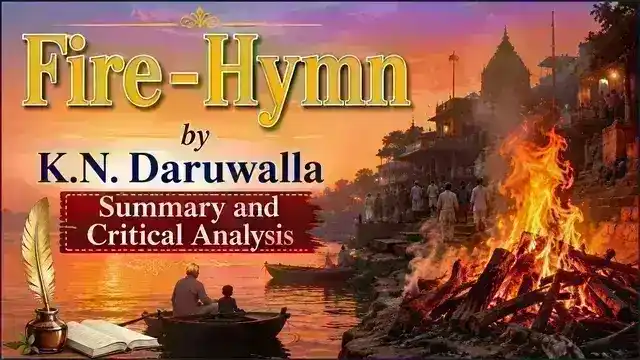
The poem opens with a haunting picture of a burning ghat, where the eerie glow of funeral pyres, ghostly lights, ashes, and half-burnt bodies creates an atmosphere of horror and mystery. As a child, the poet is deeply disturbed when his father points out that fire sometimes “forgets” its dead, leaving behind half-burnt limbs. This disturbing experience leads the young poet to make a solemn vow to save fire from the “sin of forgetfulness.” Many years later, however, life confronts him with another painful reality when, because the nearest Zoroastrian Tower of Silence is far away, he is compelled to cremate his own first-born child according to Hindu custom. In that moment, the sacred fire appears to absolve him of his guilt, but the poet once again rebels by resolving to save fire from the “sin of forgiving.” Through these two contrasting resolutions, Daruwalla transforms a personal experience into a profound reflection on faith, grief, responsibility, and conscience.
At a deeper level, Fire-Hymn is a symbolic poem that explores the paradoxical nature of fire. Traditionally regarded as a purifier, a divine witness, and a source of spiritual transformation, fire in this poem also becomes an imperfect and morally ambiguous force capable of both failure and forgiveness. Daruwalla uses vivid imagery, irony, symbolism, and psychological insight to reveal the complex relationship between religious rituals and human emotions. The poem raises universal questions about death, memory, sin, forgiveness, and the limitations of ritual, making it much more than a poem about cremation. It is a meditation on the human condition, where faith and doubt coexist in painful harmony.
Thus, Fire-Hymn stands as one of K.N. Daruwalla’s finest achievements, blending autobiographical experience with philosophical depth and artistic excellence. Its rich symbolism, haunting imagery, and emotional intensity make it a significant contribution to Indian English poetry. The poem ultimately reminds readers that true spirituality lies not merely in religious customs but in compassion, moral responsibility, and the enduring struggle of the human conscience.
Summary of the Poem:
This poem centres round two incidents, each of which led the poet to form a certain resolve. The first incident occurred when the poet was yet a boy. Walking along the river – bank in the company of his father, and passing the ghat where the Hindus cremated their dead, the boy saw the red – hot embers still glowing, many hours after a dead body had been cremated. But what attracted the father’s attention was the half – burnt fingers of the dead body. Pointing to those half – burnt fingers, the father told the boy that sometimes the fire failed to perform its task fully and that, as a consequence , some limb or portion of a limb remained only half – burnt.
On seeing those half – burnt fingers to which his attention had been drawn by his father, the boy felt somewhat depressed. As a Parsi and a follower of Zoroaster, the boy felt pained by the thought that the fire, of which he was a worshipper because of his Parsi religion, sometimes failed to perform its function fully. Clenching his fist, he swore that he would never again allow the fire to commit the sin of forgetting its function.
Subsequently the poet never again came across any case of the fire having failed to consume a dead body fully. In the meanwhile he had grown up into a man and had got married. Twenty years had passed since his father had drawn his attention to the failure of the fire to burn a dead body fully. And now his own first – born child was dead. According to the Parsi custom, the dead body should have been exposed on a raised structure known as the Tower of Silence to be eaten up by birds of prey ; but the nearest such place was about a thousand miles away. The poet was therefore compelled to have his child cremated. When the dead body was consigned to the fire, the poet heard the fire telling him that he was forgiven for having committed a sin by violating the Parsi code. In other words, the fire forgave the poet for not exposing the dead child to the vultures. But the poet could not forgive himself for having deviated from the Parsi code of conduct; and he therefore felt that the fire had this time committed another sin. Now its sin was that it had forgiven him for his violation of the Parsi code. What the poet means to say is that, even if the Tower of Silence was situated a thousand miles away, he should have carried out the Parsi ritual instead of having adopted an alternative method of disposing of the dead child.
Critical Analysis of the Poem:
Fire as a Sacred Symbol:
Fire Hymn is a fine specimen of Daruwalla’s poetic craftsmanship. It centres round two incidents in the poet’s life. The first incident took place when as a boy he was walking along the river bank with his father. Passing through the burning ghat the boy saw phosphorescence light enveloping the environs. Once wandering “at dawn fast river bank and ghat” they (the poet and his father) saw the red – hot embers still glowing, many hours after a dead body was cremated. Fire consumes dead body leaving only bones and ashes. One day his father was upset to see half burnt fingers of a dead body, which he showed to his son. Pointing to these fingers the father told him that sometimes fire failed perform its task and leaves unburnt limbs and other parts of the body.
Fire’s Failure in Cremation:
Half cooked limbs
bore witness so the fire’s debauchery.
My father said, “You see those half – burnt fingers
and bone stubs? The fire sometimes forgets its dead.”
The Father’s Oath to Preserve Fire’s Sanctity:
At this he was depressed. Being a Parsi and worshipper of fire he was pained at the forgetfulness of fire towards it dead. He swore “to save fire from the sin of forgetfulness.” Subsequently the poet minutely observed that the fire never failed in performing its duty of consuming the whole human body.
The Tragic Death of the Poet’s Son:
The next episode takes place after a long gap of twenty years. The poet’s first born child was dead. Contrary to the Parsi custom he consigned the dead body his son to the flames, as the nearest tower of silence was a thousand miles away. But the poet had a feeling of guilt because he failed to observe the Parsi custom. When fire was consuming his son’s dead body the poet heard the fire telling him: “You stand forgiven” for violating the Parsi code. The poet solemnly ruminates:
Broken, yet rebellious, I swore this time
to save it from the sin of forgiving.
Conclusion: A Thoughtful and Artistically Crafted Poem:
Fire Hymn is a serious, touching and thoughtful poem. It is conspicuous for lucid, succinct style, pithy and highly condensed expressions, apt words and excellent craftsmanship. It also acquaints us of Parsi custom of disposing of dead bodies.