Introduction:
Mulk Raj Anand occupies a distinguished place in Indian English literature as one of the pioneering novelists who gave voice to the poor, the oppressed, and the socially marginalized. More than a novelist, he was a profound humanist whose literary works reflect his unwavering faith in the dignity, equality, and brotherhood of humanity. Deeply influenced by the ideals of Mahatma Gandhi, Karl Marx, Rabindranath Tagore, and the universal principles of compassion and justice, Anand believed that literature should not merely entertain but also awaken social consciousness and inspire positive change. His novels expose the evils of caste discrimination, untouchability, poverty, exploitation, and colonial oppression while affirming the inherent worth and humanity of every individual.
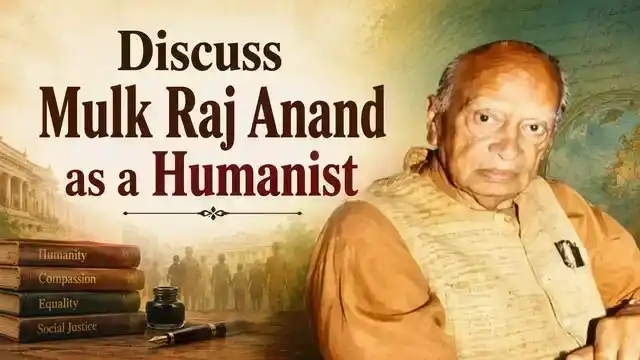
Anand’s humanism is rooted in his deep sympathy for the downtrodden and his passionate concern for social justice. Instead of glorifying the lives of kings, aristocrats, or the privileged classes, he chose ordinary men and women—untouchables, coolies, peasants, labourers, and the impoverished—as the heroes of his fiction. Through unforgettable characters such as Bakha in Untouchable, Munoo in Coolie, Gangu in Two Leaves and a Bud, and Lal Singh in The Sword and the Sickle, Anand presents the suffering of the oppressed not to evoke mere pity but to demand empathy, equality, and reform. His realistic portrayal of their struggles highlights the cruelty of social institutions while emphasizing the resilience and nobility of the human spirit.
As a humanist, Anand strongly opposed every form of discrimination based on caste, class, religion, race, or economic status. He believed that all human beings deserve equal respect, freedom, and opportunities regardless of their social background. His novels advocate love, compassion, tolerance, and mutual understanding as the foundations of a just society. Although he vividly depicts human misery and exploitation, his works never descend into pessimism. Instead, they express hope for a better world where justice, dignity, and humanitarian values triumph over prejudice and oppression.
Thus, Mulk Raj Anand’s fiction stands as a powerful testament to his humanitarian vision. His novels combine artistic realism with a deep moral purpose, making him not merely a social realist but one of the greatest humanists in Indian English literature. His enduring concern for the common man, unwavering faith in human dignity, and commitment to social transformation firmly establish him as a novelist whose works continue to inspire readers with their timeless message of humanity, equality, and compassion.
Meaning of Humanism:
Humanism means interest in man as an ordinary man. Man should be made the subject of a piece of art. He should be accepted and loved as a whole human being with all his weaknesses, instincts and impulses as well as his virtues and high qualities. It is a system of thought in which human interests, values and dignity are held dominant. It is an attitude of mind that concentrates upon the activities of man rather than upon the supernatural world, the world of nature or the animal world. During the Renaissance humanism flourished greatly. It was related with the ancient classics that emphasised things human and of this world as contrasted with supernatural things. According to humanism which is a Renaissance doctrine, man is great, dignified and worthy, while according to the medieval or older view man was wicked, worthless and doomed to destruction.
A Thorough Humanist:
Mulk Raj Anand is a thorough humanist as he upholds the dignity of man. He emphasises the dignity of man irrespective of caste, creed and wealth. He pleads for the compassion for man. He treats art as an instrument for developing the whole man. He attacks superstitions feudalism, imperialism, oppressors and wealthy people for exploiting man as a whole. Man is supreme for the novelist. Anything or any person that comes in the way of his life and development is to be rejected by him. He says, “Man is the measure of all things, he is the maker and breaker of worlds.” Anand has genuine respect and love for man, faith in his ability to live a life full of dignity. According to him man can solve all his problems with the help of imagination, reason and knowledge.
His Disbelief in Fatalism:
Mulk Raj Anand does not believe in fatalism. According to him it is a malady that has plagued the Indian masses for centuries. Fatalism weakens man’s faith in his own dignity and power. It persuades him to be a passive dependent on unseen and non – existent forces. There are no doubt a few social and economic maladies but they can be removed from the life of man with the help of advancing science, knowledge and love and compassion for the low and the weak. Anand is against Fascism, Feudalism and Imperialism; he is in favour of democracy, socialism and peaceful co-existence.
Salient Features of His Humanism:
(1) The highest reality in the world is man, ‘the whole man’, and not God and the supernatural. There is no life hereafter; man has only one life that is here and now. (2) Religion is a matter best left to individual preference. (3) Man’s highest duty is to realize his full potential for a complete life. This can be achieved by accepting the principles of equality between man and woman, brotherhood of all men, the right of every person to enjoy social, economic and political freedom. (4) Differences in nationality, culture, religion, creed and caste and exploitation of man by man should be totally eradicated for the full development of man. (5) Art and science should go together to make man happier and nobler. (6) Education should be available to all for social reconstruction. (7) Casteism is a heinous crime and a severe blow to the concept of the dignity, of man; so it is to be rejected. (8) Women must have equal rights with men. They should not be enslaved.
His Concern for the Under – dog:
Mulk Raj Anand wrote for the upliftment of the under – dog of society. He thinks that a “truly humanist art is commensurate with the needs of our times”, and he has a conscious mission to raise the untouchables, the peasants, the coolies and other suppressed members of the society, to human dignity and self-awareness . He is a crusader in the cause of humanity, he writes not for art’s sake but for the sake of man, for refining and ennobling him and for inspiring him into action which can achieve the well – being of mankind as a whole. He has not written fairy tales for mere amusement. He writes his novels with a social purpose to teach man the art of human dignity. The oppressed should know the essential dignity of man in spite of his weakness and under privileged situation, while the oppressor should have love and compassion for the oppressed. This is the motive behind most of his novels.
His Humanism in Untouchable:
Mulk Raj Anand’s Untouchable is a socially conscious novel . It is concerned with feelings of Bakha, a sweeper – boy, and his experiences in the course of a single day in the town of Bulasahab. The priest reaches his sister Sohini with foul intentions but seeing Bakha cries out, “defiled, defiled.” Bakha feels highly humiliated and declares to his father: “They think we are mere dirt because we clean their dirt.” He tries to find a out solution of his predicament. Three solutions are offered to him: Conversion to Christianity, Gandhi’s message of brotherhood of men and a proper drainage system. Here the novelist acts as a social reformer, or plays the role of the propagandist.
His Humanism in Coolie:
Anand’s humanism is revealed in Coolie. The novel expresses his belief in the essential dignity of man whether he belongs to the rich or the poor class, to low or higher class. In the novel Anand shows that suffering and pain are inevitable features of human life but man can control pain and remove suffering by brotherhood, love, compassion and equality. Had Bibi Amrit Kaur treated Munoo with kindness, his tragedy would have been avoided. Munoo meets not only bad people but also good people. The good people who are kind to him are Chota Babu, Prabhu Dayal and his wife, the elephant driver and Ratan. Anand brings home to the reader the living conditions of the poor and the heartlessness of the rich and suggests that true comradeship of man for man exists only among the very poor people. In the novel the author rejects Fate or God or Chance. Munoo is a victim of the cruelty of man. Anand says that most of our problems are created by man and they can be solved by him. Man is the reason the miseries of mankind, and he alone can fight against and undo them if he has the vision doubled with the requisite will. Through his novels Anand tries to awaken man’s slumbering conscience to acquire the true vision and develop necessary will to reconstruct humanity in India, and the world at large.
Conclusion:
Anand uses his art in the service of humanity. He regards all human beings as one unit, humanity. There should not be any division between the rich and the poor, the haves and have – nots. He has sympathy for the fate of the have – nots, coolies, untouchables, peasants, villagers, factory – workers, labourers and soldiers all are paid due attention and should be treated with love and compassion by the better placed people. As Anand has a great deal of humanistic zeal he has been criticised as a propagandist. But the fact is that he never suggests any solution to the problem as a propagandist does. He leaves it to the reader to conclude. Another remarkable thing to be noted is that he has not sacrificed art for the sake of propaganda. His novels are fine pieces of beautiful art.