Introduction:
Lord of the Flies is one of the most celebrated and influential novels of the twentieth century. Written by the British novelist and Nobel Prize-winning author William Golding, it was first published in 1954. The novel is widely regarded as a masterpiece of modern English literature because of its profound exploration of human nature, civilization, morality, power, and the inherent conflict between order and chaos. Although it appears to be an adventure story about a group of schoolboys stranded on a deserted island after a plane crash, it is, in reality, a powerful philosophical allegory that examines the darker aspects of human behaviour.
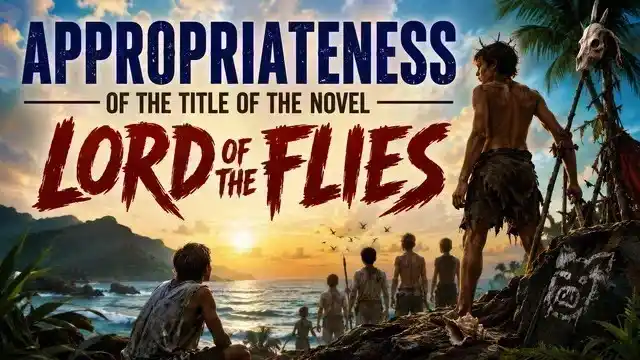
The story revolves around a group of British boys who find themselves isolated on an uninhabited tropical island with no adult supervision. Initially, they attempt to establish a democratic society based on rules, cooperation, and mutual respect. However, as time passes, fear, selfishness, the desire for power, and primitive instincts begin to dominate their actions. The gradual collapse of order into violence and savagery illustrates Golding’s belief that the seeds of evil exist within every human being and that civilization merely suppresses these destructive impulses.
Golding wrote Lord of the Flies in the aftermath of the Second World War, a period during which humanity witnessed unprecedented violence, cruelty, and destruction. His personal experiences as a naval officer during the war deeply influenced his view of mankind. Unlike earlier writers who portrayed children as naturally innocent and society as corrupting them, Golding presents a contrasting vision by suggesting that evil is an inherent part of human nature. Through the behaviour of the boys, he demonstrates how quickly civilized values can disappear when external authority and social restraints are removed.
The novel is rich in symbolism and allegory. Characters such as Ralph, Piggy, Jack, Simon, and Roger represent different aspects of human personality and society. Similarly, symbolic objects like the conch shell, Piggy’s glasses, the signal fire, the beast, and the Lord of the Flies itself convey deeper meanings related to democracy, intelligence, hope, fear, evil, and the collapse of civilization. These symbols transform the novel from a simple survival narrative into a profound reflection on political systems, moral responsibility, leadership, and the psychological struggle between good and evil.
One of the central themes of the novel is the conflict between civilization and savagery. Golding demonstrates that civilization depends upon laws, discipline, cooperation, and ethical values, while savagery emerges when fear, violence, and the lust for power are allowed to prevail. The novel also explores themes such as leadership, innocence, loss of childhood, fear of the unknown, group psychology, the abuse of power, and the fragile nature of social order. Through these themes, Golding raises timeless questions about human morality and the true foundations of civilization.
The language and style of Lord of the Flies are simple, vivid, and highly descriptive, making the novel accessible while simultaneously conveying complex philosophical ideas. Golding combines realistic narration with symbolic imagery and psychological insight, creating a narrative that is both intellectually stimulating and emotionally compelling. His skillful use of irony, symbolism, foreshadowing, and natural imagery enhances the novel’s artistic and thematic depth.
Today, Lord of the Flies continues to be studied in schools and universities across the world because of its universal themes and enduring relevance. It serves as a powerful warning about the dangers of unchecked human instincts, the abuse of authority, and the collapse of moral values. More than a survival story, the novel is a timeless exploration of human psychology and society, reminding readers that the struggle between civilization and barbarism exists not only in isolated islands but within every individual and every community.
The title ‘Lord of the Flies’ can be traced to the Jewish hierarchy (order of the angels) of demons. There is reference to Beelzebule who is known as the Lord of the Flies. He was the chief representative of false Gods. The title, therefore, is appropriate to a novel which like a fable conveys a moral that the world is not the reasonable place we are best to believe. Because all power corrupts us: One has to live with the darkness of man’s heart.
It is the author’s philosophy to restore principles in an unprincipled world. He wants to restore belief to a world of disbelievers. In Chapter 10 for the first time in the novel there is mention of the ‘Lord of the Flies’. It is the head of the killed sow swarmed with flies. Thus, the beast and Lord of Flies are identified with each other. “Man produces evil as the bee produces honey”. Evil plays dominant role in the novel.
Background, Principle and Message:
William Golding is one of the greatest novelists of this age. He had seen two world wars in 1914-18 and 1939-45. During the Second World War he joined the Royal Navy and was present at the sinking of the Busmarck. After the war he started writing novels. So, he had personal experience of what a war does to human society. The background of the novel ‘Lord of the Flies’ is a nuclear warfare in Europe. The novel also opens in a terrifying atmosphere. Nuclear war has broken out in Europe and a school from the English Home Countries has been evacuated by an aeroplane to an unknown forest. The writer wants to restore traditions, civilization and human values in an atmosphere of barbarism. This is what he wants to achieve in this novel. It deals with a boyish adventure. But the inner theme is “an attempt to bring out the defects of society back to the defects of human nature.”
Derivation of the Title:
The title of the novel is taken from Jewish order of angels of demons. Beelzebule was supposed to be the chief representative of false God. He was called ‘Lord of the Flies’. What we realise is that once the restraints of civilization are removed, the Lord of the Flies or the Evil begins to rule over us. The grown – ups are engaged in deadly warfare. So, the children on the island get into open conflict. There is conflict between Jack and Ralph. There is conflict between democracy and dictatorship. England and France stand for democracy and Germany and Italy stand for dictatorship. The writer wants to reveal this fact through this novel in the person of Ralph and Jack. The vast majority of them paint themselves. They throw off their clothes and turn into savages. They begin to worship the Lord of the Flies. The naval officer is ashamed of their appearance and reprimands them when he sees them painted. He expects them that they should have behaved better.
Worship of the Beast and Murder of Simon and Piggy:
The beast becomes a reality for the boys. Jack soothes it by ceremony and sacrifice. He leaves the head of the sow he killed as offering to the Beast. He says that this head is for the beast. It is the gift. He hopes that in this way the Beast will leave them alone. This was the practice of the primitive savages. They please and satisfy their deities by sacrifices and offerings. In this way, Jack sets up a new order. Murder and torture takes the place of peaceful life and co-existence. Simon is killed by spears and clubs by the dancing boys mistaking him for a beast Piggy is killed by the huge rock that flew over him. Ralph is hunted in the end. Thus, we see the full impact of the Lord of the Flies on the boys. The inherent evil of the human heart becomes obvious through Jack and his hunters.
Conclusion:
Simon alone is free from the delusion of the beast and the spirit. Because he is governed by his intuition and instincts which often prove correct. And he is not frightened of the beast. He does no believe in it. He also sees the killing of the some by Jack. He also sees offering of its head as a gift for the darkness. He is nauseated and falls in a fit. The sow’s hand is swarmed with flies on a stick planted in the ground. It seemed to him to be the Lord of the Flies. The grinning head told him what the beast was. There was none to help him except him. He was beast. He was the evil in man. He was a part of him. Thus, we can say that the title is appropriate and to the mark of the novel.