Introduction:
Alfred, Lord Tennyson’s The Lady of Shalott is one of the finest and most celebrated allegorical poems in English literature. First published in 1832 and revised in 1842, the poem is inspired by the medieval Arthurian legends, yet its significance extends far beyond its romantic setting. While on the surface it narrates the tragic story of a mysterious lady confined to a tower on the island of Shalott, the poem symbolically explores profound themes such as the conflict between art and life, isolation and society, imagination and reality, freedom and restriction, and the inevitable consequences of pursuing one’s desires. Through its rich symbolism and vivid imagery, Tennyson transforms a simple narrative into a powerful allegory of the human condition.
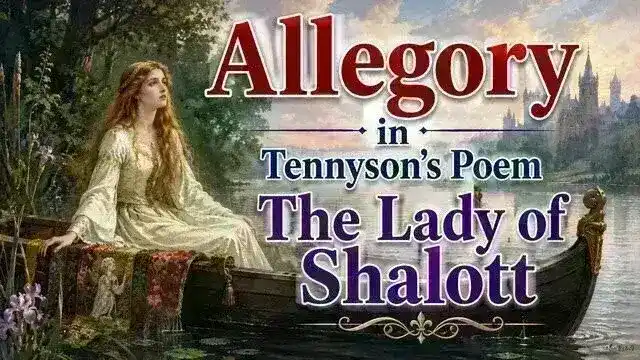
The Lady herself is not merely a medieval maiden but an allegorical figure representing the artist, poet, or creative individual who remains detached from the ordinary world in order to preserve artistic vision. Her tower symbolizes isolation, the mirror represents indirect perception of reality, the web signifies artistic creation, the mysterious curse reflects the limitations imposed upon the artist, and Sir Lancelot embodies the irresistible attraction of real life, beauty, and human experience. When the Lady abandons her artistic seclusion to embrace reality, her symbolic world collapses, illustrating the eternal struggle between the ideal world of imagination and the practical world of experience.
The poem, The Lady of Shalott also reflects the spiritual and intellectual concerns of the Victorian age. It raises questions about the role of the artist in society, the price of creativity, the conflict between duty and personal desire, and the tension between individual freedom and social constraints. Tennyson deliberately leaves many symbols unexplained, allowing readers to interpret the poem on multiple levels—psychological, moral, artistic, and philosophical. This richness of meaning makes The Lady of Shalott a timeless allegory rather than merely a romantic narrative.
Thus, The Lady of Shalott stands as a masterpiece of allegorical poetry in which every major character, object, and event carries symbolic significance. By blending medieval romance with universal human concerns, Tennyson creates a poem that continues to fascinate readers and critics alike. Its enduring appeal lies in its ability to express, through allegory, the eternal conflict between imagination and reality, artistic devotion and worldly experience, making it one of the greatest symbolic achievements of Victorian literature.
The Hidden Allegorical Meaning:
The Lady of Shalott is not a simple romantic narrative. There is a hidden meaning behind this poem. For its subject – matter the poem has a lady who is doomed to live all alone. If she ever dared to leave her tower or to peep out of the window, she would meet her end. One day it happened that Sir Lancelot, a bold and brave knight, bearing redcross passed that way. The Lady having seen his figure through the hanging mirror in her house fell in love with him. She came to see him through the win low. The curse then befell her. The mirror cracked and the walls shook. She then journeyed through a boat towards Camelot. On the boat she wrote her name: The Lady of Shalott. But she died in the way and the boat carried her body to the city of Camelot where all people including Sir Lancelot paid tributes to her. Under the grab of this story, there is an allegorical meaning. The key to the allegory is contained in the following lines:
“Or when the moon was overhead,
Came two young lovers lately wed;
I am half sick of shadows, said
The Lady of Shalott.”
Allegory of Reality versus Imagination:
Some critics find the symbolic meaning that a person who lives in a world of dreams and fantasy finds it fatal to come into contact with reality. A life of isolation is therefore condemned. The Lady of Shalott keeps herself away from the reality of life because she is afraid that if she does so, a curse will fall upon her. Therefore, she lives a secluded life and keeps herself contented with looking at the shadows of reality. But these shadows do not give her permanent satisfaction and there is an inward urge in her to share the real life with the real people. The allegorical meaning behind the story is that there is no doubt that real life is full of problems, struggles and worries and therefore there is a tendency among some persons to escape the reality of life and live comfortably in the world of imagination. But such persons succeed only for a short time, because the real life and the temptations to live it are so strong that they cannot be avoided for long. No doubt, real life creates many problems, but it has a pleasure of its own. Human nature cannot be happy for long with imaginative creations. Within every human being, there is an inner urge to face the reality of life, though it may bring him all kinds of sorrows and miseries. So in spite of these trials and tribulations of life a man cannot help plunging into it even at the risk of being defeated in the process of living. This is what exactly happens in the case of the Lady of Shalott.
Allegory of Artistic Isolation:
There is another allegorical interpretation also of the poem. The poem also deals with the problem of artistic isolation. Shalott is an island, the island – paradise that Tennyson also uses in the Lotos Eaters. This island Paradise is the imaginative heaven of the poet. The Lady of Shalott symbolises the retired artist or poet, living in ivory tower, her web, the poet’s work of art and the curse, the contact with harsh reality. As soon as the artist faces the reality of life, his dreams are shattered.
Symbolism of the Mirror and the Artist:
The mirror in the poem suggests much beyond its role as an item in the fairy story. As the Lady weaves ‘the mirror’s magic sights’ in her tapestry, she is herself partly taking the role of artist and her existence in the island castle has something in common with the artist’s apartness. Moreover, as she sees reality only through her mirror, so the artist may tend to experience life at second hand, drawing his knowledge not from direct contact but from other works of art. The artist has his own special nature, like the Lady partly an affliction to him, partly a blessing. For life in the ordinary day – to – day world, he may be all unfit, as was the Lady, and for him, as for her, only disaster may follow the attempt to break bounds. This seems to be an apt allegorical background of the poem.