Introduction of the Story:
Hunger is a powerful and thought-provoking short story written by the renowned Indian author Nasira Sharma, one of the most distinguished contemporary writers in Hindi literature. The story is a realistic portrayal of poverty, unemployment, and the relentless struggle for survival among the underprivileged sections of society. Rather than presenting hunger merely as the absence of food, Sharma explores it as a symbol of human deprivation, helplessness, social inequality, and shattered dreams. Through simple language, realistic dialogue, and vivid characterization, she exposes the harsh realities of people whose lives revolve around the basic necessity of earning enough to satisfy their hunger.
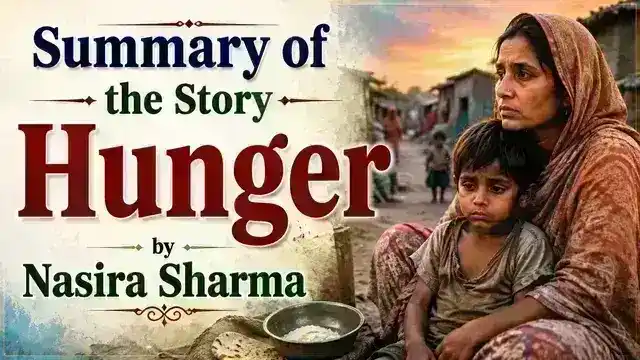
The story is centred on two poor individuals—Rizwan, an educated young man searching for employment, and Kasim, a rag seller who struggles every day to earn enough money to feed his family. Although one is educated and the other is illiterate, both are victims of the same economic hardship. Their conversation reveals that hunger, unemployment, and poverty affect people regardless of their educational background. Through their experiences, Nasira Sharma highlights the widening gap between the promises of development made by governments and the harsh realities faced by ordinary people.
One of the most striking features of the story is its conversational style. Instead of following a traditional narrative pattern, the story unfolds mainly through a series of questions and answers resembling an interview. This unique technique makes the narrative lively, realistic, and emotionally engaging. As Rizwan interviews Kasim, the readers gradually discover the painful truths about poverty, unemployment, family responsibilities, and the struggle for dignity. The dialogue-based structure also reflects the contrast between the educated world of journalism and the silent suffering of the working poor.
The title “Hunger” carries both a literal and symbolic significance. Literally, it refers to the lack of food that dominates the lives of poor people. Symbolically, it represents the hunger for employment, security, dignity, justice, and a better future. The story emphasizes that when people are compelled to fight for their daily bread, they hardly have the time or energy to think about politics, social reforms, or national development. Hunger thus becomes a powerful metaphor for the many forms of deprivation that continue to exist in society.
Nasira Sharma’s realistic approach, deep social concern, and sensitive portrayal of human suffering make Hunger a remarkable work of social realism. The story does not merely evoke sympathy for the poor; it also urges readers to reflect upon the structural inequalities and failures of society that perpetuate poverty. It ultimately conveys a universal message that every human being deserves dignity, opportunity, and the basic necessities of life. Through its compelling characters and meaningful themes, Hunger remains a timeless commentary on the human condition and the enduring struggle for survival.
The story entitled “Hunger” written by Nasira Sharma is not called a typical story, but it is a sort of conversation, with short questions and answers. It can be considered to an interview, though there are no lengthy answers, nor any debate on some topic.
The story deals with the basic problem of the poor people who had to struggle a lot to satisfy their extreme hunger. Sometimes, for want of work, they are seen at the edge of starvation. Sometimes they work hard, but fail to earn enough money to buy food. For the poor, it is very difficult to sustain their livelihood. Besides satisfying hunger, there are other basic needs which they cannot fulfil. If they earn a little money, they cannot get rid of other problems which rise in every family. They cannot give proper treatment if someone is ill in their house. Their children remain uneducated, so they cannot seek proper job. The poor are struggling throughout their lives only to fulfil their basic need of food. They have no time to ponder over on any other matter. They are hardly aware of larger social, political or economic issues. They do not bother who rules them and how.
Through the story, Nasira draws our attention towards poverty that is striking feature of the world. Some people possess a lot of wealth whereas a large number of people are left to suffer every day without basic necessities of life. The story deals with such two individuals – one is educated and is trying his hands in the world of media as a journalist whereas the other is rag seller who struggles hard to earn a little money and support his family living at village.
Nasira Sharma portrays the picture of absolute poverty of the two characters not only to make us be pitiful towards them but to comment also on the government schemes for the poor and the destitute which promise much but are of no help to the people suffering every day in different corners of India . Through her writing, Nasira Sharma tries to build up a social and political awareness amongst the masses about India, the real India.
Summary of the Story:
Rizwan’s Search for Employment:
The story depicts a day in Rizwan’s life when he completed his education and was in search for a suitable job. He wandered here and there in search of a job which could fulfil the basic requirements of his family. Ultimately, he succeeded to get a job as a journalist through an acquaintance in the Kihaan newspaper. While appointing on the job of journalist, a condition was put before him. He had to submit interviews with five people with their names and addresses. If he succeeded to do so, he would be considered an eligible candidate for this job. Rizwan, who badly needed the job, got ready to accept the condition.
Rizwan’s First Interview with Kasim:
When the story begins, Rizwan is found at a shop where the cold drinks were being sold. He was observing people in the crowded market. He did not know whom to approach for his interview as everybody seemed to be busy. He had to interview a person who worked to earn his livelihood but was not a shopkeeper. It was a busy market place where despite high prices and unemployment, people were buying things, eating and drinking. Rizwan saw a man carrying a load on his head and walking in his direction. Thinking that he was the right person to be interviewed, he quickly went to the man. Placing a hand on his shoulder, Rizwan asked his name. The man told him that his name was Kasim. Then Rizwan began to ask questions related to his profession, income, residence and family. At first he looked at the questions with suspicion. Then he agreed to answer Rizwan’s questions, but he was reluctant to answer his questions. He told Rizwan that he sold old clothes and his earning was about five hundred rupees a month. When Rizwan asked if he could manage with that, He replied in positive. When Rizwan asked him about his address, Kasim got angry, for he had no permanent place to live in the city. He slept wherever he found a place. When asked about his family, he told that his family and children lived in the village. When Rizwan asked him he knew that the government was helping the poor farmers, he replied that he did not have any knowledge.
Kasim’s Views on Farming, Poverty and the Government:
Rizwan consoled Kasim saying that he was only a journalist and he should not have any fear of him. Next Rizwan asked him if he would like to possess land and do farming. Kasim clearly answered in negative. He told Rizwan that he was happy with his present work. He also told him that besides him, there was nobody in his family to do farming. His father was so old that he could do nothing, and he did not have any brother who could cooperate with him. He told Rizwan that his father was a labourer and his income was not sufficient to meet the family needs. Then he asked Kasim if the latter knew that their country was prosperous in petroleum resources; or whether he knew who the Shah was or whether in his reign there was peace and prosperity. Kasim replied that he did not have any knowledge about the Shah or his reign. He told Rizwan that his father used to talk about his (Kasim’s) grandfather and the hunger and poverty the family supported Kasim’s grandfather died due to hunger and cold. His great grandfather did physical labour in someone’s house and he died due to suffering from high fever.
Kasim’s Distrust of Government Promises:
Kasim told Rizwan that his son was four years old. He played around in the village running after the dogs. He thought that next year when he would be of five, he would also engage him in his own business. He told Rizwan that he had already crushed under heavy debts and did not want to add more problems in his life by getting any help from anyone. He did not want to get loan from bank. Rizwan asked him if he was interested in setting up a business and passing a blissful life in the midst of luxuries. Kasim replied that the schemes and promises were made by the government to help them with a number of things, but all this was deceptive to innocent people. All the promises and schemes of the government were hollowed. No consequences could be found. Kasim did not want to waste time over a meaningless interview. He said that he had no more time for such idle talks and left the place abruptly to start work.
Rizwan’s Despair and Hope for the Future:
When Kasim left the place, Rizwan felt helpless. Rizwan thought that he had also unending problems at home – problems of hunger and poverty. His mother was suffering from ailment. His father had left this world and his younger brothers had to drop out of school. It seemed now time to starve. Having taken the interview with Kasim, he thought of reaching his office in order to submit the report of interview. By now, he was badly tired. He felt extremely hungry because he had eaten nothing since morning. There was no money in his pocket except for the bus pass. After reaching office, Rizwan submitted the interview. He replaced Kasim’s name and address with his own. As he moved out of the office, his feelings were extremely soothed. He was consoled to think that he had work at least for the next day. But the problem for finding another name and address for tomorrow’s interview was already worrying him. Having an optimistic attitude he tried to ease his mind from this tension. He assured himself that he would find a way for the next day. He thought of the better conditions for tomorrow. He left everything to his fate and set about for his home.