Introduction:
T. S. Eliot’s The Waste Land (1922) is one of the greatest and most influential poems of twentieth-century English literature. Written in the aftermath of the First World War, the poem vividly portrays the spiritual, moral, cultural, and psychological collapse of modern civilization. Rather than presenting a unified narrative, Eliot employs a fragmented structure, shifting voices, multiple languages, myths, religious references, and literary allusions to reflect the shattered condition of the modern world. The poem captures the deep sense of despair, alienation, confusion, and hopelessness that characterized post-war Europe, where traditional beliefs and values had lost their meaning.
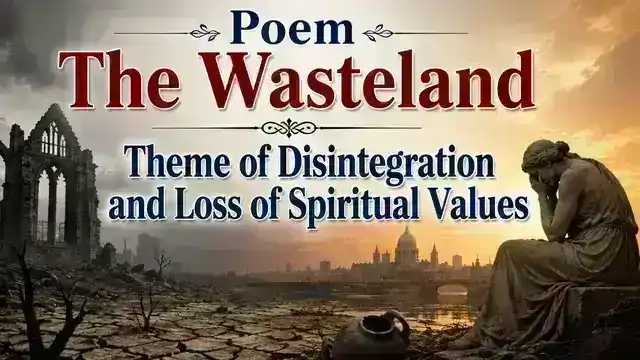
The central theme of The Waste Land is the disintegration of human life and the loss of spiritual values. Eliot presents modern society as a barren wasteland in which people have become emotionally sterile, morally exhausted, and spiritually empty. Materialism, selfishness, mechanical living, and the pursuit of sensual pleasures have replaced faith, love, compassion, and religious devotion. Human relationships have become superficial and meaningless, while individuals experience loneliness, isolation, and a profound lack of purpose. The physical barrenness of the landscape serves as a powerful symbol of the inner desolation of humanity, emphasizing that spiritual decay is more destructive than material poverty.
Eliot further suggests that the crisis of modern civilization is not merely political or economic but fundamentally spiritual. The collapse of religious faith, ethical ideals, and cultural traditions has left humanity without moral direction or inner peace. Through numerous references to Christianity, Buddhism, Hindu philosophy, Greek mythology, and the legend of the Holy Grail, Eliot contrasts the spiritual richness of the past with the emptiness of the present. These allusions reinforce the idea that modern civilization has become disconnected from the timeless values that once sustained human life.
Despite its overwhelming portrayal of decay and fragmentation, The Waste Land is not entirely pessimistic. Eliot hints at the possibility of spiritual renewal through self-discipline, self-sacrifice, compassion, and religious awakening. The concluding Sanskrit words—“Datta” (Give), “Dayadhvam” (Sympathize), “Damyata” (Control), and “Shantih Shantih Shantih”—offer a message of hope and spiritual regeneration. Thus, The Waste Land ultimately presents the theme of disintegration and the loss of spiritual values not merely as a record of modern despair but as a profound warning that humanity can regain harmony and peace only by rediscovering faith, moral responsibility, and spiritual consciousness. Through its rich symbolism, complex imagery, and universal vision, the poem remains a timeless exploration of the spiritual crisis of the modern age.
Theme of Disintegration:
One of the important themes of The Waste Land is a vision of dissolution and spiritual drought. This spiritual drought arises from the degeneration, vulgarisation, and commercialisation of sex. Sex – act is the source of life and vitality, when it is exercised for the sake of procreation and when it is an expression of love. But when it is severed from its primary function, and is exercised for the sake of momentary pleasure or monetary benefit, it becomes a source of degeneration and corruption. It then represents the primacy of the flesh over the spirit, and this results in spiritual decay and death. It was a woman, and Adam’s concupiscence or obedience to the flesh, that led to the original sin and the Fall of man, and it is this very obedience to the flesh which accounts for the spiritual and emotional barrenness of the modern age.
Sexual Degeneration at all Levels:
The poem, in its spirit, reflects the anxiety, despair, neurosis, boredom, and mental vacuity of the modern age. In the contemporary waste land there is a corruption and sexual degeneration at all levels. The title A Game of Chess suggests that sex has become a matter of intrigue, a matter of moves and counter moves, a source of momentary pleasure , a sordid game of seduction and exploitation of the innocent . There is the fashionable society woman who, despite all her pomp and show, despite all the luxury with which she is surrounded, is bored and fed up with the meaningless routine of her life, and is neurotic and hysterical as a consequence. Her love, too, suffers from mental vacuity and is unable to keep up even small conversation.
Spiritual Degeneracy due to Sexual Perversion:
Perversion of sex is just animal like copulation. There is neither repulsion nor any pleasure, and this absence of feeling is a measure of the sterility of the age. This perversion of sex is also to be seen in the lower classes of society. The songs of three Thames daughters clearly show that they have been sexually exploited, but they can do nothing about it. There is decay and spiritual degeneracy whenever the sexual function is perverted. The purpose of the sexual function is procreation and it is sanctified only in marriage. When the sexual act is separated from procreation, there is spiritual degeneracy. Sex has been separated from love, marriage and procreation. The sex act has become beastly or mere animal copulation and hence there is decay and spiritual barrenness.
Having no Faith in God and Religion:
Throughout the poem, it is evident that man is shown to have lost his faith in God and religion. This decay of faith has resulted in the As of vitality, both spiritual and emotional. Consequently, the life in the modern waste hand is a bite – in – death, a living death, like that of the Sibyl at Cumse. Modern man has lost his sense of good and evil. In the modern desolate land the people are dead. They merely exist like dead things.
No Belief in Independent Souls:
Materialists do not believe that they possess independent souls in them. According to Christianity and the Upanishad, the bodies which do not have souls in them are dead. Materialism strictly prohibits spiritual pursuits, since denies an independent existence of the soul. Materialism is the cause of spiritual death. On the London Bridge Tiresias finds so many people going to, and coming from, the places where they work. So, he exclaimed:
“I have not thought death had undone so many.”
Materialistic Life, a Waste Land for the Soul:
The modern materialistic life is a waste land for the soul. For materialism teaches its followers not to follow spiritual pursuits such as prayer to God, meditation, etc. It looks upon charity as an incentive to beggary, and upon compassion as sentimentality. The soul feeds no noble acts of spirituality such as selfless prayers to God, meditation, etc. It drinks the water of selfless Christian brotherly love called Agape. But modern materialistic life has for the soul neither spiritual food nor spiritual drink. It is hence a waste land for the spirit.