Introduction of the Poem:
Fire and Ice is one of the most celebrated and thought-provoking short poems by the renowned American poet Robert Frost. First published in 1920 and later included in his poetry collection New Hampshire (1923), the poem consists of only nine lines, yet it presents profound philosophical, moral, and psychological insights into human nature. Despite its brevity, the poem explores the destructive potential of two powerful human emotions—desire and hatred—and suggests that either has the capacity to bring about the end of the world.
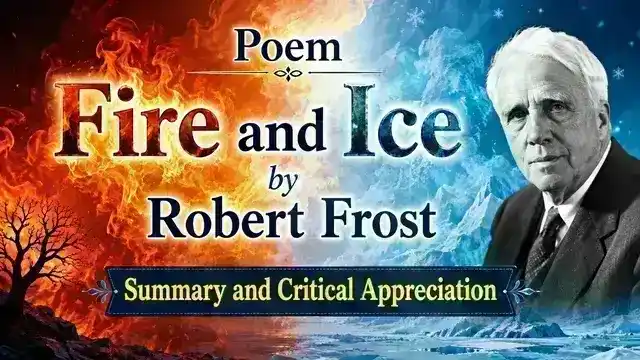
Drawing upon the symbolic images of fire and ice, Frost transforms natural elements into metaphors for conflicting human passions. Fire represents uncontrolled desire, greed, ambition, lust, and excessive craving, while ice symbolizes hatred, indifference, cruelty, and emotional coldness. Through these vivid symbols, the poet emphasizes that both intense passion and deep resentment are equally dangerous because they destroy not only individuals but also society and civilization.
The poem is inspired by the traditional belief that the world may end either in flames or in freezing cold, but Frost gives this idea a deeper allegorical meaning. Rather than focusing on physical destruction alone, he highlights the moral and emotional forces that gradually ruin human relationships and ultimately threaten humanity itself. Thus, the poem becomes a universal reflection on the consequences of human weaknesses and uncontrolled emotions.
Although Fire and Ice is remarkably concise, it is rich in symbolism, irony, imagery, and philosophical depth. Frost’s simple conversational language conceals a profound message about the dual nature of human emotions and the necessity of self-control. The poem demonstrates his extraordinary ability to express complex truths through ordinary words and familiar images.
Ultimately, Fire and Ice is not merely a poem about the possible end of the world; it is a timeless meditation on the destructive power of human desire and hatred. Its universal theme, compact structure, memorable imagery, and enduring relevance have made it one of Robert Frost’s finest short poems and a masterpiece of modern English literature.
Summary of the Poem:
Some people are of the view that fire will ultimately destroy the world. Against this some others hold that ice will be the ultimate destroyer of the world. The poet from his own experience of the passion of desire favours the first view. The meaning is that desire or longing is such a fiery passion that it will ultimately bring total destruction of the world. But then immediately the poet realizes that the passion of hatred is as much destructive as ice. As such he says that if the world undergoes two total ends ice too will be a sufficient source of its destruction. But the poet is non – committed. He keeps the issue open because these two alternatives are only tentative and not absolute. However the moral of the poem remains undisturbed that passion of every kind is destructive.
Critical Appreciation of the Poem:
Theme: Human Passions and Their Destructive Power:
The lyric “Fire and Ice” is a short composition of only nine lines but within the compass of only nine lines the poet has been successful in enclosing vast concepts. The theme of the poem is that human passions are always destructive, whether it is the passion of desire or the passion of hate. The analogy here implied establishes a comparison between the heat of human passions and desires on the one side and the cold ice-like hatred on the other side. Both of these antithetical passions have equal power of destruction. If we try to analyse the poem on a symbolic level, the fire stands for the heat of love and the ice stands for the cold of hatred. In the last line of the poem the poet uses the word “suffice”; its use is significant. It tells us that fire and ice both have equal destructive power.
Compact Structure and Artistic Excellence:
The poem has a very compact structure. Within nine lines the poet has spoken about the alternative methods in which the world could come to an end. Speaking about the structure of this poem, Thompson observes: “Structurally, such a compact unit, nicely balanced strikes with the clean accuracy of a poised fist. The backward thrust of ‘fire’ at the end of the fourth line seems to intensify the thought; the paired rhymes in the second half lead to such a natural pause after ‘great’, that the octosyllabic line is permitted to break to give the seemingly internal rhyme after force and to permit the laconic understatement of the last three words.”
Emersonian Wisdom and Balanced Philosophy:
The economy with which Frost achieves his purpose is marvellous. This poem frees Robert Frost from the charge of being a Puritan. This is the most representative poem of Frost to tell us about the Emersonian wisdom in Frost. Opposing views have been synthesized so beautifully that a casual reader is not able to observe any dichotomy in it at all. He believes that the world will end in fire. In this he is with those who feel like this. He also believes that ice or the great deluge will end this world. And this is perhaps the accumulated wisdom to say ‘yes’ to everything spoken to you. The poet does not want to make his poetry palpable by loading his views on the reader. He rather, not in so many words, says that we should entertain the views of others, even if they are divergent.
Colloquial Style and the Power of Understatement:
The real charm of the poem lies in the Yankee habit of understatement. Although the emotion is intensely felt, yet it is expressed in extremely controlled language. As a record of colloquial language this poem is superb. In this connection John Lynen has observed: “The colloquial phrasing does not negate the poem’s bitterness. Quite opposite: It is the means of raising to an extreme pitch. The more the speaker’s manner disclaims strong feelings, the more powerful his feelings seem. Furthermore, the understatement dramatizes the special character of the Yankee swain. His ironic, casual manner manifests a more than normal sensitivity of thought. He is speaking of things in human nature which arouse the deepest terror, but he will not yield to emotional outbursts. Instead, he holds back, pretending to be amused, indifference because only by reining in his own feelings can he be free to face the brutal results of man’s emotions realistically, or recognize their full destructiveness.”