Introduction of Poem:
This poem “Enterprise” appeared in Nissim Ezekiel’s fourth volume of poems which was first published in 1960 and, in its second edition, in 1965, under the heading “The Unfinished Man”. Here we have an allegorical poem, that is, a poem which, apart from its surface meaning, has a meaning below the surface. R. Parthasarathy, himself a poet, says that Ezekiel’s poetry is the work of a keen, analytical mind trying to explore, and communicate, on a personal level, feelings of loss and deprivation. Nissim Ezekiel himself said that scores of his poems were written for his personal, therapeutic purposes (that is, for purposes of giving an outlet to his morbid feelings and unpleasant thoughts in order to find relief and comfort). One such poem is Enterprise. In this poem a situation is examined with ironic detachment in the hope that it would offer the writer with a release for his pent-up feelings.
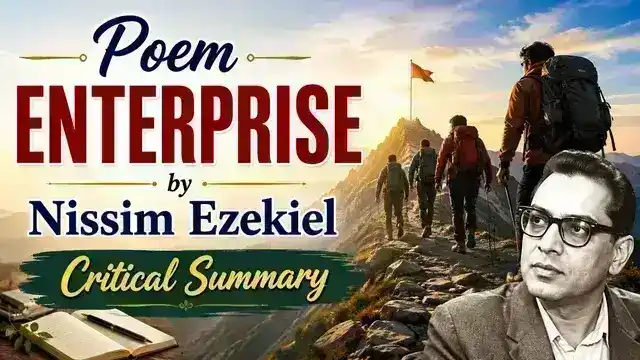
Poem “Enterprise”:
It started as a pilgrimage,
Exalting minds and making all
The burdens light, the second stage
Explored but did not test the call.
The sun beat down to match our rage.
We stood it very well, I thought,
Observed and put down copious notes
On things the peasants sold and bought,
The way of serpents and of goats,
Three cities where a sage had taught.
But when the differences arose
On how to cross a desert patch,
We lost a friend whose stylish prose
Was quite the best of all our batch.
A shadow falls on us and grows.
Another phase was reached when we
Were twice attacked, and lost our way.
A section claimed its liberty
To leave the group. I tried to pray.
Our leader said he smelt the sea.
We noticed nothing as we went,
A straggling crowd of little hope,
Ignoring what the thunder meant,
Deprived of common needs like soap.
Some were broken, some merely bent.
When, finally, we reached the place,
We hardly know why we were there.
The trip had darkened every face,
Our deeds were neither great nor rare.
Home is where we have to gather grace.
Critical Summary of the Poem:
A group of men, including the poet, embarked on a voyage. They called it a “pilgrimage”. They were spiritually exalted. Because of the noble and sacred nature of their enterprise, i.e., the journey, they made light of the hurdles in their way. The first phase went off well, but the pilgrims found that, at the second stage, the sun scorched them; it tested their courage and fortitude. At a spiritual level, the journey was akin to the journey to the Holy Land.
They bore this well. They were keen observers; they took copious notes and recorded their observations “on the things peasants sold and bought” as well as the behaviour of serpents and goats, as also the “three cities where a sage had taught”. The allusion to the “three cities” is obscure here.
They then reached a desert, and there arose differences among them on how to cross that patch. One of the pilgrims, who possessed a gift for stylish writing, abandoned the journey midway. They lost their best intellect. This entailed a great loss, and they were dismayed. A pall of gloom fell over them.
In another phase of the voyage, the pilgrims were attacked twice and they lost their way. Some of them broke away from the group as they wished to travel the rest of the way on their own. The poet tried his best to persuade them to remain with the rest of the group. He also “tried to pray” for the success of their enterprise, and the leader informed him that they were near the sea, meaning that they were on the right track. Now they could continue their “pilgrimage”.
On their way, this small group of stragglers did not notice anything. They were without hope; they did not pay and heed to what the thunder said. They despaired of the success of their mission. They were deprived of their common basic needs like soap. Some of them were totally broken down, while others were bent with their physical and spiritual burden.
Finally when they reached their destination, they hardly knew that they were there. They had all become dark and gloomy; they were all clueless. They hadn’t achieved anything great or exceptional in the alien land. Their best achievements had been back home, and that is where their future achievements would lie.
Critical Analysis of “Enterprise” by Nissim Ezekiel:
Introduction:
“Enterprise” is one of the most celebrated poems by Nissim Ezekiel, one of the pioneers of modern Indian English poetry. The poem presents an allegorical journey that begins as a noble pilgrimage but gradually turns into an experience of confusion, conflict, disappointment, and self-realization. Though the poem appears to describe a physical expedition, it is actually a symbolic representation of human life, social movements, spiritual quests, and the pursuit of ideals.
Through simple language, vivid imagery, and profound symbolism, Ezekiel conveys that people often lose sight of their original purpose because of ego, disagreements, and worldly distractions. Ultimately, the poem concludes with the realization that true peace and spiritual fulfillment are found not in distant destinations but within one’s own home and inner self.
Central Theme:
The central theme of Enterprise is the futility of external pursuits when inner harmony is absent. The poem explores how noble ideals gradually lose their significance because of human weaknesses such as pride, selfishness, division, and misunderstanding. It also emphasizes that spiritual grace is not attained through wandering but through self-awareness, unity, and inner peace.
Enterprise as an Allegory of Human Life:
The entire poem is an allegory. The pilgrimage represents the journey of human life, while the travelers symbolize humanity. Their changing attitudes, internal conflicts, and eventual disappointment mirror the experiences of people who begin life with dreams and ideals but often lose direction because of material concerns, ego, and personal ambitions.
Thus, the poem suggests that life’s greatest lessons are learned not through outward adventures but through inward realization.
The Pilgrimage: Symbol of Noble Aspirations:
The journey begins with enthusiasm and idealism:
“It started as a pilgrimage
Exalting minds and making all
The burdens light.”
The pilgrimage symbolizes a quest for truth, wisdom, knowledge, or spiritual enlightenment. At the beginning, everyone shares the same purpose, making difficulties appear insignificant. Their unity strengthens them and fills them with optimism.
This stage reflects the innocence and idealism of youth when people are motivated by high ambitions and noble dreams.
Observation Instead of Understanding:
During the second stage, the travelers become observers rather than seekers.
“Observed and put down copious notes
On things the peasants sold and bought.”
Instead of concentrating on their spiritual mission, they become interested in documenting external details. Their observations remain superficial and fail to deepen their understanding.
Ezekiel suggests that excessive intellectual curiosity without genuine insight often distracts people from their real objectives.
Conflicts and Loss of Unity
The turning point comes when disagreements arise:
“But when the differences arose
On how to cross a desert patch.”
Even a small disagreement leads to serious consequences. A friend leaves the group, symbolizing the breakdown of unity and trust.
The growing shadow mentioned in the poem symbolizes increasing despair, suspicion, and emotional distance among the travelers.
Ezekiel highlights how human ego and differences of opinion can destroy even the noblest enterprises.
Leadership, Division, and Isolation:
As the journey continues, the group faces attacks, loses its direction, and becomes divided.
“A section claimed its liberty
To leave the group.”
The splitting of the group reflects the fragmentation of societies, political organizations, religious movements, and even families. Individual freedom is important, but excessive individualism often weakens collective strength.
The speaker’s attempt to pray indicates his search for guidance, while the leader’s false confidence (“he smelt the sea”) shows misplaced optimism without clear vision.
Physical and Mental Exhaustion:
The travelers gradually become exhausted and hopeless.
“A straggling crowd of little hope.”
They ignore the warning signs represented by thunder and become deprived of basic necessities such as soap, symbolizing the loss of both physical comfort and moral cleanliness.The line:
“Some were broken, some merely bent.”
beautifully illustrates the different ways people respond to hardship. Some are completely defeated, while others survive with emotional scars.
Failure of the Enterprise:
When the travelers finally reach their destination, they experience no joy or fulfillment.
“We hardly know why we were there.”
Their long journey has become meaningless because they have forgotten its original purpose.
The destination offers neither glory nor satisfaction. Instead, it leaves them emotionally and spiritually exhausted.
Ezekiel suggests that achieving a goal without preserving one’s ideals results in emptiness rather than success.
The Significance of the Final Line:
The concluding line is the philosophical climax of the poem:
“Home is where we have to gather grace.”
This line carries multiple meanings. Home symbolizes inner peace, self-realization, and spiritual fulfillment. Grace represents divine blessing, wisdom, contentment, and moral strength. The poet argues that happiness cannot be found through endless wandering or external achievements. Real enlightenment begins with self-discovery and harmony within one’s own surroundings.
This memorable conclusion transforms the poem from a travel narrative into a profound spiritual statement.
Symbolism in the Poem:
Ezekiel employs rich symbolism throughout the poem. Pilgrimage symbolizes human life and spiritual quest. Desert represents hardships and difficult decisions. Sun symbolizes suffering and challenges. Sea represents hope and the illusion of reaching one’s destination. Thunder symbolizes warnings that people ignore. Shadow represents despair, conflict, and growing disappointment. Home symbolizes inner peace, self-knowledge, and spiritual realization. Grace symbolizes divine wisdom, inner fulfillment, and moral redemption. These symbols deepen the philosophical meaning of the poem.
Use of Imagery:
The poem contains vivid and realistic imagery. The burning sun creates an atmosphere of hardship. The desert evokes loneliness and uncertainty. The peasants, serpents, goats, and cities provide realistic travel images. Thunder and shadow create emotional tension. The final image of home offers peace and resolution. The imagery strengthens both the literal and symbolic dimensions of the poem.
Tone and Mood:
The tone changes gradually throughout the poem. It begins with hope, enthusiasm, and confidence. It becomes reflective and analytical. It then turns pessimistic as conflicts increase. The final stanza is philosophical, calm, and deeply introspective. The changing tone mirrors the emotional journey of the travelers.
Language and Style:
Nissim Ezekiel’s style is remarkable for its simplicity and clarity.
1. Simple Diction:
The language is direct, conversational, and accessible while conveying profound philosophical ideas.
2. Narrative Style:
The poem unfolds like the story of an expedition, making its symbolic meaning easy to follow.
3. Irony:
The greatest irony lies in the fact that the travelers complete their journey only to discover that they no longer understand why they undertook it.
4. Symbolism:
Almost every object and event possesses symbolic significance, making the poem rich in multiple layers of meaning.
Message of the Poem:
The poem conveys several universal messages. Noble ideals require unity and perseverance. Human ego and internal conflicts often destroy collective efforts. External success is meaningless without inner purpose. True spiritual fulfillment comes from self-realization rather than physical journeys. Home, family, and one’s inner conscience remain the true sources of peace and grace.
Conclusion:
“Enterprise” is a profound philosophical poem that uses the metaphor of a pilgrimage to explore the complexities of human life, ambition, and spiritual searching. Nissim Ezekiel masterfully demonstrates how lofty ideals can be undermined by pride, division, and loss of purpose. The travelers’ disappointing journey ultimately reveals that lasting fulfillment is not found in distant destinations but in inner awareness and moral integrity. With its powerful symbolism, lucid language, reflective tone, and universal message, Enterprise remains one of the finest achievements of modern Indian English poetry, offering timeless insights into the human condition and the enduring search for meaning.