Character Sketch of Hayavadana:
Introduction:
After reading the story of the play ‘Hayavadana’ written by Girish Karnad we find Hayavadana as an important character. He was the product of an unequal marriage between a celestial being and a princess living on the earth. As a princess as well as the mother of Hayavadana she belonged to Karnataka. She had fallen in love with a white stallion at the time of her marriage. She had given up her ego to get completeness. She could marry any handsome prince because many of them had come there from different places to marry her but she made her choice in a strange manner because she had chosen an animal as her life – partner. Both of them spent their whole life on the earth. The mother of Hayavadana had her choice for a horse because she needed it. In this way, Hayavadana was a mythological figure out of his unequal parents. Hayavadana had the traits both of his earthly mother and gandharva father. He had the human body from his mother and the head of a horse, being very fond of it.
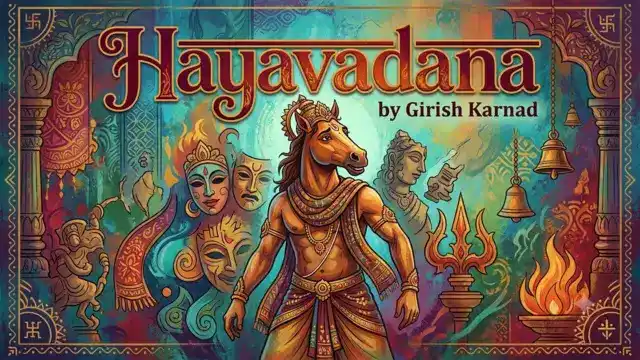
Hayavadana is one of the most remarkable and symbolic characters in Girish Karnad’s Hayavadana. He is neither completely human nor completely horse. He has the body of a man and the head of a horse, making him a strange and tragic figure. His unusual appearance becomes the central symbol of the play’s exploration of identity, incompleteness, and the search for perfection. Although his name gives the play its title, Hayavadana is much more than a comic or mythical character. He represents the universal human desire to become complete and to discover one’s true identity.
Hayavadana as a Symbol of Incompleteness:
The most significant aspect of Hayavadana’s character is that he symbolizes incompleteness. He is trapped between two forms—human and animal—and belongs fully to neither world. His physical appearance causes him immense suffering because society rejects him as abnormal. His life reflects the condition of every human being, who often feels incomplete in one way or another.
Hayavadana’s struggle symbolizes the inner conflict experienced by people who seek wholeness and fulfillment but are unable to achieve it completely. Through this character, Karnad suggests that incompleteness is an essential part of human existence.
His Mysterious Origin:
Hayavadana narrates the story of his birth, revealing that his mother was a princess who fell in love with a magnificent horse. Later, the horse transformed into a celestial being, leaving behind the child Hayavadana with a horse’s head and a human body. This mythical origin adds a supernatural dimension to the play while emphasizing the confusion surrounding Hayavadana’s identity.
His extraordinary birth also reflects the blending of folklore, mythology, and fantasy that characterizes Karnad’s dramatic style.
A Seeker of Complete Identity:
Hayavadana’s greatest desire is to become a complete human being. He travels to temples and holy places, hoping that divine intervention will remove his horse’s head. His journey reflects the universal search for identity and self-acceptance.
Ironically, when Goddess Kali grants his wish, he becomes a complete horse instead of a complete man. This unexpected transformation demonstrates that destiny often operates beyond human control. Karnad uses this irony to show that perfection is not always achieved in the way people expect.
Innocence and Simplicity:
Despite his unusual appearance, Hayavadana possesses a simple, innocent, and honest nature. He openly shares his problems without bitterness or deceit. He sincerely hopes that others will help him find a solution to his suffering.
His childlike faith in divine power and his straightforward behavior make him a sympathetic and lovable character. The audience feels compassion for him because he never intentionally harms anyone.
Comic Yet Tragic Character:
Hayavadana combines comedy with tragedy. His horse-headed appearance often creates humorous situations, and his conversations provide moments of laughter. However, beneath this comic surface lies deep emotional pain and loneliness.
His inability to fit into society makes him a tragic figure. Karnad skillfully blends humor and pathos, making Hayavadana both entertaining and emotionally moving.
Representation of the Play’s Central Theme:
Hayavadana embodies the central themes of the play—identity, completeness, and the conflict between appearance and reality. While Devadatta and Kapila struggle with the relationship between the body and the mind, Hayavadana struggles with the conflict between human and animal identity.
His story runs parallel to the main plot and reinforces the idea that complete perfection is impossible for human beings.
Transformation into a Complete Horse:
At the end of the play, Hayavadana becomes a complete horse. Surprisingly, instead of sorrow, he experiences happiness because he has finally become whole. However, one human quality remains—his human voice. Later, through the innocent laughter of the child, even this disappears, and he neighs like a real horse.
This final transformation symbolizes the acceptance of one’s true nature. Unlike the human characters, whose conflicts remain unresolved, Hayavadana achieves a form of completeness, though not the one he originally desired.
Hayavadana as a Mythical and Symbolic Figure:
Hayavadana is not merely an individual character but also a powerful symbol. He represents every person who struggles with questions of identity, selfhood, and fulfillment. His mythical nature allows Karnad to explore philosophical ideas in a dramatic and engaging manner.
The character also reflects the influence of Indian mythology and folk theatre, particularly the traditions of masks, storytelling, and symbolic representation.
Moral and Philosophical Significance:
Through Hayavadana, Girish Karnad conveys that the pursuit of absolute perfection is often futile. Human beings constantly seek completeness, but life remains filled with contradictions and imperfections. Hayavadana’s journey teaches that true peace may come through accepting one’s destiny rather than endlessly resisting it.
His character reminds us that identity is complex and that perfection is not always defined by human expectations.
Conclusion:
Hayavadana is one of the most memorable characters in modern Indian drama. His unique appearance, emotional suffering, innocence, and symbolic importance make him the heart of Girish Karnad’s play. He represents the eternal human search for identity and completeness while demonstrating the irony of fate. Through Hayavadana, Karnad brilliantly combines mythology, philosophy, humor, and tragedy to present a profound reflection on the human condition. Thus, Hayavadana stands as a timeless symbol of humanity’s quest for wholeness and self-realization.
Though Hayavadana had wished to get rid of his human voice, yet he could not become successful in his efforts because he could not get a complete neigh of the horse. He felt that it was the wish of the almighty to use all human beings for His play. The head of the horse proved important in the end because it controlled the body. The body and head of a horse showed the complete life of the horse. The idea is very clear from these words of the text: “Though the play grants his wish and he does not get rid of his human voice and acquires a complete neigh of the horse – this is a comic overture. Hayavadana also undermines the beliefs that it is the head that rules. His horse bead ultimately has its say on the body, though he had been willing otherwise.” In that way. Hayavadana could live a complete life of an animal, or hors