Introduction:
Midnight’s Children is the most celebrated novel of Salman Rushdie and one of the greatest achievements of modern Indian English literature. Published in 1981, the novel won the Booker Prize in the same year and was later honored with the Booker of Bookers (1993) and the Best of the Booker (2008), recognizing it as one of the finest novels ever to receive the prestigious award. The novel established Rushdie as an internationally acclaimed writer and became a landmark in postcolonial literature for its innovative narrative style, imaginative storytelling, and profound exploration of history, politics, identity, and nationhood.
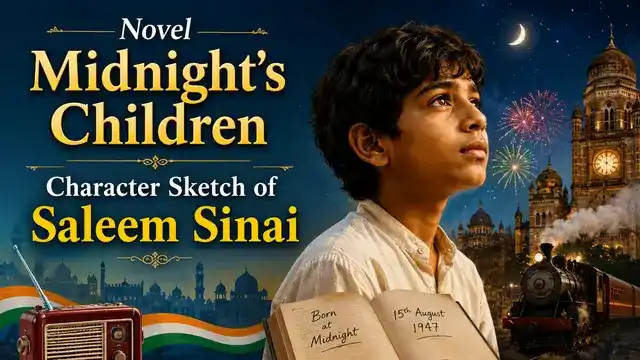
Set against the backdrop of India’s transition from British colonial rule to independence and the subsequent decades of political and social change, Midnight’s Children presents a fascinating blend of historical reality and fantasy. The story begins at the exact moment of India’s independence on 15 August 1947, when Saleem Sinai, the protagonist and narrator, is born precisely at the stroke of midnight. Because of his birth at this historic moment, Saleem’s life becomes mysteriously intertwined with the destiny of the newly independent nation. Through his personal experiences, the novel portrays the triumphs, struggles, hopes, and disappointments of modern India.
The narrative revolves around the extraordinary children born during the first hour after midnight on the day of India’s independence. These “midnight’s children” possess unique supernatural powers that symbolize the immense potential and diversity of the new nation. Saleem himself possesses telepathic abilities, enabling him to communicate with the other midnight’s children, while each child represents a different aspect of India’s cultural, linguistic, religious, and regional diversity. Through these magical elements, Rushdie transforms history into myth, creating a unique literary form known as magical realism, where the ordinary and the extraordinary coexist naturally.
One of the most remarkable features of the novel is its narrative technique. Saleem Sinai narrates his life story retrospectively, constantly moving between the past and the present while addressing his listener, Padma. His storytelling is nonlinear, fragmented, humorous, and self-conscious, reflecting the complexity of memory and history. Rushdie deliberately blurs the boundaries between fact and fiction, suggesting that history itself is shaped by personal perspectives and subjective interpretations rather than by objective truths alone.
At its core, Midnight’s Children explores several universal themes, including identity, memory, history, nationalism, cultural hybridity, family relationships, destiny, power, and the impact of political events on individual lives. The novel examines how personal identities are influenced by national history and how individuals cannot remain detached from the social and political forces surrounding them. It also raises important questions about the meaning of freedom, the challenges of nation-building, and the coexistence of diverse cultures within a single nation.
Rushdie’s language is rich, vibrant, and highly imaginative, combining English with Indian expressions, myths, folklore, and oral storytelling traditions. His energetic prose reflects the multilingual and multicultural character of India, making the novel both intellectually stimulating and artistically captivating. The fusion of satire, irony, fantasy, symbolism, and historical realism gives Midnight’s Children a distinctive literary identity that has influenced generations of writers across the world.
As a postcolonial masterpiece, Midnight’s Children is much more than the story of one individual; it is an allegory of independent India itself. Saleem Sinai’s life mirrors the nation’s journey through independence, partition, wars, political upheavals, and social transformations. By intertwining personal destiny with national history, Salman Rushdie creates a powerful narrative that celebrates India’s diversity while critically examining its complexities and contradictions.
Midnight’s Children stands as a monumental work of contemporary literature that brilliantly combines history, myth, politics, fantasy, and human experience. Its innovative narrative style, memorable characters, philosophical depth, and symbolic richness continue to make it an indispensable text for the study of postcolonial literature, magical realism, and modern Indian fiction. Even decades after its publication, the novel remains a timeless exploration of the relationship between individual lives and the destiny of a nation.
After reading the story of the present novel ‘Midnight’s Children’ written by Salman Rushdie we find Saleem Sinai as the chief narrator. He was born at the stroke of midnight on August 15, 1947 at the precise moment of India’s independence. It is said about him that he was celebrated in the press and he was also welcomed by the then Prime Minister Jawaharlal Nehru himself. He was not related by telepathic powers to 1,000 other midnight’s Children who were born in the first hour of the Independence of India. He was not only related to India but he was also related to Pakistan and Bangladesh by his narrated biography. Saleem Sinai who was a man of multi – faced personality related 31 years of his own life to his detailed narrative in the present novel ‘Midnight’s Children’.
Saleem Sinai’s Role as the narrator of the story:
The close and the serious study of the present novel indicates Saleem Sinai’s role as the chief narrator who is well – versed with the contemporary conditions of the three countries, India, Pakistan and Bangladesh. He related the war between India and Pakistan which was fought in 1971. He related how Pakistan was defeated by India and after it Bangladesh came into being after General Niazi had surrendered before General Manek Shaw of India. He also related how he himself escaped from Bangladesh (Dacca) into India with three other young soldiers who had been killed one by one in the course of their escape. As soon as he reached Bombay, he succeeded to marry Padma who had met him at the gate of the pickle factory. Both of them loved each other and they had a plan to celebrate their honeymoon in Kashmir. It was also the moment of his 31st birthday when he had an idea of his death and disintegration.
The Description of the Contemporary conditions of India, Pakistan and Bangladesh:
As we study closely the narration or the biography of the three countries in the present novel ‘Midnight’s Children’ we also get the real picture of the contemporary life of the people of the India, Pakistan and Bangladesh. He related the war between India and Pakistan in 1971 resulting in the defeat of Pakistan and the creation of Bangladesh from the eastern part of Pakistan after the surrender of about ten million soldiers of the Pakistani army under the order of General Niazi before the Indian General Manek Shaw. Saleem narrated how the Pakistani soldiers had killed innocent peoples, raped a large number of women and looted the shops, etc. of the city of Dacca. He also related his own pitiable condition of that group or unit which was with him at that time.
Multi – faced Personality of Saleem:
After reading the story of the present novel we find that Saleem Sinai was in the possession of his multi – faced personality. He related the story of his own life and the biography of India and Pakistan which he had narrated in ‘Midnight’s Children’. Though he was the biological son of William Methwold and Vanita, yet later he became the adopted son of Ahmed and Amina. Both his life and personality came under the influence of both Hindu and Muslim culture. It is necessary to mention that Mary had changed the nametags of Saleem and Shiva out of her cunning nature. In the beginning, Nadir Khan was his original father. Later General Zulfikar had left his own son in favour of Saleem. Later Picture Singh had adopted him as reincarnated Saleem after Parvati had made him invisible. Saleem himself had described it, in these words: “My inheritance includes this gift, the gift of inventing new parents for myself whenever necessary.”
If we analyse the multi – faced personality of Saleem Sinai we find it a perfect blending of science, facts and fiction. His own life and personality were closely related to the contemporary conditions in the twin countries of India and Pakistan. In writer of the, ‘Midnight’s Children’, Salman Rushdie admitted that he knew and loved the story when he was writing ‘Grimus’. He created the character of Saleem with his multi – faced personality in relation to the character of the novel mentioned above. The present novel shows not only his multifaceted personality but it also shows the contemporary conditions of both the countries, India and Pakistan. He also described how the War of 1971 between India and Pakistan indicated the low morals of the soldiers who has killed numberless people and looted their all possessions.
Saleem as the Unifying Factors in the Present Novel:
The study of the present novel ‘Midnight’s Children’ shows that Saleem Sinai had acted as the unifying factor in the course of the narration of the present biography. It is clear from his such role when he had acted to unite 581 surviving members of the M.C.C. He became the living symbol for the young persons’ hope which was soon crushed. In that situation he tried to maintain the unity but he failed miserably. When he tried to use his telepathic powers he thought, “that .I was somehow creating a world; that the thoughts I jumped inside were mine that the bodies I occupied acted at my command.” It is n s necessary to mention that Saleem tried his best to include everything in the present novel ‘Midnight’s children’ it was broadly Hindu feeling when Saleem had lost his memory. The idealism ended when Saleem had crossed the border into Pakistan. He described the War in East Pakistan highly destructive and fearful. The conditions did not improve even after Saleem’s return to India. It was a situation of disorder on both sides of the border.
The Plurality of the Indian Culture and Hinduism:
The further study of the story of the present novel clearly shows that Saleem had described the plurality of Indian culture as well as of Hinduism. It is true that the Indian culture has always been of multiplicity and of blending different cultures into the main Indian culture. According to the narrator, the Indian people always blended those elements which are interesting and they rejected the rest. He hinted that the extremists both in India and Pakistan have been showing their religious favour. He mentioned that the plurality of Indian culture shows the product of plurality of Hinduism. It is clear from a number of gods and goddesses in Hindu religion. Dr. Radhakrishnan has said that “It is this synthetic vision of Indian philosophy.” Only with this reason there is religious toleration in Hindu religion.
The Narrative Mode and Tone of the Present Novel:
As we study the present novel more and more we find the narrative mode and tone of the novel as the main source of deconstruction. It is clear through the description of the single narrator, Saleem who is present everywhere from the beginning of the novel upto its end. It is also an example of the unity of its plot. The presence of Padma, for example, is the narrative mode of the story. Though Saleem tried to unite different factors related to the contemporary political condition both of India and Pakistan but he failed miserably in his efforts. He openly admitted the difference of dates between the death of Mahatma Gandhi and the General election of 1957. He also admitted openly that he had told a lie about the death of Shiva. He could not relate the history of his family with that of India. At places, the readers of the novel clearly feel that he was hiding the truth. The description about Padma was not comprehensive.
Conclusion:
Saleem Sinai was born at the stroke of midnight on August 15, 1947 which was also the right moment of India’s independence. He added that his birth was also celebrated both in the press and by the then Prime Minister Nehru. Just then about one thousand midnight’s children were also born in the first hour. The narration clearly shows that Saleem had his multi – faced personality. He was not the biological son of William Methwold and Vanita but he was the adopted son of Ahmed and Amina. His multi – faced personality showed the blending of science, facts and fiction. His development was in relation to Salman Rushdie’s first novel ‘Grimus’. Saleem also acted as the unifying factor for all the children born at the same midnight. He became the living embodiment of the symbol of young children. Saleem also showed the plurality of Indian culture and Hindu religion. His narrative mode showed deconstruction.