Introduction of the Poem:
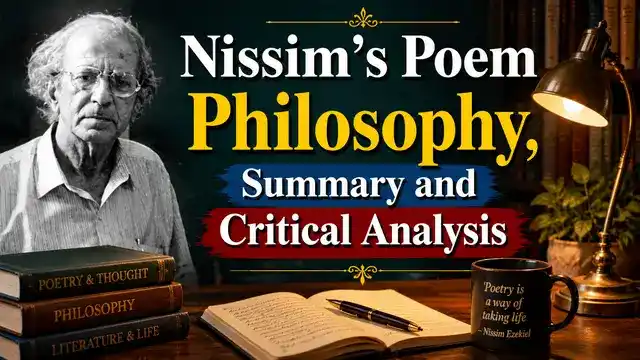
Philosophy was included in Nissim Ezekiel’s fifth volume of poems, The Exact Name (1965). It is one of Ezekiel’s most abstract poems. The poet is certainly interested in the real world of human beings and in the familiar manifestations of human nature, as also in human inter relationships. But one of his basic concerns has always been philosophy or the speculations of the human mind. Ezekiel had become interested in philosophy quite early in his life when he was living in a basement room in London. His three companions at that time (1948-52) he said were “philosophy, poverty and poetry”. Although he recognizes the value of philosophy as well as science, he feels that poetry is even more valuable.
Summary of the Poem:
The poet says, “There is a place to which I often go” in the first line. This is the domain of philosophy. He often studies philosophy and indulges in philosophical speculations, but it is not according to some pre – conceived plan; he is propelled to do so by an inner urge. On such occasions he tears himself away from his physical environment and enters a sphere ruled by the ways and rules of philosophy. He knows that philosophy employs the method of logic and reasoning. He realizes that this method is “cold” as it is totally devoid of any emotion. In this sphere there is no dearth of ideas. Philosophers are by no means slow in producing new ideas and theories about this universe.
The geologist remains busy in his researches into the origins of the earth and the evolutionary process that it has been undergoing. The original condition of the earth was far different from what its present shape and nature is. It must have been all mud in the beginning, but now it has become a solid mass. Thus geology explores the nature of the earth and offers its discoveries to us for our enlightenment. Science tells us that, in the course of the evolutionary process, numerous stars came into existence and went out of existence. However, according to the poet, every convulsion of the earth during its evolutionary process was a fleeting phenomenon—a phenomenon which must have made Time feel sorry because of the momentary duration of that convulsion. In these lines the poet mentions the changes. Science has thus done a good deal to enlighten the human mind about the nature of the universe in which man lives.
After philosophy and science have explained the mysteries of this universe, something still remains to be explained because we still continue to be puzzled by certain aspects of this universe; we painfully struggle to find a clue to its remaining secrets. The poet is not prepared to accept the explanations provided by philosophy and science as final and incontrovertible. He is of the firm view that philosophy and science or any other breach of human learning should refrain from trying to explain what they cannot really explain. Certain secrets of the universe, of the earth, and of the sky, and the mysteries of human nature can be explained only by poetry.
Poetry is the language of the common people; it is the language of the senses as distinguished from the technical language of logic and philosophy and of science. This language of the emotions offers its own explanations of the mysteries of human nature; this is the language that poetry employs. Poetry deals with the common and familiar aspects of human life, which constitute its substance and fabric. On the other hand, human nature and human inter – relationships cannot be explained by the cold, “mundane” and unemotional methods pursued by philosophy and science. Poetry can thus prove most useful to us to understand the mysteries of human life and human nature.
Critical Analysis of the Poem:
Introduction:
“Philosophy” is one of Nissim Ezekiel’s most profound and intellectually stimulating poems. It reflects the poet’s deep engagement with philosophical thought, human existence, and the search for truth. Rather than presenting philosophy as a fixed system of ideas, Ezekiel portrays it as a complex journey between reason and mystery, intellect and experience, clarity and uncertainty. The poem demonstrates his belief that while human beings constantly strive to understand life through logic, some aspects of existence remain beyond rational explanation. Through vivid imagery, symbolic language, and reflective meditation, Ezekiel explores the limitations of human knowledge and the enduring significance of ordinary life.
The Journey into Philosophical Consciousness:
The poem begins with the speaker describing a mysterious state of mind that he frequently enters without conscious effort. He is carried by an inner “flow” into a realm of cold intellectual clarity where detached philosophical thinking dominates. This state is not achieved by deliberate reasoning but appears naturally, suggesting that philosophical contemplation is an involuntary aspect of the poet’s mind.
The opening establishes philosophy as a movement away from everyday existence into a higher level of abstract reflection, where emotions are replaced by intellectual objectivity.
The Vision of Cosmic Perspective:
Ezekiel expands the poem’s scope from individual experience to the vastness of the universe. The earth is viewed in its earliest geological form, reducing civilization to primitive “slime.” Human history, achievements, and emotions become insignificant when measured against cosmic time.
The image of “a million stars” disappearing and “historic passion” appearing only as a brief “blink” emphasizes the transitory nature of human existence. Compared with eternity, all human conflicts, ambitions, and emotions appear momentary and insignificant.
Thus, the poem presents a philosophical vision in which the universe is vast, indifferent, and eternal, while human life remains fragile and temporary.
The Persistence of Meaning:
Although the poem initially suggests that everything loses significance under philosophical scrutiny, Ezekiel refuses to accept complete nihilism. He observes that “residues of meaning” continue to survive despite the apparent emptiness of existence.
Ancient myths, symbols, and human beliefs continue to guide people through suffering toward enlightenment. Even when rational thought strips away illusions, certain truths remain embedded within human culture and imagination.
This section reveals Ezekiel’s balanced outlook. He neither embraces complete skepticism nor unquestioning faith but recognizes that meaning survives even when certainty disappears.
Rejection of Absolute Rationalism:
One of the poem’s central ideas appears in the famous line:
“What cannot be explained, do not explain.”
This statement is not an encouragement to ignorance but a warning against forcing artificial explanations upon life’s mysteries. The poet rejects excessive rationalism that attempts to solve every mystery through logic alone.
Ezekiel accepts that certain aspects of existence—love, death, faith, consciousness, and the universe—cannot be fully understood through reason. Intellectual humility becomes the true philosophical attitude.
This rejection of false certainty reflects the influence of modern existential and philosophical thought, where questioning is often more valuable than easy answers.
Celebration of Ordinary Experience:
After travelling through abstract philosophical reflection, the poem returns to the ordinary world. The “mundane language of the senses” becomes meaningful because everyday experiences possess their own wisdom.
Common objects and daily life provide truths that abstract philosophy often overlooks. Reality is understood not only through intellectual reasoning but also through sensory experience, practical living, and ordinary human relationships.
Ezekiel suggests that philosophy should not separate people from life but deepen their appreciation of its simplest realities.
Imagery and Symbolism:
The poem contains powerful symbolic images that reinforce its philosophical ideas. The “flow” symbolizes the natural movement of consciousness into philosophical reflection. The “cold lucidity” represents detached intellectual reasoning free from emotional influence. The “geological prime” symbolizes the origin of existence and humanity’s insignificance within cosmic history. The “sad eye of Time” personifies Time as an eternal observer before whom all human passions quickly disappear. The “residues of meaning” symbolize enduring truths that survive despite doubt and uncertainty. The “mundane language of the senses” represents practical human experience as an alternative source of knowledge.
These symbols create multiple layers of meaning while maintaining the poem’s intellectual depth.
Language and Style:
Nissim Ezekiel employs a language that is simple in vocabulary but highly philosophical in meaning. The poem is written in a calm, reflective, and meditative tone. Every stanza develops a single philosophical idea with remarkable precision and logical progression.
The imagery is concrete, yet it conveys abstract concepts effectively. Ezekiel combines scientific references, historical perspective, mythology, and ordinary experience into a unified philosophical vision.
The poem follows a disciplined structure with regular rhyme and rhythm, reflecting the poet’s control over both thought and expression.
Philosophical Significance:
“Philosophy” reflects Ezekiel’s mature intellectual outlook. Rather than offering fixed answers, he presents philosophy as a continuous process of questioning. The poem rejects dogmatism and celebrates openness, uncertainty, and self-awareness.
It combines elements of existentialism, rational inquiry, scientific observation, and spiritual reflection. Ezekiel ultimately argues that wisdom lies not in explaining everything but in accepting the limits of human understanding while remaining fully engaged with ordinary life.
Philosophy, Poetry, and Human Understanding:
In his early autobiographical poem, Nissim Ezekiel says that “philosophy, poverty and poetry “were his three companions in his basement room in London during his student days (1048.52). Philosophy, it seems, was Ezekiel’s first love while poetry must have come to him against his wishes. The poem Philosophy shows Nissim Ezekiel as a thinker and philosopher – but a thinker and a philosopher who is not satisfied with the methods employed by philosophy to reach its conclusions about the world and the universe. Philosophy, he says, has its limitations and what cannot be explained by philosophy, or by science, has to be explained by “the mundane language of the senses”, i.e., by poetry which is more familiar to us than the language of philosophy. Poetry is not mentioned anywhere in the poem by name; it is only by implication that Ezekiel refers to poetry which, he says, “sings its own interpretations”.
The World of Cold Lucidity and Scientific Knowledge:
The poem begins with Ezekiel telling us that there is a place to which he goes often. But he doesn’t go there with any planning; it is from a natural urge within. It is a place of “cold lucidity”, i.e., the cold and unemotional method of reasoning which leads to crystal – clear conclusions and which is fertile in producing new ideas and theories about this world. He then speaks of the knowledge which scientific research has provided us with. Geology has acquainted us with the origin, the history, and the nature of this earth which, to begin with, must have all been mud but which has acquired a different shape altogether through the millennia. Astronomy tells us that numerous stars appeared in the course of centuries and then disappeared later. Ezekiel views these turbulent changes and developments in the evolutionary process as a blink of the eyes.
The Superiority of Poetry over Philosophy and Science:
Ezekiel then argues that after philosophy and science have done their job, they leave behind many things which continue to remain a mystery to us and the mind of man strives and struggles to find a clue to these mysteries; it seeks a “final formula of light”. Ezekiel rejects the cold reasoning of philosophy and science because he believes that “the mundane languages of the senses”, i.e., the language of poetry can really illumine our mind with regard to the unsolved mysteries. Philosophy and science offer us only abstractions which leave us cold and unmoved like a naked person who is already dead and, therefore, unable to feel anything. Poetry, according to Ezekiel, provides us with wisdom whereas philosophy and science provide us with knowledge. Philosophy and science have their limitations because they leave behind “residues of meaning and dark myths”, which poetry alone can illumine. The language of poetry is warm and emotional in contrast to the “cold lucidity” of philosophy. Thus Ezekiel asserts the superiority of the poet’s vocation over that of the philosopher and the scientist.
Philosophical Vision and Poetic Craftsmanship:
The poem reveals Ezekiel’s philosophic bent of mind. The bulk of his poetry is characterised by concreteness, but much of it deals with the working of the human mind. Philosophy proves that Ezekiel make poetry out of his philosophic meditations just as he can make poetry out of “the ordinariness of most events” as in The Visitor. Structurally, it is a compact and well – knit poem comprising five stanzas of uniform length moving briskly to its conclusion. It is characterized by felicity of word and phrase. The metaphor, “Here, the mills of God ground show” and the sustained simile in which each historic passion is compared to the blink of an eye adds to its vivid imagery.
Critical View:
The poem is admired for its intellectual depth, artistic discipline, and philosophical maturity. Ezekiel successfully transforms abstract philosophical ideas into vivid poetic experience without becoming obscure or overly academic.
Critics appreciate the poem’s balance between skepticism and faith, intellect and emotion, abstraction and reality. Its restrained language, symbolic richness, and universal themes make it one of Ezekiel’s finest philosophical poems. The famous concluding assertion—“What cannot be explained, do not explain”—has become one of the defining expressions of his poetic philosophy.
Conclusion:
“Philosophy” is a remarkable meditation on the nature of truth, existence, and human understanding. Nissim Ezekiel demonstrates that while philosophy broadens our vision and reveals the insignificance of individual life within the universe, it also teaches humility by acknowledging the limits of reason. The poem ultimately affirms that genuine wisdom lies not in possessing absolute answers but in accepting mystery, appreciating ordinary experience, and continuing the lifelong search for meaning. Through its profound insights, elegant structure, and universal appeal, Philosophy stands as one of the greatest philosophical poems in modern Indian English literature.