Introduction:
Tiresias is one of the most significant and complex figures in T. S. Eliot’s The Waste Land (1922). Although he appears directly only in a few lines of the poem, Eliot himself regarded Tiresias as the central consciousness that unifies the entire work. In his famous notes to the poem, Eliot states that “Tiresias, although a mere spectator and not indeed a ‘character,’ is yet the most important personage in the poem, uniting all the rest.” This statement highlights the symbolic importance of Tiresias, who transcends the boundaries of time, gender, and individual experience to become the universal witness of human civilization.
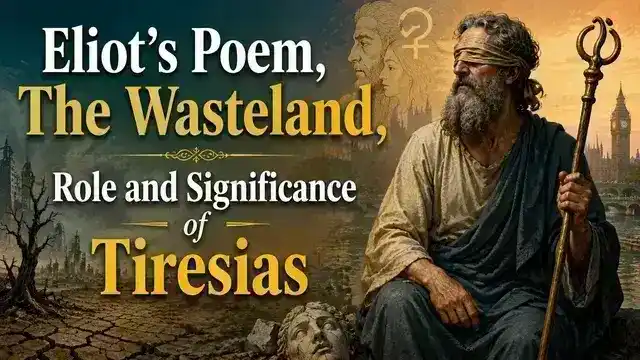
In Greek mythology, Tiresias was the blind prophet of Thebes who possessed the extraordinary experience of having lived as both a man and a woman. As a result, he represents the union of masculine and feminine perspectives, enabling him to understand the complexities of human relationships more profoundly than any other character. Though physically blind, Tiresias possesses spiritual vision, allowing him to perceive truths that remain hidden from ordinary people. Eliot employs this mythical figure to observe the moral decay, spiritual emptiness, and emotional sterility of the modern world portrayed in The Waste Land.
Tiresias serves as the connecting link between the poem’s diverse episodes, voices, and characters. Through his timeless consciousness, the fragmented scenes of ancient myths and modern urban life are brought together into a coherent vision of civilization’s decline. He witnesses the mechanical and passionless relationship between the typist and the young clerk in “The Fire Sermon,” and through his experience, the personal tragedy of modern individuals becomes a symbol of universal human degradation. His presence demonstrates that the moral failures and spiritual crises of humanity are not confined to a single age but are recurring patterns throughout history.
Moreover, Tiresias symbolizes the contrast between physical blindness and spiritual insight. While the inhabitants of the waste land remain spiritually blind despite possessing physical sight, Tiresias, though blind, understands the deeper causes of human suffering. He recognizes that the modern world’s barrenness arises from the loss of faith, the decline of genuine love, the dominance of materialism, and the absence of spiritual values. Thus, he embodies wisdom, prophecy, and the possibility of self-awareness in an otherwise fragmented and desolate world.
The significance of Tiresias also lies in Eliot’s use of the mythical method, whereby ancient myths illuminate the condition of contemporary society. Tiresias bridges the ancient and the modern, demonstrating that the problems of lust, moral corruption, spiritual exhaustion, and the search for redemption are timeless aspects of human existence. His universal perspective enables readers to interpret the poem not merely as a reflection of post-World War I Europe but as an exploration of the enduring crisis of humanity itself.
Tiresias is far more than a mythological figure in The Waste Land; he is the poem’s spiritual centre, symbolic observer, and unifying consciousness. Through his prophetic vision and dual identity, Eliot presents a comprehensive picture of the moral, emotional, and spiritual desolation of modern civilization while simultaneously suggesting the enduring possibility of wisdom and renewal. Understanding the role and significance of Tiresias is therefore essential to appreciating both the structure and the deeper meaning of The Waste Land.
Tiresias has been projected as the protagonist in The Waste Land. Basically, there is only one character in the poem. His presence gives the poem a sense of the oneness of experience and of the unity of all the periods. Tiresias assumes many masks and his voice alternates with the voices of the inmates of the modern waste land, and at times with the ghostly voices from the past: The poem is seen a single whole in the fact that its substance is formed of Tiresias’ stream of consciousness.
Tiresias, an Invisible Poet:
Tiresias is the invisible poet in the poem. From the beginning to the end, he is the poet inside the poem. While describing the room of the typist girl, the speaker tells us that he is Tiresias:
“I Tiresias, though blind, throbbing between two lives,
Old man with wrinkled female breasts….”
A Character from Ancient Greek Legend:
Tiresias is a well – known character from ancient Greek legend. His four peculiar qualities, according to Greek legend, are: “He is blind; he however possesses power of prophetic vision; and he is immortal and bisexual. On asking, the critic himself answers: A man who had also been a woman, who lived forever and could foretell the future. That is to say, not a single human consciousness but a mythological catch – all and as a unifying factor of no effect whatever.”
Fusion of Other Characters in Tiresias:
There is only one character in the poem. Other characters are only his memories, thoughts, visions, etc. Tiresias is the protagonist or the central character and the poem is his interior monologue. Memories flash through his mind. He also meditates on certain things, makes allusions and thinks like a thinker. All the poetic passages are fragments.
Tiresias, a Symbol of Nobel Soul:
Tiresias is a symbol of the noble soul as it is understood in the Vedanta. Tiresias possesses all the four qualities of the soul. In religion, the soul subsists on spiritual food and spiritual drink. In the modern materialistic world, spiritual pursuits like prayer to God, meditation, etc., have been discarded. So, the modern materialistic world is a waste land for the soul as well as for Tiresias.
His Importance:
The importance of Tiresias can be seen from various angles. He embodies the poet’s thoughts. He is Eliot’s poetic spokesman. It is he who gives expression to what the poet feels about the spiritual barrenness of the world. Tiresias is a spiritualist and believes that in the universe there is nothing real but the soul which is the root of the life’s tree called man and also the seed of future lives. The following points are being given of his importance.
(a) A Fountain – Head of Poetic Thought:
Placed in the materialistic world, Tiresias is the fountain – head of all the poetic thought of the poem. He sees, comments, makes literary echoes, reproduces from his memory conversation of others, and so on.
(b) Assuming Many Masks:
Other characters in the poem are creatures of his memories and thoughts. Male or female – each figure emerges from his memory, thoughts, vision, etc. Then he or she gets merged in his personality.
(c) His Belief in Spiritualism and Christian Existentialism:
He believes in Spiritualism and Christian Existentialism. He believes in the Upnishadic doctrine of the Atman. He also believes in Patanjali’s doctrine of Self – Realization in Yoga Samadhi. His philosophies are the bases of his symbolism and the real meaning of the poem. For example ‘rock’ consists of matter. And ‘water’ stands for the water of human kindness in man’s heart.
Conclusion:
Without his presence, The Waste Land would be a series of disconnected statements, scenes etc. For example, in section V, if we forget the presence of Tiresias, we start running after allusive themes namely, the journey to Emmaus, the approach to the Chapel Perilous, and the present decay of religion in Eastern Europe. But once we realize that the speaker is Tiresias, not Eliot, we see that those themes are only allusive ones, only echoes, nothing else. Thus, Tiresias occupies an important place in the scheme of things.