Introduction:
Night of the Scorpion is one of the most celebrated and widely anthologized poems by Nissim Ezekiel (1924–2004), a pioneer of modern Indian English poetry. First published in his collection The Exact Name (1965), the poem is a remarkable blend of realism, irony, compassion, symbolism, and social observation. Based on a childhood memory, it recounts the incident of the poet’s mother being stung by a scorpion during a rainy night in a small Indian village. While narrating this seemingly simple domestic event, Ezekiel explores profound themes such as the conflict between superstition and scientific reasoning, the endurance of maternal love, the psychology of fear, and the complexities of Indian rural life.
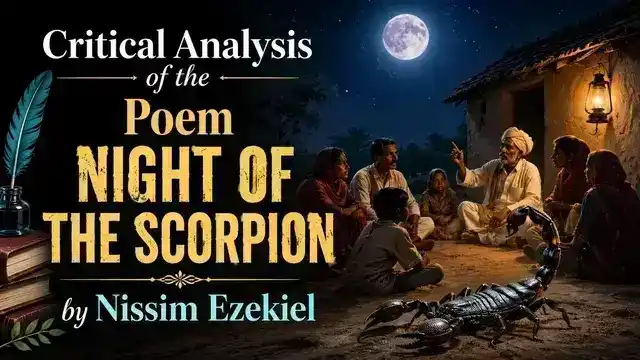
The poem vividly portrays the atmosphere of an Indian village where traditional beliefs coexist with modern ideas. After the scorpion sting, villagers gather at the poet’s home and perform various rituals, prayers, and chants to counter the poison. They believe that the movements of the scorpion influence the spread of the venom and that the suffering will purify the victim’s past sins and improve her future life. At the same time, the poet’s father, an educated and rational man, tries scientific methods and medical remedies to cure his wife. Through this striking contrast, Ezekiel neither completely condemns superstition nor glorifies scientific rationalism. Instead, he presents both perspectives objectively, allowing readers to appreciate the cultural and emotional realities that shape human behaviour during moments of crisis.
One of the greatest strengths of Night of the Scorpion is its realistic and balanced depiction of Indian society. The villagers are portrayed as compassionate and deeply concerned, even though their beliefs may appear irrational from a modern scientific viewpoint. Similarly, the father represents logic and education but is ultimately unable to provide immediate relief. The poem subtly suggests that in times of helplessness, people often seek comfort in faith, rituals, and collective support. Thus, Ezekiel captures not only the social customs of rural India but also the universal human tendency to search for hope in the face of suffering.
The poem also stands out for its emotional depth and powerful portrayal of motherhood. After enduring hours of intense pain, the poet’s mother does not complain about her own suffering. Instead, her final words express gratitude that the scorpion spared her children: “Thank God the scorpion picked on me / And spared my children.” This simple yet profoundly moving statement reveals the selfless nature of maternal love and elevates the mother into a symbol of sacrifice, compassion, and unconditional affection. Her response forms the emotional climax of the poem and leaves a lasting impression on the reader.
From a literary perspective, Night of the Scorpion is admired for its vivid imagery, dramatic narration, irony, symbolism, and conversational style. Ezekiel’s use of free verse, realistic details, and restrained language creates a powerful narrative that is both personal and universally relevant. The scorpion itself functions as a rich symbol of pain, fear, fate, and the unpredictable challenges of life, while the rain-soaked setting intensifies the mood of uncertainty and helplessness.
Overall, Night of the Scorpion is not merely a narrative about a scorpion sting; it is a profound exploration of Indian culture, human psychology, family relationships, faith, rationality, and the enduring power of maternal love. Through his sensitive observation and artistic craftsmanship, Nissim Ezekiel transforms an ordinary childhood incident into a timeless reflection on human values and social traditions, making the poem one of the finest achievements in Indian English literature.
Nissim Ezekiel’s subject in the poem has been drawn from the spectrum of Indian life. Night of the Scorpion deals with Indian customs, superstitious, blind faith and dogmatism juxtaposed with rational thinking. Ezekiel here shuns any comment on what he faithfully records and describes. The reader is free to draw his own conclusions.
Indian Life, Beliefs, and the Central Theme:
The universally admired and acclaimed Night of the Scorpion (from The Exact Name, 1965) describes an Indian situation through forceful imagery, its ironic contrasts and the warmth of human love and affection. It is a brilliant narrative poem without any break or division into stanzas, except for the last three lines which stand apart:
“My mother only said
Thank God the scorpion picked on me
and spared my children.”
The Scorpion’s Sting and the Beginning of the Incident:
The speaker might be the poet himself or an imagined persona who speaks in the first person. We are told that his mother was stung by a scorpion one rainy night. It had been raining continuously for ten hours and, during this time, a scorpion had sought shelter beneath a bag of rice in the dark room. It stung the speaker’s mother when she came to the room to fetch some rice. Having emptied its diabolic tail of all poison, it crawled out, risking its life in the rain again rather than being hunted and killed by the peasants with “lanterns and candles” who had come there on hearing the shrieks of the mother.
The Villagers’ Superstitions and Collective Response:
The peasants and neighbours gathered in a flash like a swarm of flies while the mother was lying in the centre of the room, crying with pain. They “buzzed” incantations and mantras in the name of God. Simple, well – meaning people, they were confident of the efficacy of prayer that could paralyse or render ineffective the harm caused by the scorpion, the symbol of evil. Ignorant and superstitious, they believed that if the scorpion moved, its poison would also move in the mother’s blood. But if it remained still, the poison would not flow and spread. When they failed to locate the scorpion, they “clicked their tongues” in disappointment and started praying in order to exorcise evil.
“May the sins of your previous birth
be burned away tonight, they said.
May your suffering decrease
the misfortunes of your next birth, they said.
May the sum of evil
balanced in this unreal world
against the sum of good
become diminished by your pain.
May the poison purify your flesh
of desire, and your spirit of ambitions,
they said …”
Rational Efforts, the Mother’s Suffering, and the Contrast of Beliefs:
All this while, the mother was writhing in pain as “more candles, more lanterns, more neighbours, more insects, and the endless rain” poured in. The speaker thus juxtaposes the world of myth, magic and superstition with the world of science, rationalism and scepticism. The speaker’s father tried “powder, mixture, herb and hybrid” to ease the pain of his wife. He even poured paraffin on the bitten toe to burn out the poison as the child watched the flames with interest amidst the chanting of incantations and prayers for the mother’s recovery and well – being. She suffered intense agony for full twenty hours till the pain subsided automatically.
Conclusion: Superstition, Human Compassion, and Poetic Achievement:
The poem evokes superstitious practices which we still haven’t outgrown. It enacts an impressive ritual in which the mother’s reaction, towards the end, to her own suffering cancels out earlier responses, both primitive and sophisticated. The inter-relationship between the domestic tragedy and the surrounding community is unobtrusively established. According to Paul Varghese, “The success of the poet lies in the careful variation of rhythm which helps him to achieve different effects.”