Introduction:
Kapila is one of the most significant and memorable characters in Girish Karnad’s Hayavadana. He represents physical strength, natural vitality, courage, and instinctive wisdom. As the son of a blacksmith, Kapila belongs to the working class and possesses extraordinary muscular power, athletic ability, and practical intelligence. Unlike his close friend Devadatta, who is scholarly, intellectual, and physically weak, Kapila is deeply connected with nature, action, and the realities of life. Through the striking contrast between these two friends, Karnad explores the eternal conflict between the body and the mind, one of the central themes of the play.
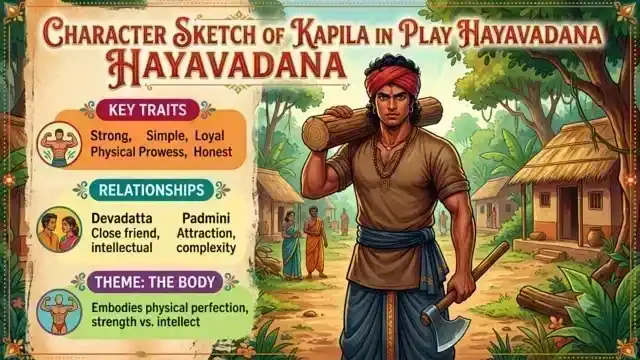
Kapila is portrayed as a loyal, selfless, and affectionate friend who sincerely loves Devadatta and is always ready to help him. His unwavering friendship is evident when he acts as the mediator between Devadatta and Padmini, helping his friend win her love despite his own growing attraction towards her. Kapila never intentionally betrays his friend; instead, he constantly struggles to suppress his emotions out of loyalty and moral responsibility. This inner conflict makes him a deeply human and tragic character whose life is shaped by duty, friendship, and unfulfilled desire.
The character of Kapila also symbolizes the power and beauty of the human body. His handsome physique, fearless personality, and spontaneous nature fascinate Padmini, who gradually becomes attracted to him even after her marriage to Devadatta. This attraction creates the central tension of the play and ultimately leads to the tragic chain of events involving the exchange of heads between Devadatta and Kapila. Through this symbolic incident, Karnad raises profound philosophical questions about personal identity, human completeness, and the relationship between the mind and the body. The play asks whether a person is defined by the head, which represents intellect and identity, or by the body, which symbolizes physical experience and desire.
After the exchange of heads, Kapila undergoes a remarkable transformation. Possessing Devadatta’s head but retaining his own body, he gradually loses his physical strength while Devadatta’s body acquires Kapila’s former vitality. This transformation demonstrates Karnad’s belief that the mind ultimately shapes the body and highlights the complexity of human identity. Unable to reconcile his emotions and haunted by guilt, Kapila withdraws into the forest, where he embraces a life of solitude. His final confrontation with Devadatta results in the death of both friends, making Kapila one of the play’s most tragic figures.
On a symbolic level, Kapila represents the instinctive, passionate, and physical dimension of human existence. He embodies energy, action, natural freedom, and emotional honesty, standing in contrast to Devadatta’s intellect, culture, and rationality. Through Kapila’s character, Girish Karnad masterfully examines the limitations of human perfection, the conflict between desire and morality, and the impossibility of achieving complete harmony between the body and the mind. Thus, Kapila emerges not merely as an individual character but as a powerful symbol of humanity’s eternal struggle for wholeness, making him one of the most compelling and unforgettable figures in modern Indian drama.
After reading the story of the play “Hayavadana” written by Girish Karnad we find that Kapila was an important character with his simple and loving nature. He was slow of mind but strong in his body. He had animal like instincts based on Dionysian principles. Some other traits of Kapila’s character are briefly described in the following lines:
Kapila and Devadatta as Best Friends:
The close study of the present play clearly shows that both Kapila and Devadatta were very fast and intimate friends who were popularly known as ‘one mind and one heart’ and they could be different by their temperament. It is true that the friendship between them was very genuine. Kapila used to come to the house of Devadatta daily and regularly and they talked and worked together. Kapila used to do some servile type of work because he was the son of an ironsmith. On the other hand, Devadatta was intelligent, wise and learned because he belonged to the Brahmin class. With this reason he used to sit in the chair but Kapila used to sit on the floor because he belonged to the lower caste.
Kapila as the Messenger of Devadatta to Padmini:
The early part of the story shows that Devadatta had fallen in love to Padmini who was very young and highly beautiful. He thought to marry her, so he asked Kapila to serve as his messenger to her and persuade her to marry him. When Kapila learnt of his friend’s deep love for Padmini and his seriousness to marry her, he became ready to serve as his messenger to help him in persuading her for marriage to his friend. Though Kapila was not an expert in such errands, yet he succeeded to persuade Padmini to marry his dear friend, Devadatta. Without any further delay, both Devadatta and Padmini were married together. It was the marriage between richness and learning because Padmini was the daughter of a very rich merchant and Devadatta was very learned with the reason of being the son of a learned and great Brahmin.
Kapila as Padmini’s Driver:
Though Devadatta had deep love for his friend, Kapila, yet he had jealous feelings for him when Padmini took him for a ride as her driver. It was outside her marriage to Devadatta that Padmini started loving Kapila who had strong body and impressive personality. She also awakened a kind of love for her in the heart of Kapila which was not of moral type. Their journey together created a soft corner in the heart of Kapila for Padmini which took the form of love after some time. In this way, he became the important part of love – triangle. If he had not come in the contact of Padmini, he would have lived a contented life by marrying another girl. In that way, he fell in the eyes of his good friend and later he also became a cause of trouble for him.
Kapila’s Love for Padmini:
This story shows that Kapila felt drawn towards Padmini. He began to move around her all the time in order to get her love. With this reason he was always very eager to do anything which Padmini wanted. When the trip for Ujjain was cancelled for some time he felt it very seriously because he could not understand what he should do in the remaining week. His meetings with Padmini landed all the three in further trouble. On the other hand, Kapila still tried to control himself advancing towards the wife of his dear friend. Then, he said these words, “Why this emptiness … Kapila, Kapila, get a tight hold on yourself. You are slipping, boy control yourself. Don’t lose that hold. Go now – don’t come here again for a week – Devadatta’s found to get angry with you for not coming. Sister – in – law will be annoyed. But don’t come back. Go, go! [Aloud] Well then I’ll start.”
Devadatta’s Suffering:
As Kapila and Padmini started on their journey, both of them were happy. On the way, Padmini broke the limits of decency and courtesy because she spoke ill of her husband and admired Kapila for driving the cart very well. Devadatta suffered much at his wife’s comparison. He felt negative thoughts, forgot his power and he also surrendered to the mighty body of Kapila because any woman could fall in that case. Without thinking of any ill to Kapila, he decided to kill himself. He also remembered his promise which he had given to the goddess Kali some time back that he would offer his head if he succeeded in marrying the young and beautiful Padmini. Now, it was the high time to fulfil his promise, so he advanced towards the temple of the goddess, Kali.
Kapila’s Loss:
After that Kapila had suffered a great loss of his strong body as well as of his identity. It was Padmini’s mistake that his body was joined to theDevadatta’s Suffering:
As Kapila and Padmini started on their journey, both of them were happy. On the way, Padmini broke the limits of decency and courtesy because she spoke ill of her husband and admired Kapila for driving the cart very well. Devadatta suffered much at his wife’s comparison. He felt negative thoughts, forgot his power and he also surrendered to the mighty body of Kapila because any woman could fall in that case. Without thinking of any ill to Kapila, he decided to kill himself. He also remembered his promise which he had given to the goddess Kali some time back that he would offer his head if he succeeded in marrying the young and beautiful Padmini. Now, it was the high time to fulfil his promise, so he advanced towards the temple of the goddess, Kali. head of Devadatta because it was decided that ‘Head is the sign of man’. It was his theory that body may perform important function, so it may decide human destiny but it was not right. He asserted that Padmini was married to that body which he had been possessing, and he was also the father of the child of Padmini by virtue of that body.
It is clear that Kapila had the greatest loss by keeping his head without learning with the weak body of Devadatta. The writer has shown that Kapila, in the end, had failed to get Padmini after the Rishi had decided that the head of Devadatta was important, so he should get Padmini as his wife. Kapila felt as a loser by losing even his strong body. He felt serious mental conflict when Padmini whispered into Kapila’s ear, “I am going with your body let that cheer you up.”
Kapila’s Meeting with Padmini in the Forest:
Padmini spent some months happily and enjoyed the married life with Devadatta and then she did not remember Kapila even once. She was proud to possess the strong body of Kapila and the wise head of Devadatta. Gradually the power of the body which Devadatta had been possessing began to decrease. Then Padmini’s love also turned to Kapila who had lost his strong body. Kapila had compromised with his new body under new conditions in the forest where he had started to live the life of a hunter.
Then Padmini had a strong desire to meet Kapila in the forest. She went towards the forest, but Devadatta on a false track and she herself went to the forest with her child. When Kapila saw her face to face, he felt surprised and unhappy. He was living with his changed body and mind under his new identity but he felt Padmini’s arrival as a great disturbance to his life. She became very unhappy to know about the sorrow and suffering of Kapila. He felt romantic when Padmini suddenly touched his moving hair with her fingers giving him a touch of completeness. Kapila also put her head on his broad chest.
The Tragic Deaths of Kapila and Devadatta:
It is necessary to mention that the bliss of Kapila was transient in his meeting with Padmini in the forest. Its reason is that an Indian woman cannot live in our society with another man without performing the marriage ties. Devadatta became very angry when he saw her with Kapila after he had returned back. He welcomed Kapila as his long lost friend who also greeted him with the same smile. Though Kapila suggested to live like Pandavas and keep Padmini as Draupadi as their common wife, Devadatta rejected his suggestion. Soon after, both of them died in the most tragic manner after the duel, so Kapila became the greater loser for losing his best friend and also Padmini. Devadatta was survived by his son but Kapila had no such consolation. His parents had already died but he could not perform their last rites. Padmini assigned her son to Bhagavata to get him developed into an ideal man with his strong body like Kapila and learned head like that of Devadatta.