Introduction:
Nissim Ezekiel (1924–2004), widely regarded as the father of modern Indian English poetry, occupies a distinguished place in Indian literature for his intellectual depth, psychological insight, and realistic portrayal of human life. Unlike the earlier generation of Indian English poets who often celebrated nationalism, romantic idealism, or spiritual transcendence, Ezekiel turned his attention to the complexities of the modern individual. His poetry is deeply introspective and explores themes such as identity, alienation, loneliness, love, urban existence, morality, religion, and the continuous struggle for self-realization. One of the most striking and recurring features of his poetic vision is an obsessive sense of failure—a persistent awareness of human inadequacy, frustration, incompleteness, and the inability to attain perfection.
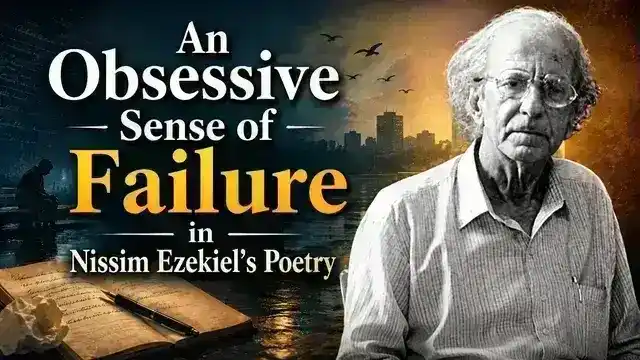
The sense of failure in Ezekiel’s poetry is not confined to external disappointments or material setbacks. Rather, it is an inner psychological condition that reflects the poet’s constant self-examination and relentless search for truth. His speakers frequently confront their own weaknesses, emotional conflicts, moral shortcomings, and intellectual uncertainties. Instead of presenting himself as a heroic or ideal figure, Ezekiel honestly acknowledges his limitations and failures. This rare honesty gives his poetry authenticity and universal appeal, making it deeply relevant to readers who experience similar struggles in their own lives.
Ezekiel’s obsessive awareness of failure is closely linked with the existential condition of modern humanity. Living in a rapidly changing urban society, his characters often experience isolation, confusion, spiritual emptiness, and a loss of purpose. They seek meaning in love, religion, philosophy, and social relationships, yet repeatedly encounter disappointment and dissatisfaction. Failure, therefore, becomes not merely a personal experience but a universal human condition. His poetry reflects the predicament of modern man, who is caught between aspiration and reality, hope and despair, faith and skepticism, success and defeat.
Several of Ezekiel’s major poems vividly illustrate this recurring theme. In “Background, Casually,” the poet reflects on his fragmented identity and his lifelong struggle to reconcile his Jewish heritage with his Indian identity. “The Professor” satirizes the superficiality and emptiness of middle-class life, revealing the failure of communication and genuine human relationships. “Enterprise” portrays the spiritual failure of pilgrims whose outward journey ends in inner disillusionment. In “Poet, Lover, Birdwatcher,” Ezekiel suggests that impatience and haste often lead to failure, while true achievement demands patience and perseverance. Poems such as “Philosophy,” “The Visitor,” “Night of the Scorpion,” and “The Railway Clerk” also reveal different dimensions of human weakness, frustration, and existential anxiety.
What distinguishes Ezekiel from many modern poets is that he does not portray failure as an end in itself. His recognition of failure often becomes the starting point for self-awareness, moral growth, and spiritual reflection. His poems encourage readers to confront reality honestly, accept human imperfections with humility, and continue the search for meaning despite inevitable setbacks. Failure, in his poetic universe, is not simply defeat but an essential part of the human journey towards wisdom and maturity.
Thus, an obsessive sense of failure forms one of the central themes of Nissim Ezekiel’s poetry. Through his penetrating psychological analysis, ironic wit, conversational style, and profound humanism, Ezekiel transforms personal disappointment into a universal exploration of the human condition. His poetry demonstrates that the acceptance of one’s limitations is not a sign of weakness but the beginning of genuine self-knowledge. Consequently, his treatment of failure remains one of the most significant and enduring contributions to modern Indian English poetry, establishing him as a poet of remarkable honesty, realism, and philosophical insight.
Failure as a Central Motif in Ezekiel’s Poetry:
Connected with, and arising from the theme of alienation, is the motif of failure in Ezekiel’s poetry. “A refugee in spirit” in search of his “dim identity”, ruefully accepts his failure to identify himself with his Indian ethos and environment in an effort “to weave myself more closely into things”, “My backward place is where I am.” He finds that he is a failure even in “this backward place”, and this obsessive sense of failure leads to agonized bouts of self – doubt and laceration”, says Naik, revealing the poet “in exile from himself”.
Background, Casually: Childhood Alienation and Personal Commitment:
In one of his early poems, Background, Casually, Ezekiel has condensed a lot of the material pertaining to his boyhood and later life. Here he speaks of the intolerance of the Christian, Muslim and Hindu boys in a Roman Catholic school that he attended , where he found himself to be a “mugging Jew among the wolves”. They accused him of murdering the Christ. The complexity of his experience comes out clearly in the concluding lines of the poem in which he says that he has made his commitments and that one of these commitments is to stay where he is. Here he speaks about the compulsions making it necessary for him to continue to live in this “backward place”—a country which he dislikes and the conditions of life which have always irked and upset him.
Case Study: The Story of an All-Round Failure:
In Case Study, Ezekiel reveals his own nature and speaks about a person who has proved a failure all round. Right from his early days, “whatever he had done was not quite right.” His masters did not fail, but he did when he could not decide whether to practise yoga or study Greek or “bluff his way throughout with brazen cheek”. He then goes on to list his failures:
“Beginning with a foolish love affair
After common school and rotten college,
He had the patient will but not the flair.
To climb with quick assault the envied stair;
Messed around instead with useless knowledge…”
Failure in Family Life and Marriage:
But “the worst mistake of all” was his marriage “Although he loved his children when they came.” He alternately pampered and spoiled them or drove them to the wall with “discipline”. So did his wife and servants. “A man is damned in that domestic game,” he concludes.
Professional Instability and Unfulfilled Dreams:
Then to compound his failures in life, he rapidly changed jobs which is an echo of the earlier lines in Background, Casually: I prepared for the worst, married, Changed jobs, and saw myself a fool. This made people say that he “shopped around for dreams” —dreams that he could not realise but
“… he never moved
Unless he found something he might have loved.”
Advice to Overcome the Pattern of Failure:
He was advised to break this pattern “with a sudden jerk”, use his head to decide upon his future course of action and reminded that all those who failed in life were not “fake”.
Failure in Love: The Poem of the Separation:
This sense of failure has strongly coloured Ezekiel’s poetry of love and marriage also. In the Poem of the Separation the poet speaks of an affair between him and a woman whom he fell in love when he suddenly met her one day. The woman too seemed to have fallen in love with him. The affair did not last long because the woman went away. But she has been writing to him. In her last letter she has informed him that she would like to play with fire and get burnt, if necessary. The woman was obviously a flirt and she had merely wanted to have a good time with the poet. Now she would like to have another fling and try another lover.
Marriage: From Romantic Idealism to Disillusionment:
Marriage talks of a man and a woman who are in love with each other. When they get married, they are ecstatic; they are certain that they would never be separated in life. Subsequently when they tire of each other, like the poet, they regret the marriage; their spell is shattered. But the poet here plays safe by saying that he would not like to destroy the mystery of marriage by dwelling upon its dark side and the suffering that it brings in its wake for both the partners. He has been frequently invited to attend other people’s marriages and he does not feel justified in criticizing or condemning the institution of marriage as such; he has not become cynical about the bond which marriage establishes between a man and a woman.