Introduction:
Alfred Tennyson’s The Lady of Shalott is one of the finest examples of sensuous and pictorial poetry in English literature. As a leading Victorian poet, Tennyson possessed an extraordinary ability to paint vivid pictures with words and to appeal to the reader’s senses through rich imagery, melodious language, and delicate descriptions of nature. In this poem, he transforms an ordinary medieval legend into a magnificent work of art, where every scene appears like a living painting filled with colour, light, movement, music, and emotional intensity. His artistic imagination enables readers not only to visualize the landscapes and characters but also to experience the sights, sounds, textures, and atmosphere of the enchanted world of Camelot.
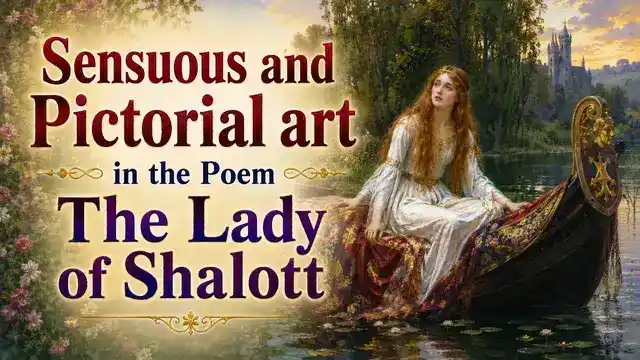
The poem is remarkable for its sensuous appeal, as it stimulates almost every human sense. The reader sees the golden fields, flowing river, lilies, towers, and the dazzling armour of Sir Lancelot; hears the whispers of the wind, the song of the Lady, the murmur of the river, and the echoes of Camelot; and feels the beauty, loneliness, and mystery surrounding the Lady’s isolated existence. Tennyson’s careful selection of musical words, vivid colours, and symbolic images creates an atmosphere that is both dreamlike and emotionally captivating. His language possesses a lyrical sweetness that enhances the poem’s aesthetic charm and makes every scene memorable.
Equally significant is Tennyson’s pictorial artistry. Every stanza unfolds like a carefully composed painting, rich in visual details and artistic precision. The island of Shalott, the mirror reflecting the outside world, the web woven by the Lady, Sir Lancelot’s radiant appearance, and the Lady’s final journey in the boat are all presented with remarkable clarity and beauty. Tennyson uses light, colour, contrast, and movement with the skill of a painter, making the poem a series of vivid tableaux. His descriptive power allows readers to witness each event as though it were displayed on the canvas of a great artist.
Moreover, the sensuous and pictorial qualities of the poem are not merely ornamental but contribute significantly to its deeper meaning. The contrast between the colourful world outside the tower and the Lady’s confined existence symbolizes the conflict between art and life, imagination and reality, isolation and human experience. Thus, Tennyson’s imagery serves both aesthetic and symbolic purposes, enriching the poem’s emotional depth and philosophical significance.
The Lady of Shalott stands as a masterpiece of sensuous and pictorial art because of Tennyson’s unparalleled descriptive genius, his musical expression, and his ability to create vivid visual imagery. The poem exemplifies his belief that poetry should delight both the senses and the imagination. Through its enchanting landscapes, brilliant colours, harmonious sounds, and unforgettable images, The Lady of Shalott remains one of the greatest achievements of Victorian poetry and a perfect illustration of Tennyson’s mastery as a poet-painter.
Tennyson as a Great Descriptive and Pictorial Artist:
Tennyson was a great descriptive artist. His art is essentially picturesque in the sense that he uses words as the painter uses his brush and colours for conveying his inner thoughts and feelings through his paintings. About his pictorial quality, Steadman has remarked, “Leaving the architecture of Tennyson’s poetry and coming to the sentiments which it seeks to express we are struck at once by the fact that an idyllic, or picturesque mode of conveying that sentiment is the one natural to this poet, if not the only one to be permitted by the limitations … He does not, like Browning, catch the secret of a master passion; on the contrary he gives us an ideal picture of an ideal person , but sets against a background more tangible than other artist can draw making the accessories, and even the atmosphere, convey the meaning of the poem.”
The Picturesque Beauty of the Island of Shalott:
In The Lady of Shalott, the poet shows his sensuous art. Tennyson describes the natural beauty of Shalott. It is a silent island on the bank of a river. The river flows round long fields of barley and of rye. Through the fields there is a road to Camelot. Camelot is a prosperous town with high towered buildings. The road is never at quiet. People go up down, gazing the lilies blooming round the island.
“On either side the river lie
Long fields of barley and of rye,
That clothe the world and meet the sky;
And thro’ the field the road runs by
To many – tower’d Camelot;
And up and down the people go,
Gazing where the lillies blow
Round an island there below,
The island of Shalott.”
The Sensuous Word Picture of Nature and the Lady’s Isolation:
He draws sensuous word picture of nature. There are trees of willow that look white for the wind turns over their leaves exposing the white under part. The light leaves of aspen tremble and quiver in the slightest breeze. In darkness light breeze blows over waves flowing down to Camelot. The Lady of Shalott is confined into her palace with four gray walls and four gray towers amid a large field of flowers.
“Willows whiten, aspens quiver,
Little breezes dusk and shiver
Thro’ the wave that runs for ever
By the island in the river
Flowing down to Camelot.
Four gray walls, and four gray towers,
Overlook a space of flowers,
And the silent isle imbowers
The Lady of Shalott.”
The Brilliant and Attractive Picture of Sir Lancelot:
Tennyson draws sensuous word picture of Sir Lancelot’s appearance. It is attractive enough to charm the Lady. Sir Lancelot’s face shines bright in sunlight. The shoes of his horse are bright. Sir Lancelot’s dark black curls make his shining helmet look brighter. From the river bank his image is reflected in the mirror hanging before The Lady of Shalott.
“His broad clear brow in sunlight glow’d;
On burnish’d hooves his war – horse trode;
From underneath his helmet flow’d
His coal black curls as on he rode,
As he rode down to Camelot.
From the bank and from the river.
He flash’d into the crystal mirror,
“Tirra lira”, by the river
Sang Sir Lancelot.”
The Lively Picture of the Lady of Shalott’s Final Journey:
The poet draws a lively word picture of the Lady. The Lady of Shalott looks towards Camelot with great sense of satisfaction like a saint who does not give importance to his physical misfortune. It is sunset when she loses the chain of the boat and sails it to Camelot. The fast waves take the boat away:
“And down the river’s dim expanse
Like some bold seer in a trance,
Seeing all his own mischance—
With a glassy countenance
Did she look to Camelot.
And at the closing of the day
She loosed the chain, and down she lay:
The broad stream bore her far away,
The Lady of Shalott.”
The Moving Picture of the Lady’s Death and Last Song:
Tennyson’s word pictures are comprehensive and full of movement. He tells about the storm as well as the Lady’s dress. At this time, the Lady of Shalott is in a snow white dress. It is loose and flutters in stormy wind. Leaves from trees fall on her lightly in the silent night when the boat is taking her to Camelot. The boat moves with waves passing through hills and fields. People living in nearby area hear her last song.
“Heard a carol, mournful, holy,
Chanted loudly, chanted lowly,
Till her blood was frozen slowly,
And her eyes were darken’d wholly,
Turn’d to tower’d Camelot.
For ere she reach’d upon the tide
The first house by the water – side,
Singing in her song she died,
The Lady of Shalott.”