Introduction:
Lord of the Flies is one of the most influential and widely studied novels of the twentieth century. Written by William Golding and first published in 1954, the novel is a profound allegorical masterpiece that explores the darker aspects of human nature. Set on a remote, uninhabited tropical island, it narrates the story of a group of British schoolboys who become stranded after a plane crash during an unspecified war. Initially, the boys attempt to establish an orderly society based on cooperation, democracy, and mutual respect. However, as the restraints of civilization gradually disappear, fear, selfishness, and the instinct for power take control, leading them into violence, cruelty, and moral collapse.
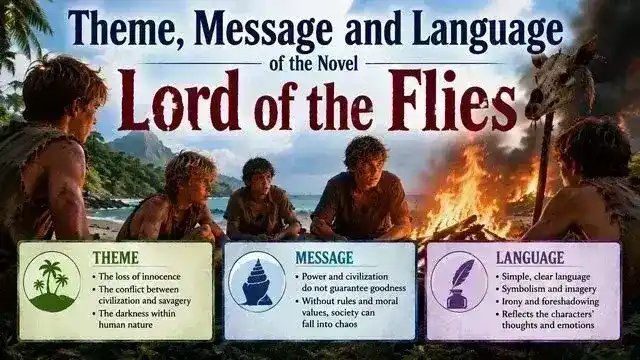
Golding wrote Lord of the Flies in the aftermath of the Second World War, drawing upon his own experiences in the Royal Navy and his observations of the brutality of war. Through the novel, he challenges the optimistic belief that human beings are naturally innocent and that evil arises solely from social institutions. Instead, he presents the disturbing idea that the seeds of savagery and violence exist within every individual, and that civilization merely suppresses these primitive instincts. The novel therefore serves as a powerful psychological, philosophical, and political commentary on the fragile nature of human society.
The title, Lord of the Flies, carries deep symbolic significance. It refers to the severed pig’s head placed on a stick by the hunters, which becomes a symbol of evil and corruption. The phrase is also a translation of “Beelzebub,” a biblical name associated with the devil, emphasizing that the greatest threat to humanity comes not from external forces but from the darkness residing within the human mind.
The novel is rich in symbolism and allegory. Nearly every character, object, and event represents broader ideas about human behaviour and society. Ralph symbolizes leadership, democracy, and civilization; Piggy represents intelligence, reason, and scientific thinking; Jack embodies dictatorship, aggression, and savagery; Simon symbolizes goodness, spirituality, and moral truth; while the conch shell represents law, order, and democratic authority. As these symbols lose their power throughout the narrative, the novel vividly illustrates the gradual disintegration of civilized values.
One of the greatest strengths of Lord of the Flies is its universal relevance. Although the story focuses on a small group of boys isolated on an island, its themes extend to the entire human race. Golding examines the conflict between civilization and savagery, reason and instinct, order and chaos, innocence and experience, morality and evil, leadership and tyranny, and the consequences of fear and the desire for power. These timeless themes make the novel meaningful to readers across different cultures and generations.
The novel is also admired for its vivid narrative style, realistic characterization, and compelling psychological insight. Golding combines adventure with symbolism, creating a work that functions simultaneously as a survival story, a political allegory, a philosophical exploration, and a psychological study. His simple yet powerful language and rich imagery make the novel intellectually stimulating as well as emotionally engaging.
Today, Lord of the Flies remains a classic of modern English literature and is prescribed in schools and universities throughout the world. It is regarded as a timeless exploration of the complexities of human nature and the delicate balance between civilization and savagery. Through its unforgettable characters, profound symbolism, and enduring themes, the novel continues to encourage readers to reflect on morality, leadership, society, and the hidden darkness that exists within every human being.
In the novel ‘Lord of the Flies’ the author Golding tries to bring Ballantyne’s coral island upto date. He wants to probe or examine it deeper into the human heart. It is a novel of boyish adventure in its external framework. The author has borrowed the external from Ballantyne’s coral island. It was published in 1857, a century back. It deals with the adventures of three English boys marooned (left on desolate shore) on an island. But the story in Golding is not stale but has an originality of design and plot.
Reality of the Story:
The reader is kept excited and in suspense in every scene. The incidents in the novel lead to an overwhelming climax. We become more and more aware of boyish character as the story proceeds. There is relation between the elders and the youngers. We see several types – the fair sporting Ralph, the seeming revengeful Jack and simple intelligent Piggy and philosophic intuitive Simon. Golding being a school teacher came upon these types during his teaching career. Now he displays them for evaluation.
Artistic Value:
Golding is a novelist of artistic value so he excels here as a portrayer of the Mature. There is clear description of coral island brightened by the sun, the stars and the moon. The Sound of the Shell, Fire on the Mountain, Hints on the Beach are the examples from nature. The blue ocean, the calm lagoon and the fruit trees linger on in our imagination as we study and read the novel.
The Theme of the Novel:
The novel conveys a theme, which goes beyond the simple story of boyish adventure. It is the story of development of the human society in reverse order. The boys reach the island from a civilized society but they gradually become savage and primitive. They become victims of primary passions like anger, revenge, pride and fear. They descend into barbarism. Jack pleases the Beast by offering it a part of their kill— the head of the sow. Jack who resents killing in the beginning because of unbearable blood ends up in hunting and murdering his own fellows Piggy and Simon. The behaviour of boys has been interpreted differently. Some see it as a parable of customs and civilizations while others it as a tract about democracy. Others relate to the story of the Fall of Man and the Garden of Eden.
Message:
The world of the boys in the island makes us realize that good and evil exist side by side in the darkness of man’s heart. Golding seems to tell us that the world should restore principles in an unprincipled world, restore belief to a world of disbelievers. This is the message of the novel. This novel was written after the 2nd world war. So, this era was of much misunderstanding and disbelief among the nations of the world.
The Title of the Novel:
The title of the novel may be traced back to the Jewish hierarchy of demons where Beelzebule is called ‘Lord of Flies’. He is supposed to be the chief representative of false Gods. The title is more appropriate because the author tries to convey that moral that the world is not a reasonable place. Because all power corrupts and that one has to live with the darkness of man’s heart. The novel ends with a sobbing scene of the Gathered boys with Ralph before English naval officer. What we realize that once the restraints of civilization is removed, the ‘Lord of the Flies’ or evil begins to rule over us. The majority of the boys turn into savages and worship the ‘Lord of the Flies’.
Story of the Novel:
The events and character are decently searched and related. The story depends on the attitudes and behaviour of the boys themselves. There is plenty of suspense and interest. Readers curiosity is held intact till the last. The story is narrated in an interesting manner. The narration is never boring. Only descriptions of Nature are overdone. But they help in bringing out the theme enriching and riching the symbolic background. The novelist has made use of rumour and superstition by making the castaways fearful. He uses irony like a master and changes the atmosphere gradually. The principal characters portrayed by the novelist are the five boys – Ralph, Jack, Roger, Simon and Piggy.
Language and Style:
The language of the novel is simple, chaste and graceful. The style is poetic. The writer uses poetic devices—Similes, Metaphors, epithets and alliterations quite frequently but functionally. The novelist also uses symbols element of irony pervades the work. The whole situation is ironical in that environment of an island which offers food for the taking and a moderate climate with plenty of swimming. The circumstances announcing Simon’s death are bitterly ironical as the consequences of that episode.