Introduction of the Poem:
The Abandoned British Cemetery at Balasore is one of Jayanta Mahapatra’s most profound and reflective poems, first published in his collection Relationship (1980). Set in an old British cemetery at Balasore in Odisha, the poem explores the themes of history, death, memory, colonialism, time, and human suffering. Inspired by the neglected graves of young British men and women who died of cholera during the colonial period, Mahapatra meditates on the transience of life and the inevitable decay of both human beings and empires.
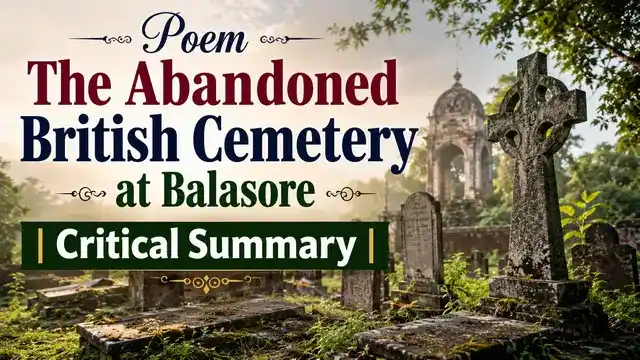
Rather than expressing political hostility toward the British colonial past, the poet adopts a deeply humane perspective. He is moved not by the lost empire but by the tragic deaths of young people whose lives ended far from their homeland. The abandoned cemetery becomes a powerful symbol of forgotten history, while the continuing presence of disease and death reminds the poet that human suffering transcends national, racial, and historical boundaries.
Rich in vivid imagery, symbolism, and philosophical reflection, the poem combines personal meditation with historical consciousness. Mahapatra’s modernist style transforms a silent graveyard into a universal meditation on mortality, the passage of time, and the fragile nature of civilization. Through this evocative poem, he suggests that while empires vanish and monuments crumble, the shared experience of human suffering remains timeless and deserves remembrance.
In “The Abandoned British Cemetery at Balasore,” which appears in his Selected Poems, Jayanta Mahapatra reflects over the deaths of young British citizens of cholera a hundred and fifty years ago, who are buried in the cemetery at Balasore. This is a poignant and heart rending poem about “the forgotten dead”.
Critical Summary:
This poem describes the author’s reflections upon entering a cemetery in which a number of Britishers lay buried but which was now deserted because of a lapse of a long period of time of about a hundred and fifty years. The poem refers to a historical incident. A number of British lives were lost on account of the outbreak of cholera at Balasore; and their dead bodies were buried in the graves in a specially selected piece of ground which thus became a cemetery or a graveyard. The poem opens with the words: “This is history,” meaning that what the poet is witnessing brings to his mind a historical incident. Then the poet says that he would not disturb it, meaning that he would not go much further into the cemetery because he would not like to disturb the graves wherein the dead lay buried. The tombs in this cemetery are now in a state of ruin. One can, of course, see the stone and the marble which had been used in building the tombs but which have now almost crumbled because of the passage of time. The poet then asks himself how he should behave at the present moment while standing in this cemetery where lie the dead belonging to a time long past. He uses the word “archaic”, meaning “ancient” because a long, long time has passed since these persons were buried here.
It was one hundred and fifty years back that the incident happened. It is quite possible that the poet, instead of living in the present times, might himself have lived in those days when this incident occurred. But now he stands here and sees only grass, bushes, thorns, and weeds around him. Nor does it matter that he did not personally know those who were buried here. What difference does it make to him who died of cholera in those days and who survived.
In spite of his attitude of indifference towards who died and who survived, the poet yet feels awed by the thought of the dead persons who were buried here and who have been forgotten because of the passage of time. He walks around the various graves of which there are thirty – nine. In other words, thirty – nine persons died of cholera and were buried here. His entering this cemetery cannot bring the dead back to life. His presence here cannot stir the remains of the dead persons. There is silence all around him though a lean lizard is closely watching what goes on, and though there is a scorpion resting upon one of the tombs on which the name of the dead person is inscribed.
The poet then reads the names of the dead persons inscribed on the tombstones. (A tombstone is a slab of marble planted at the head of a grave to indicate who lies buried here. The dates of birth and death of the person concerned and certain other particulars are also inscribed on a tombstone). The poet reads the name of Florence who is described on the tombstone as “the darling wife” of an army captain. She was just nineteen at the time of her death, and she had died of cholera. Then he reads the name of Helen, the beloved daughter of a British couple. She was just seventeen when she died of the same epidemic.
The British were at that time the rulers of India (which was a part of the British Empire). But now that empire does not exist any longer, and the poet says that the vanished British Empire is of no concern of his. It does not matter to him if his remote ancestors had lived as the subjects of the British imperialists. What he is concerned with are the deaths of the young persons who lie buried here and the young persons who die even now – a – days of one cause or another. It is the deaths of the young people which move the human heart deeply and which bring to surface the feelings and emotions lying dormant in the depths of the human heart.
Cholera still breaks out and kills young people. When it breaks out, it travels rapidly and powerfully, bringing about ruin and destruction. It is as sharp and cruel as iron. It may remain in abeyance like iron which is allowed to remain at one place and rust. But its menace or threat never ceases. Those, who die, leave behind a memory of their deaths. Death seems to smile as the victims die.
Seeing a heavy piece of timber lying close to the graves, the poet says that the force of the earth’s gravity would continue always to operate upon this piece of timber. (The force of gravity means the power of the earth to pull things downwards). This heavy piece of timber, or anchor as it may be called, might in course of time acquire certain sanctity in the eyes of the people. By virtue of its very ancientness, this anchor might one day be treated as a deity and as an object of worship. This anchor would keep history alive by reminding people of the deaths which had taken place long, long ago; and this anchor would disallow the survivors to speak and make their existence known to others. In other words, this anchor would act not only as a source of some historical information but also as a forbidding power.
This poem reminds us vaguely of the famous Elegy Written in a Country Churchyard by Thomas Gray, though there is no resemblance of any kind between the two poems.
Critical Analysis of the Poem:
Introduction
“The Abandoned British Cemetery at Balasore” is one of Jayanta Mahapatra’s most profound and meditative poems. Set in an old British cemetery in Balasore, Odisha, the poem goes far beyond a description of a neglected graveyard. It becomes a philosophical reflection on history, death, memory, colonialism, the passage of time, and the fragility of human existence. The abandoned cemetery symbolizes the forgotten legacy of the British Empire and reminds readers that even the mightiest political powers eventually disappear, leaving behind only ruins and silence. Mahapatra transforms an ordinary historical site into a universal meditation on mortality and the impermanence of life.
History as a Living Presence
The poem begins with the striking declaration, “This is history. I would not disturb it.” These words establish a respectful attitude toward the past. The cemetery is not merely a collection of graves but a sacred repository of history. The speaker recognizes that the lives buried beneath the broken stones once possessed hopes, dreams, and identities, though time has erased most traces of them.
Mahapatra does not glorify colonial history, nor does he condemn it. Instead, he presents history as something silent and mysterious, inviting contemplation rather than judgment. The decayed graves illustrate how history survives not through political power but through fragile memories preserved in forgotten places.
Symbolism of the Cemetery
The abandoned cemetery functions as the central symbol of the poem. On one level, it represents the end of British colonial rule in India. The once-powerful rulers have vanished, and their graves lie neglected in a foreign land.
On another level, the cemetery symbolizes the universal destiny of humanity. Regardless of nationality, race, or social status, every individual eventually becomes part of history. The ruined tombs remind readers that wealth, authority, and imperial glory cannot defeat time or death.
Thus, the cemetery becomes a metaphor for the transience of human civilization itself.
Meditation on Death and Mortality
Death is the poem’s most dominant theme. Mahapatra emphasizes that death ultimately erases all distinctions between conquerors and the conquered. The British officials and their families who once exercised authority over India now lie forgotten beneath broken marble and crumbling bricks.
The poet is especially moved by the graves of young victims of cholera. Their early deaths evoke sympathy because they were denied the opportunity to fulfill their dreams and ambitions. Through these forgotten graves, Mahapatra highlights the tragedy of human mortality and the unpredictable nature of life.
Death appears neither heroic nor dramatic; it is quiet, inevitable, and impartial.
Time as the Great Destroyer
Throughout the poem, time functions as an invisible yet powerful force. The weathered stones, broken walls, faded inscriptions, and overgrown vegetation reveal the relentless passage of years.
Nature slowly reclaims what human beings once built with pride. The cemetery illustrates that time destroys monuments, memories, and even empires. What remains is only silence and decay.
Mahapatra suggests that while history records great events, time eventually reduces them to fragments scarcely remembered by future generations.
Colonialism Without Political Bitterness
Unlike many postcolonial writers, Mahapatra avoids presenting the British solely as oppressors. Instead, he sees them as fellow human beings whose lives ended tragically far from home.
The graves no longer represent colonial authority but human suffering. The poet’s compassion transcends political divisions. By focusing on mortality rather than imperialism, Mahapatra presents a deeply humanistic vision in which death removes all historical hierarchies.
This balanced treatment gives the poem remarkable emotional depth.
Nature Reclaims Human History
Nature occupies an important place in the poem. Grass, weeds, lizards, and scorpions now dominate the abandoned cemetery.
These natural images symbolize the gradual triumph of nature over human civilization. The living creatures move freely among the graves, indifferent to the identities of those buried beneath. Nature neither mourns nor celebrates history; it simply continues its eternal cycle.
This contrast between enduring nature and temporary human achievement reinforces the poem’s philosophical message.
Powerful Imagery and Symbolism
Mahapatra’s imagery is vivid, concrete, and deeply symbolic.
Some of the most significant images include:
1. Crumbling marble and stone symbolize the decay of civilization and memory.
2. The abandoned cemetery represents forgotten history and the impermanence of empire.
3. The scrawny lizard and scorpion create an atmosphere of silence, decay, and death while emphasizing nature’s dominance.
4. Cholera victims symbolize the vulnerability of human life.
5. Overgrown grass and weeds suggest that nature eventually absorbs every trace of human existence.
These images transform the physical landscape into a profound philosophical meditation.
Philosophical Vision:
The poem raises several important philosophical questions:
1. How should we respond to the past?
2. What remains after death?
3. Can history preserve individual lives?
4. Does political power possess any lasting significance?
Mahapatra offers no direct answers. Instead, he encourages readers to reflect on the inevitable disappearance of human achievements before the forces of time and mortality.
The poem therefore belongs as much to philosophical poetry as to historical or political poetry.
Tone and Mood
The tone is quiet, reflective, respectful, and contemplative. There is no anger or dramatic emotional outburst. Instead, Mahapatra maintains a calm meditation throughout the poem.
The mood gradually shifts from historical curiosity to deep sympathy and finally to philosophical resignation. The silence of the cemetery mirrors the silence that surrounds death itself.
Style and Language
Mahapatra’s language is modern, economical, and highly suggestive. Rather than making direct statements, he relies on symbolic imagery, visual details, and subtle emotional undertones.
His free verse allows thoughts to flow naturally, while his descriptive precision creates an atmosphere of haunting stillness. The combination of realistic observation and symbolic meaning is one of his greatest artistic strengths.
Universal Significance
Although rooted in a specific historical location in Odisha, the poem possesses universal relevance. Every civilization leaves behind forgotten monuments, abandoned cemeteries, and fading memories. Mahapatra reminds readers that human pride, political authority, and historical fame ultimately surrender to time.
Thus, the poem becomes not merely a reflection on colonial India but on the shared destiny of all humanity.
Conclusion
“The Abandoned British Cemetery at Balasore” is a masterpiece of Indian English poetry that combines history, philosophy, symbolism, and emotional depth. Through the image of a neglected colonial cemetery, Jayanta Mahapatra explores the impermanence of life, the inevitability of death, the erosion of memory, and the futility of worldly power. The poem transcends its historical setting to become a timeless meditation on human existence. Its restrained language, haunting imagery, and profound philosophical insight make it one of Mahapatra’s most remarkable achievements and a significant contribution to modern Indian English literature.