Introduction:
Charles Dickens’s Oliver Twist (1837–1839) is one of the greatest social novels in English literature and a powerful exposure of the dark realities of the Victorian criminal underworld. While the novel is widely appreciated for its criticism of the Poor Law, workhouse system, and social injustice, it is equally significant as a vivid portrayal of the organized world of crime that flourished in nineteenth-century London. Through the experiences of the innocent orphan Oliver, Dickens reveals how poverty, neglect, and social inequality often push vulnerable children into the hands of ruthless criminals. The novel demonstrates that the criminal world is not merely a collection of lawbreakers but a carefully organized network that exploits innocence, corrupts morality, and destroys human lives.
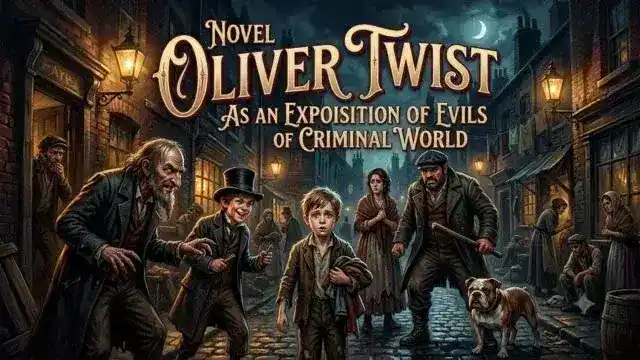
Dickens presents the criminal underworld through unforgettable characters such as Fagin, Bill Sikes, Nancy, the Artful Dodger, and Monks. Fagin, the mastermind of the gang, trains homeless and helpless boys to become skilled pickpockets and thieves, proving how crime can become an organized profession. Bill Sikes represents the brutality and violence that dominate this world, while Monks symbolizes greed, conspiracy, and moral corruption. Nancy, despite being trapped in a life of crime, retains her humanity and ultimately sacrifices her life in an attempt to save Oliver, illustrating that even within the darkest world, the human conscience can survive.
The novel also highlights the psychological and moral consequences of criminal life. Dickens shows that crime breeds fear, betrayal, cruelty, and violence rather than happiness or prosperity. The criminals constantly live under the shadow of suspicion, guilt, and punishment. The brutal murder of Nancy by Bill Sikes and Sikes’s own tragic death emphasize that crime inevitably leads to destruction and justice ultimately prevails. Thus, Dickens not only exposes the operations of the criminal underworld but also delivers a strong moral lesson that evil can never triumph permanently over goodness.
At the heart of the novel stands Oliver Twist himself, whose purity, honesty, and innocence remain uncorrupted despite constant exposure to vice and temptation. His moral strength contrasts sharply with the depravity surrounding him, reinforcing Dickens’s belief that virtue can survive even in the most corrupt environment. Oliver’s rescue from the criminal gang symbolizes the triumph of goodness, compassion, and social responsibility over crime and exploitation.
Thus, Oliver Twist serves as a compelling exposition of the evils of the criminal world. Dickens masterfully uncovers the hidden mechanisms of organized crime while exposing the social conditions that nurture it. By combining realism, suspense, satire, and deep humanitarian concern, he condemns both the criminals who prey upon society and the social system that allows such criminality to flourish. The novel remains a timeless warning against the destructive power of crime and an enduring plea for justice, compassion, and the protection of the innocent.
Observation as a Crime Novel:
Oliver Twist cannot be called a crime novel. The crime world has been depicted quite realistically as the novelist had profound curiosity about crime and criminals from his very early childhood. He used to visit his father John Dickens at the Debtors’ Prison at the Marshalsea, and there he could be found endlessly curious about the other prisoners and their histories and untiringly observant of their characters and behaviour. The novel is an exposition of all these early impressions of the novelist. It should, therefore, be read more as a social chronicle than as a crime fiction.
A Novel of Social Interest:
In fact, the present novel has social interest. There is an exposition of the evils of criminal world. The novel has murder at a place might tempt one to call it a crime fiction, apart from its being littered with other crime situations. There is a gang of criminals too. But we know that the object of the murder is not to arouse our morbid interest. The novel offers lurid pictures of the character and life of some of the most notorious criminals that haunted London. Dickens was ever fond of depicting low life, and the world of these despicable crooks, therefore, offered a congenial subject for his pen.
Fagin’s Preying upon Society:
Fagin is the leader of the gang of criminals. He is an old Jew, repulsive in appearance and unscrupulous in outlook. This man is made by nature to prey upon society. Tactful, cunning and shrewd, this old schemer is well able to hold his band of young and old law-breakers together and to bring them under contribution for purposes of plundering the public: His gang consists of some boys trained to be expert pick pockets, some daring house-breakers, and a couple of ladies who are able to do jobs of a delicate nature, such as decoying young boys from their homes.
Presenting a Life of Fear and Starvation:
The development of the plot of the novel shows that Oliver Twist and other children live a life of fear and starvation in the work house. They are treated cruelly. They are beaten and thrashed. Besides this most of the chapters are full of such activities as pick-pocketing, house-breaking, spying, murder and other such criminal activities. There are detective efforts also. The gangsters are seen locating the whereabouts of Oliver. The mystery about Oliver’s birth is solved by the detective-like efforts of Mr. Brownlow.
Exposing Evil, Sole Purpose of the Novelist:
The novelist exposes evil in all its ugliness in order to make it more hateful. In this his reformatory zeal and respect for morality is seen. Evil is defeated and good is ultimately victorious. In fact, the main theme of the novel is not raising crime but showing appalling condition of the poor orphans who are compelled to resort to criminal activities. Society is equally responsible for their neglect.
Pathetic Record of the Contemporary Victorian World:
The novel appears more as a social chronicle than a crime novel. Even in exposing the world of Fagin and his gang, Dickens is simply showing that side of society.
The cops, the Magistrates, the jailor, etc., all reveal the correlated aspects of the crime world. The novel has been saved from becoming a low crime book. On the other hand it emerges as the pathetic record of the contemporary Victorian world. The social milieu makes the novel a non-crime fiction. Crime has been condemned to the end. Bill Sikes is killed by his own device. Fagin is finally doomed. The Dodger and Nancy receive their own rewards accordingly. Nancy is cruelly murdered. Charles Bates, of course turns to be good.
Thus if we analyse the real nature of the subject of the novel, it will be seen that Oliver Twist is not a crime novel. In a crime novel, usually the plot revolves round the detection of a crime. There is always an element of suspense. But in Oliver Twist there is no investigation of a crime, though there is a picture of the world of criminals. In fact, the present novel has social interest.