Introduction:
Robert Browning’s Porphyria’s Lover is not only a remarkable dramatic monologue but also a subtle and powerful social satire that exposes the rigid moral standards, class distinctions, and hypocritical values of Victorian society. Beneath its shocking tale of love and murder lies Browning’s sharp criticism of a society that places greater importance on social status, wealth, reputation, and conventional morality than on genuine human emotions. Through the tragic relationship between Porphyria and her lover, Browning reveals how strict social conventions can suppress natural feelings, distort personal relationships, and ultimately lead to psychological conflict and destruction.
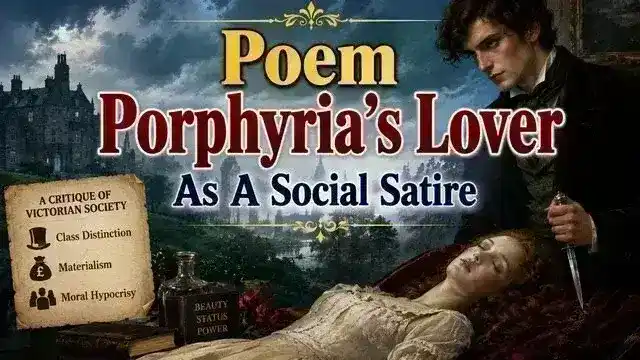
The character of Porphyria represents a woman trapped between her passionate love and the rigid expectations of her upper-class family and society. Although she deeply loves the speaker and openly expresses her affection, she cannot completely reject the social obligations, family prestige, and class barriers that prevent their union. Her inability to escape these external pressures reflects the limitations imposed upon women in the Victorian age, where personal happiness was often sacrificed for social respectability. Browning satirizes a society that forces individuals to deny their true emotions in order to maintain appearances.
The speaker, on the other hand, is portrayed as a socially inferior man who feels powerless because of the unequal social structure. His insecurity and obsession with possessing Porphyria forever can be interpreted as the psychological consequence of a society divided by rigid class distinctions. Instead of allowing love to flourish naturally, the social system creates frustration, inferiority, and emotional instability. Browning thus suggests that the real tragedy lies not only in the murder but also in the social conditions that make such distorted thinking possible.
Browning also ridicules the Victorian obsession with outward respectability and moral perfection. Society condemns passionate love when it challenges social conventions, yet it often ignores the emotional suffering caused by those very conventions. Porphyria’s secret visit to her lover indicates that their relationship cannot exist openly because society values reputation more than sincerity. Ironically, the speaker believes that by killing Porphyria at the moment of perfect happiness, he preserves her love forever, exposing the dangerous consequences of idealizing possession over mutual human freedom.
Another important satirical element is Browning’s criticism of male dominance and the desire for absolute control. The speaker transforms a loving relationship into an act of ownership, deciding Porphyria’s fate without her consent. His calm justification of murder and his belief that God remains silent expose the distorted moral reasoning that can arise when power, obsession, and patriarchal attitudes replace compassion and equality. Browning subtly mocks the false sense of authority that allows individuals to justify cruel actions while believing themselves morally innocent.
The poem further satirizes the conflict between natural human passion and artificial social restraint. The violent storm outside symbolizes the emotional turmoil created by social restrictions, while Porphyria’s warmth, love, and tenderness represent natural human affection struggling against oppressive conventions. The tragedy occurs because society leaves no acceptable space for such love to exist openly and honestly.
Thus, Porphyria’s Lover functions as a profound social satire that criticizes Victorian class prejudice, patriarchal authority, moral hypocrisy, and the oppressive social conventions that deny individual freedom. Browning demonstrates that when society values status and appearance above love and humanity, it creates emotional repression, psychological instability, and tragic consequences. Through irony, symbolism, and dramatic narration, the poem exposes the hidden flaws of Victorian civilization and remains a timeless critique of any society where social expectations overpower genuine human relationships.
Historical and Social Background of the Poem:
The poem was written just before the start of Queen Victoria’s rule, as societal standards were shifting towards repressiveness (and particularly towards repression with respect to female sexuality) but not in the heyday of Victorian principles, which didn’t occur until much later in the century. Porphyria is the disease which is believed to have caused the madness of King George III and of Vincent Van Gogh – symptoms include hallucination, paranoia, depression and more — and yet, Browning would have known none of that when he crafted his poem about a man in love with a woman named Porphyria, which manages to equate love and madness.
Critical Interpretations and Browning’s Purpose:
While the language is transparent, it is the meaning of the poet, his intention in writing the monologue that has baffled the critics. Some have regarded it as a “social satire”, on the pride of rank and birth; others have called it a study in morbid and abnormal psychology. Still others are of the view that in the monologue, the poet advocates a bold and unconventional behaviour on the part of true lovers. There is no doubt that Browning always commended bold action, even if it was considered improper by society, as necessary for success in love. For example, his Duchess in The Flight of the Duchess elopes with her Gipsy lover, and the poet is all admiration for her. While there can be no doubt that the poet would like a hold out a bold action, like that of Porphyria, there is no justification for believing that he would go to the extent of advocating a murder, even for the sake of love.
Porphyria’s Love and the Lover’s Fatal Decision:
Porphyria’s declaration of true passion of love for him makes the lover active. He finds that Porphyria’s is not sorry for giving up her wealthy family. She looks happy and proud on making great sacrifices for the sake of true love. He realizes that Porphyria’s love is as true as devotion; she really worships him. He fails to understand what in him has impressed her so strongly. He is proud of her love. He thinks how to preserve this pure love in the selfish imperfect world. At this moment she is perfectly pure and good. She is ready to sacrifice her all for him but what about the next moment. He has no power to protect her from the fury of her father and brothers, who feeling insulted on account of her elopement, may force her to marry someone else or even torture her to death. He wants to save her from it. He takes an abnormal decision. He encircles her throat with her long hair and strangles. He thus, fulfils her desire to breathe her last in the arms of her lover. Now none can take away her from him:
“Be sure I looked up at her eyes,
Happy and proud; at last I knew
Porphyria worshipped me; surprise
Made my heart swell, and still it grew,
While I debated what to do.
That moment she was mine, mine, fair,
Perfectly pure and good; I found
A thing to do, and all her hair,
In one long yellow string I wound
Three times her little throat around,
And strangled her.”
The Lover’s Justification of the Murder:
Porphyria’s lover narrates his action. He supports her head on his shoulder. Her head looks like a beautiful rose. He believes she is excessively happy for her greatest wish is fulfilled. She has died in the arms of her lover. Now she is free from mean worldly pride of this selfish imperfect world. She has attained her lover in place of those things.